Propane vs Oil Heat Calculator
Compare design-day heat demand, fuel burn, and storage runtime so you can see how propane and #2 heating oil perform under the same envelope and weather assumptions.
📌Quick Presets
⚙Heat Comparison Inputs
Fuel Comparison Results
Delivered BTU, gallons per hour, and storage endurance update after you run the calculation.
📊Fuel Spec Comparison Grid
Propane Energy
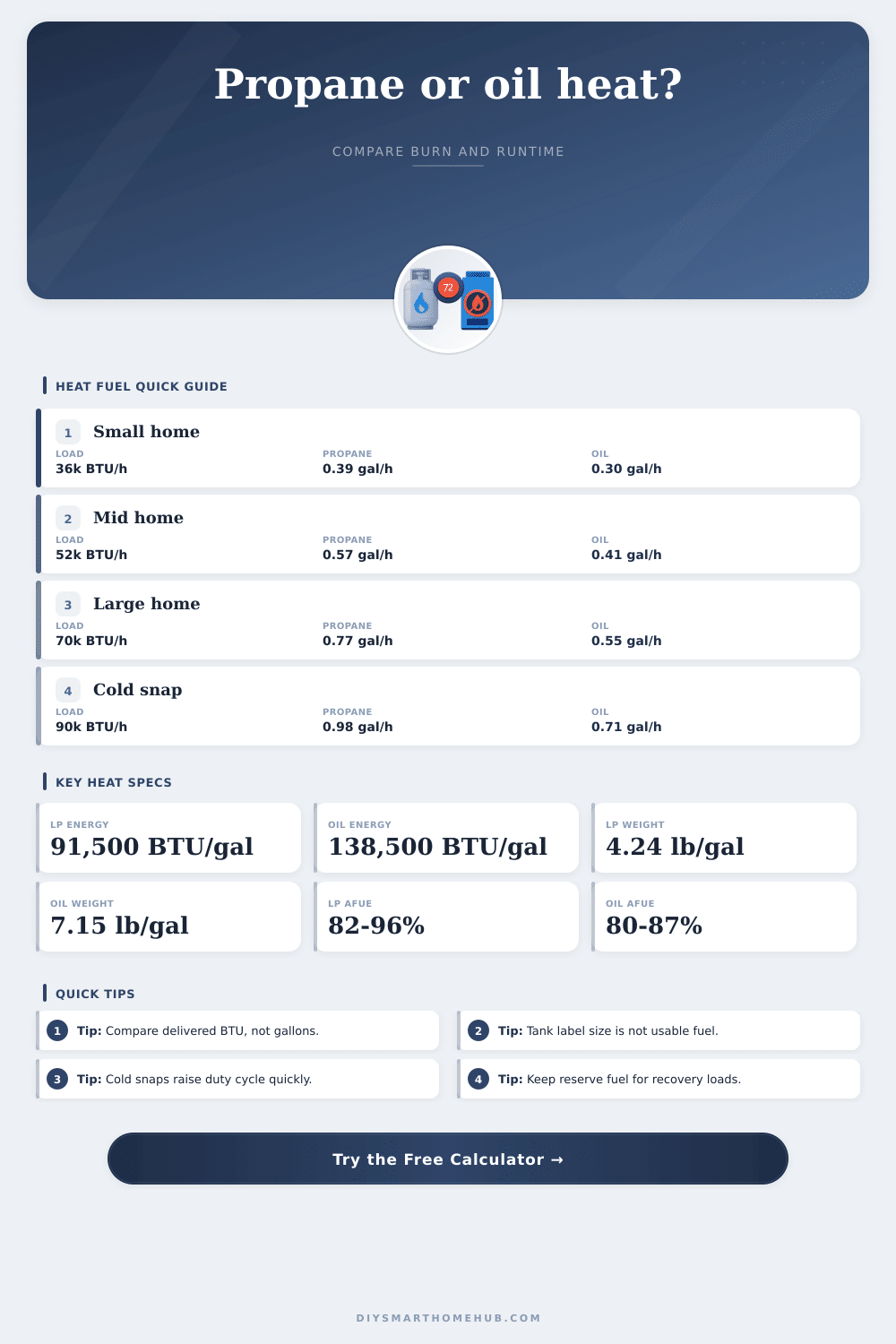
Propane carries less raw energy per gallon than heating oil, so identical heat demand always needs more propane volume.
#2 Heating Oil Energy
Heating oil stores more BTU in the same liquid volume, which is why comparable oil systems usually show fewer gallons per hour.
Propane Weight
Lower liquid density keeps propane lighter to move and store, but vaporization performance still depends on tank size and outdoor temperature.
Oil Weight
Heavier fuel means more energy per gallon and longer storage endurance, especially when the same home load is run against both fuels.
📘Fuel Energy Reference
| Fuel | Raw BTU per Gallon | Typical AFUE Range | Delivered BTU per Gallon |
|---|---|---|---|
| Propane furnace | 91,500 BTU | 90-96% | 82,350-87,840 BTU |
| Propane wall furnace | 91,500 BTU | 82-84% | 75,030-76,860 BTU |
| #2 oil furnace | 138,500 BTU | 84-87% | 116,340-120,495 BTU |
| #2 oil older unit | 138,500 BTU | 80-82% | 110,800-113,570 BTU |
Delivered BTU per gallon equals fuel energy multiplied by seasonal equipment efficiency, which is the cleanest apples-to-apples comparison for home heating output.
🔧Equipment Efficiency Reference
| Equipment Type | Fuel | Seasonal Efficiency | Best Fit |
|---|---|---|---|
| Condensing furnace | Propane | 96% | Tight ducted homes |
| Two-stage furnace | Propane | 93% | Balanced comfort loads |
| Propane boiler | Propane | 90% | Baseboard or panel loops |
| Flame-retention furnace | Oil | 86% | Conventional duct systems |
| Low-mass boiler | Oil | 87% | Hydronic retrofits |
| Older oil unit | Oil | 80% | Legacy systems |
🏠Common Home Load Reference
| Scenario | Heated Area | Design Load | Typical Notes |
|---|---|---|---|
| Basement apartment | 700-800 sq ft | 22k-30k BTU/h | Lower ceiling, shared walls |
| Tight ranch | 1,100-1,300 sq ft | 28k-40k BTU/h | Moderate delta and good sealing |
| Suburban two-story | 1,700-1,900 sq ft | 42k-58k BTU/h | Average retrofit assumptions |
| Drafty farmhouse | 2,200-2,600 sq ft | 70k-100k BTU/h | Higher envelope and leakage loss |
| Shop house | 2,800-3,200 sq ft | 80k-115k BTU/h | Tall volume and mixed occupancy |
🛢Storage Runtime Reference
| Storage Pair | Usable Gallons | Propane Days at 50k | Oil Days at 50k |
|---|---|---|---|
| 120 gal LP vs 138 oil | 96 vs 120 | 10.8 days | 15.0 days |
| 250 gal LP vs 275 oil | 200 vs 250 | 22.5 days | 31.3 days |
| 500 gal LP vs 330 oil | 400 vs 300 | 45.1 days | 37.5 days |
| 1,000 gal LP vs twin 275 | 800 vs 500 | 90.2 days | 62.6 days |
Reference days assume 50,000 delivered BTU/h, 65% average duty cycle, 93% propane AFUE, and 86% oil AFUE with no reserve holdback removed.
Tip: Use delivered BTU per gallon when comparing fuels. Oil usually wins on energy density, but a higher propane AFUE can narrow the gap in a tighter envelope.
Tip: Runtime depends on actual usable fuel, not the tank label. Starting fill, reserve holdback, and design-day duty cycle can change refill timing by several days.
Propane and heating oil are two different types of fuel that can be used to heat homes during the winter months. Individuals must make a choice between these two type of fuels. The decision between propane and heating oil will impact the cost of fuel for the individual and the length of time that the fuel will last within the tank.
Both propane and heating oil are fuels that provide heat to the home, but there are some difference between these two fuels in relation to there energy density and efficiency level. Heating oil is more denser than propane fuel, and heating oil contains more energy per gallon than propane fuel. Therefore, one gallon of heating oil contain more heat than one gallon of propane fuel.
Propane and Heating Oil for Home Heating
However, propane equipment is often more efficient than heating oil equipment. Propane condensing furnaces can be as efficient as 95 percent, whereas heating oil burners are often only as efficient as around 87 percent efficiency. For these two reason, propane fuel may be just as effective as heating oil fuel, despite the fact that propane fuel contains less energy per gallon.
The shape of a home and how well insulated the home is can also affect the amount of propane or heating oil that is require to provide heat to the home. Homes that contain many window and cracks in the walls will often lose heat more rapidly than well insulated homes. Consequently, heating systems within homes will have to run more often to maintain the set temperature within those homes.
Thus, the efficiency of the home can impact the cost for heating fuel, and the efficiency of the home impacts the total cost of heating the home. Factors like the square footage of the home and the level of insulation of the home can impact the calculation of the amount of fuel that is required to heat that home. The storage capacity of propane and heating oil tanks is another consideration for individuals that must supply fuel for heating.
Propane tank can be of different sizes. However, they should not be filled to more than 80 percent of their tanks capacity. Instead, people should leave 20 percent of the propane tank empty to allow for expansion of the fuel within the tank, and to allow for emergency fuel needs.
Similar to propane tanks, heating oil tanks should include a reserve of fuel so that there is an amount of fuel in the home during cold period when the fuel supply may be used up. The duty cycle of a heating system can also impact the rate at which a heating system consumes fuel. The duty cycle determines the percentage of time that the furnace or boiler within a home is running.
During periods when outside temperatures are low, the duty cycle will be high. High duty cycles will result in the consumption of propane and heating oil at increased rates. Consequently, individuals should consider the duty cycle of a heating system when purchasing propane or heating oil fuel; higher duty cycle will require fuel to be provided for heating the home.
Individuals can calculate the total amount of heat that the home requires based off the BTU output of the heating equipment and the temperature difference between the temperature of the home and the outside air. The greater the temperature differences between the two temperature, the more energy that will be required to heat the home. Homes with ceilings that are high indicate that there is a greater amount of air within the home, and more fuel will be required to heat that air.
Finally, each of these fuels have different requirements for maintenance of the heating systems that utilize those fuels. For instance, propane typically burn more cleanly than heating oil. As a result, heating systems that use propane will create less soot than heating systems that utilize heating oil.
Additionally, heating oil is a liquid fuel that is very dense. However, propane fuel is a gas that rely upon vapor pressure to supply fuel to the heating system’s burners. Thus, if the outside temperatures are extremely low, there may not be enough vapor pressure to supply the fuel to the heaters of a small tank of propane.
Individuals who wish to ensure that they have a reliable heat source during the winter months should consider these different feature of propane and heating oil.