Paint Booth Exhaust Fan Calculator
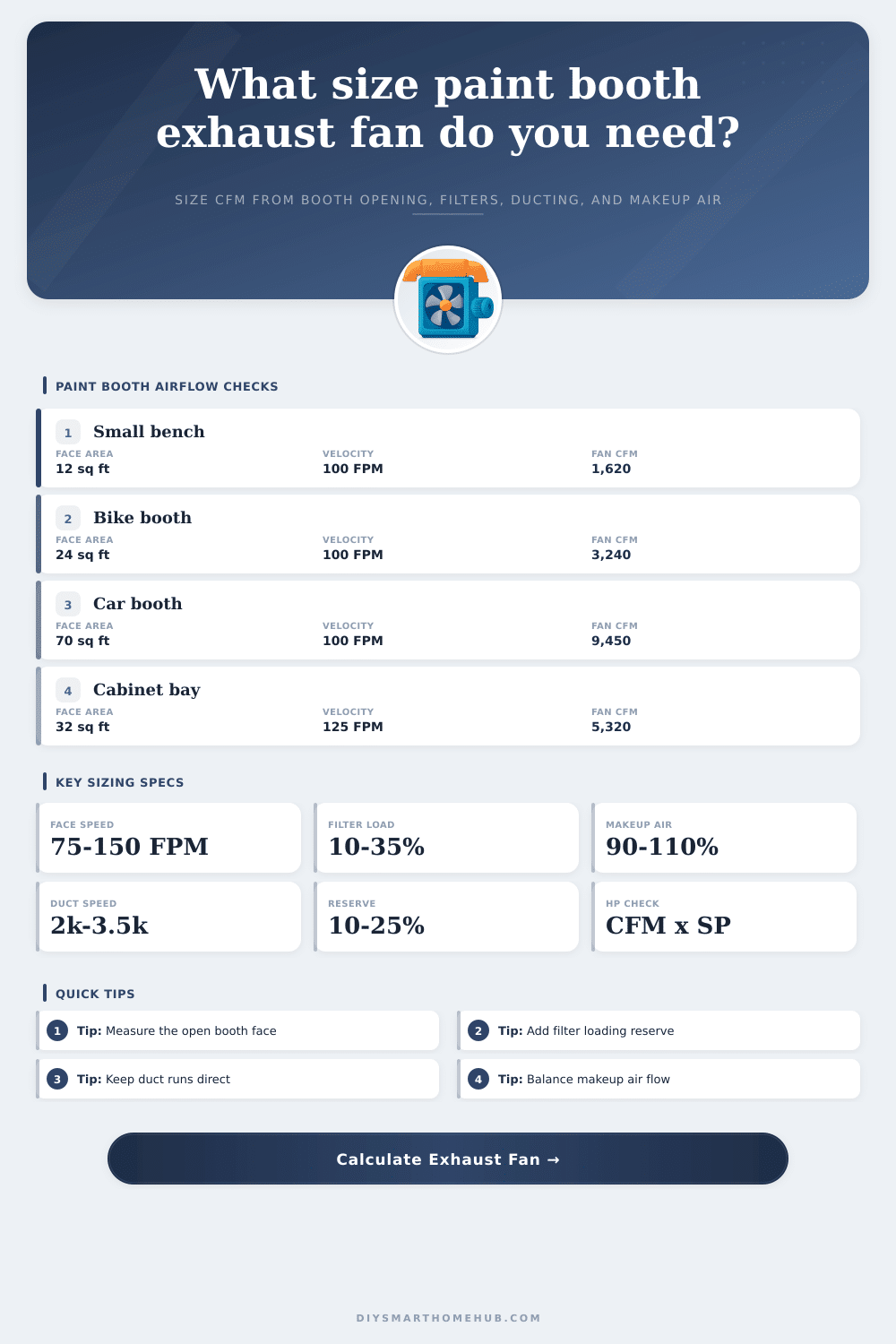
Estimate exhaust fan CFM from booth opening size, target face velocity, filter loading, duct resistance, makeup air, and fan horsepower reserve.
🎯Booth presets
⚙Booth and duct inputs
📌Booth, fan, and filter spec grid
📊Reference tables
| Booth profile | Typical face velocity | Pressure allowance | Best use |
|---|---|---|---|
| Bench spray enclosure | 100 to 125 FPM | Low to medium | Small parts, touch-up work |
| Crossdraft open face | 75 to 125 FPM | Medium | Vehicle and panel booths |
| Side-draft booth | 100 to 150 FPM | Medium high | Cabinet, door, and part lines |
| Downdraft plenum | 75 to 125 FPM | Higher | Filtered floors and long plenums |
| Exhaust filter | Clean SP | Loaded allowance | Calculator use |
|---|---|---|---|
| Polyester arrestor pad | 0.18 in. WC | Moderate | General overspray capture |
| Fiberglass arrestor | 0.12 in. WC | Faster loading | Simple exhaust banks |
| Pleated exhaust filter | 0.30 in. WC | Moderate high | Higher capture and deeper media |
| Multi-stage bank | 0.55 in. WC | High | Pre-filter plus final stage layouts |
| Carbon final stage | 0.75 in. WC | High | Odor polishing after paint arrestor |
| Duct size | Area | CFM at 2,500 FPM | Planning note |
|---|---|---|---|
| 12 in round | 0.79 sq ft | 1,963 CFM | Small booth or bench duct |
| 18 in round | 1.77 sq ft | 4,418 CFM | Medium cabinet booth |
| 24 in round | 3.14 sq ft | 7,854 CFM | Large garage bay range |
| 30 in round | 4.91 sq ft | 12,272 CFM | Full vehicle booth range |
| 36 in round | 7.07 sq ft | 17,671 CFM | Large industrial exhaust |
| Preset | Face area | Target FPM | Approx fan CFM |
|---|
💡Two sizing tips
When the paint booth loses its ability to suck, you will panic. Instead of pulling it up into ceiling filters, the mist just floats around. It lands on your freshly painted surface. It’s wet, so now you have cloud covering your flawless clear coat.
It’s rarely because fan motor burned out. Usually the system was designed with no duct resistance and clean filters. There is no margin for what realy happens in the real world: elbow drag cause suction loss and overspray collects.
How to Pick the Right Fan for Your Paint Booth
Sizing an exhaust fan isn’t as simple as pushing air. You need to push the air at a constant speed out of open face of the booth, no matter how long the duct run to the outside wall is or how dirty the filters are. Plug in your target face velocity and your opening dimensions and let calculator do the work. You won’t have to guess if your fan are big enough or hope that it works.
Face velocity determines capture efficiency. If air doesn’t move across the booth opening at approximately one-hundred feet per minute, contaminants aren’t going to stay contained. Of course that figure varys based off if you’re operating a full vehicle bay or just bench enclosure for small parts. The bigger your opening, the more volume you need to maintain that same face velocity. This is why the tool request height and width separately. Maybe you have a narrow but tall booth, or maybe you have a wide but short booth. Either way the math brings it down to cubic feet per minute so you know exactly what your fan need to deliver.
The main problem are filter loading. A brand new fiberglass arrestor pad provide minimal airflow resistance. If the fan has no reserve power, then three weeks later it’s holding so much dry overspray that it’ll choke the system to half capacity. This calculator have a field for filter loading allowance. Enter 25% and that additional CFM requirement represent the blockage from future buildup. In essence, you’re buying additional horsepower today to avoid poor finishes tomorrow. It adds only a tiny bit to your input box but avoids expensive rework later.
The other penalty is introduced by your ductwork. Each long straight run or each tee or elbow increase the static pressure the fan must overcome. If there is a straight path from the booth to the roof, your losses will be minimal. If you’re routing air around three corners and fifty feet of sheet metal before it exits, the fan have to work much harder just to push air out the door. With this tool you can enter length and diameter of your ducts as well as number of hard turns. It converts those physical obstacles into their equivalent pressure drop. Why? Because a fan rated for high CFM at low static pressure will perform terribly in a complex duct layout. What you need is a fan that can maintains flow against resistance, not just one that spins fast in a vacuum.
The second half of the equation are makeup air. Without makeup air, you can’t pull eight thousand cubic feet out of the building and expect nothing similar to come back in. If you don’t balance the exhaust with the intake, you’re going to have a negative pressure in the room. Doors won’t seal. Drafts will pull dust in under the seals. That fan won’t be able to move just air through the filter bank; it’s fighting against all the air in the building. The calculator determines how much makeup air you need based off the amount of air you exhaust. Ninety to one-hundred percent replacement keeps things stable.
Finally, there is the horsepower rating. It’s not just about saving money on your electric bill. It’s a measure of reliablity and safety. Motors that are undersized overheat under a load, particularly where ductwork is restrictive or the filter is dirty. A little over-sizing allows for some wiggle room on these inevitable variables. You should of planned for this.
The tool comes with some reference tables outlining typical pressure allowances and velocities based off various types of booths. Think of them as sanity checks. If you run a calculation that shows a face velocity of four-hundred feet per minute, you likely entered something incorrecty. That’s too fast to be considered “normal” for painting and causes turbulence that blows paint right back onto the part. Stay within the reasonable range. Consistency is key. Your system should be invisible, a good size. It’ll just move air without you noticing it unless there’s an issue. Planning ahead for balanced airflow, duct friction, and filter decay means the fan will do its job quietly so you can concentrate on the finish.