Fuse Sizing for Motors Calculator
Estimate motor branch-circuit fuse size from horsepower, full-load amps, voltage, phase, service factor, locked-rotor current, conductor ampacity, and overload relay coordination.
The branch fuse clears short-circuit and ground-fault events. For many motors, the fuse can be larger than conductor ampacity when overload protection is coordinated separately.
The starter overload relay is estimated from motor FLA and service factor. That setting is the conductor and motor heating protection, not the branch short-circuit fuse.
High locked-rotor multipliers push the calculator toward the maximum percentage allowance and flag a time-current curve check.
Calculation breakdown
| Fuse device | Base sizing multiplier | Maximum sizing multiplier | Use case |
|---|---|---|---|
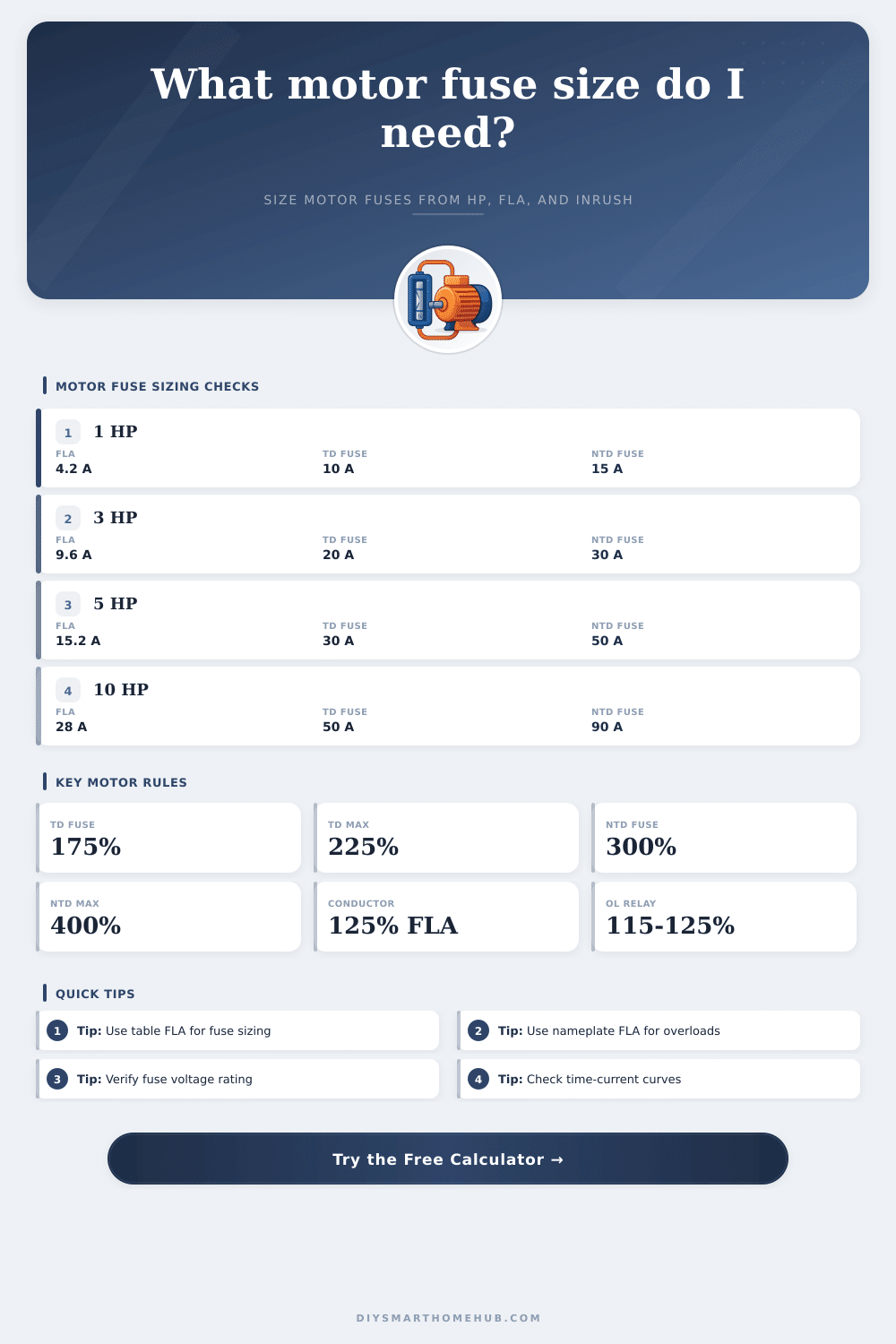
| Dual-element time-delay fuse | 175% of motor FLA | 225% of motor FLA when needed to start | Common for motor branch circuits with normal to heavy inrush |
| Non-time-delay fuse | 300% of motor FLA | 400% of motor FLA when needed to start | Fast fuse style that generally needs a larger amp rating for starting |
| Class CC time-delay fuse | 175% of motor FLA | 225% of motor FLA when listed for motor circuits | Compact current-limiting protection for smaller control panels |
| Class J / RK1 / RK5 time-delay fuse | 175% of motor FLA | 225% of motor FLA when start current requires it | Industrial motor feeders and starters needing current limitation |
Percentages reflect common NEC motor branch-circuit short-circuit and ground-fault protection limits for fuse sizing. Local code, equipment labels, and listed starter data can be more restrictive.
| Fuse class | Typical voltage rating | Motor starting behavior | Coordination note |
|---|---|---|---|
| Class CC time-delay | Up to 600 V | Good for small motors with compact holders | Current limiting; verify amp rating and rejection holder type |
| Class J time-delay | Up to 600 V | Strong current limitation with motor-rated time delay | Often selected for higher interrupting ratings and smaller footprint |
| Class RK1 time-delay | Up to 600 V | Time-delay starting with higher current limitation | Useful where downstream equipment SCCR depends on limiting fault energy |
| Class RK5 time-delay | Up to 600 V | Motor-friendly delay, usually less current limiting than RK1 | Common economical choice for many fused motor starters |
| Non-time-delay fuse | Class dependent | Needs larger percentage because it has no intentional delay | Check nuisance opening risk during across-the-line starts |
| Motor starter | Input basis | Estimated FLA | Likely fuse result |
|---|---|---|---|
| 1/2 HP sump pump | 115 V single phase, time-delay | 9.8 A | 20 A time-delay, verify overload setting |
| 2 HP air compressor | 230 V single phase, heavy start | 12 A | 25 A to 30 A time-delay depending on inrush |
| 5 HP shop compressor | 230 V three phase, dual-element | 15.2 A | 30 A time-delay for ordinary starting |
| 10 HP HVAC blower | 460 V three phase, moderate start | 14 A | 25 A time-delay with conductor ampacity check |
| 25 HP irrigation pump | 230 V three phase, non-time-delay | 68 A | 225 A to 250 A non-time-delay, curve check needed |
| Reference item | Values | Used in calculator | Important limit |
|---|---|---|---|
| Three-phase motor FLA at 230 V | 1 HP 4.2 A, 5 HP 15.2 A, 10 HP 28 A, 25 HP 68 A | Fallback FLA when nameplate field is blank | Use equipment tables or nameplate where required |
| Three-phase motor FLA at 460 V | 1 HP 2.1 A, 5 HP 7.6 A, 10 HP 14 A, 25 HP 34 A | Fallback FLA for 460 V motor presets | Do not mix 230 V and 460 V tables |
| Common standard fuse sizes | 15, 20, 25, 30, 35, 40, 45, 50, 60, 70, 80, 90, 100 A | Rounds calculated fuse amps up to next standard size | Never exceed equipment maximum fuse marking |
| Conductor ampacity check | Minimum 125% of motor FLA for one motor | Pass or fail card and ampacity utilization meter | Adjustment, terminal, and ambient rules may reduce ampacity |
Motor circuit dont often blow fuse without a warning. However, when they do, the cost of repairing the motor circuits can be expensive. Should a motor circuit stall, such as a compressor or a conveyor system gets stuck, the current draw can be several times more then that of the motors normal running current.
The fuse must determine whether the current surge is normal or caused by a fault in the motor. Determining this is part of the process of size a fuse. The first number to use when sizing a fuse is the full-load amperage (FLA) of the motor.
How to Size a Motor Fuse
You can find the FLA on the motors nameplate or with an reference table that uses the motors horsepower, voltage, and phase ratings. You should use the FLA from the motors nameplate when providing overload protection for the motor. The reference table can be used to estimate the size of a motor fuse if the motors nameplate isnt accessible, but the value from the nameplate is the most accurately value for motor protection.
The fuse provides short-circuit and ground-fault protection, while the relay on the motor starter provide overload protection. Because the fuse and relay provide this protection, the fuse dont have to be sized to the ampacity of the motor circuit conductors. By entering the horsepower of the motor, the full-load amperage, the voltage, the phase of the motor, and the fuse class into a motor fuse calculator, the calculators screen will display the fuse rating and the overload protection estimate.
The motor fuse calculator will also calculate the fuse size relative to the 125% conductor rule so that you can determine whether the motor conductors is large enough for the motor. Time-delay fuses are commonly used for motor protection because the time-delay allow the motor to ride through the inrush current that is common when the motors rotor is locked. If you use a non-time-delay fuse, the motor must have a larger fuse rating to allow for the initial start-up of the motor.
If you change the fuse type in the motor fuse calculator, the multiplier range will change. The size of the fuse will change accordingly, even if the motor are the same. The rules for sizing motor conductors is different than the rules for fuses.
The wire that conducts power to the motor must be sized to carry 125% of the motors full-load amperage. The fuse do not have to comply with this rule because the fuse dont have to protect the motor conductors from overloads. If the conductor size is too small for the motor, a fuse calculator will alert you so that you can purchase the correct size electrical conductors.
The service factor and temperature rise rating of the motor will influence the setting of the motors overload relay. A motor with a service factor of 1.15 can have an overload relay setting to 125% of the motors FLA, but a motor with a lower service factor will have an overload relay setting to 115% of the motors FLA. The service factor determine how much overload the motor can take and how often the motor starter will need to be reset.
Motors are not always the same. The load that motors experience are not always the same. A centrifugal pump may spin up quick and draw a modest amount of current when running.
A positive-displacement motor may remain at locked-rotor amps for several second. These scenarios can be programmed into the motor fuse calculator using the inrush current multiplier field. Increasing this value will increase the fuse size that the calculator suggest.
This value can also be used to determine how the motor behave on the time-current curve for the motor. After determining the numbers, you should perform a physical check of the motor. The fuse curve should be compared with the time it take the motor to reach full speed.
Additionally, the interrupting rating of the fuse should be higher than the available short circuit current in the electrical panel. These two item cant be programmed into a motor fuse calculator, but they will determine whether the fuse will clear the short circuit. The goal of sizing the fuse is not to get the largest fuse possible.
The goal is to get the smallest fuse that can handle the starting of the motor and that will clear a fault. If the fuse can handle the starting of the motor and clears a fault condition, the motor will continue to run and the motor system will remain intact.