Mini Split SEER Calculator
Estimate seasonal cooling BTU, SEER or SEER2 energy use, inverter part-load efficiency, electricity cost, and annual savings versus a baseline mini split.
📌Mini split efficiency presets
⚙SEER calculation inputs
🔍Live formula checks
📊Mini split SEER/SEER2 spec comparison grid
📘Reference tables
| SEER2 class | Approx legacy SEER context | Typical mini split use | Calculator interpretation |
|---|---|---|---|
| 13.4 to 16.0 SEER2 | About 14 to 17 SEER | Entry or baseline cooling equipment | Higher kWh for the same seasonal cooling BTU. |
| 17.0 to 20.0 SEER2 | About 18 to 21 SEER | Standard ductless single-zone and multi-zone systems | Good comparison range for practical upgrades. |
| 21.0 to 25.0 SEER2 | About 22 to 26 SEER | High-efficiency inverter mini splits | Lower kWh when runtime and load are significant. |
| 26.0 to 33.0 SEER2 | About 27 to 35 SEER | Premium small-capacity single-zone systems | Best savings in long cooling seasons and low-load rooms. |
| Mini split capacity | Seasonal cooling at 60% load | 16 SEER2 energy | 24 SEER2 energy |
|---|---|---|---|
| 6,000 BTU/h | 3,600,000 BTU/year | 225 kWh before part-load correction | 150 kWh before part-load correction |
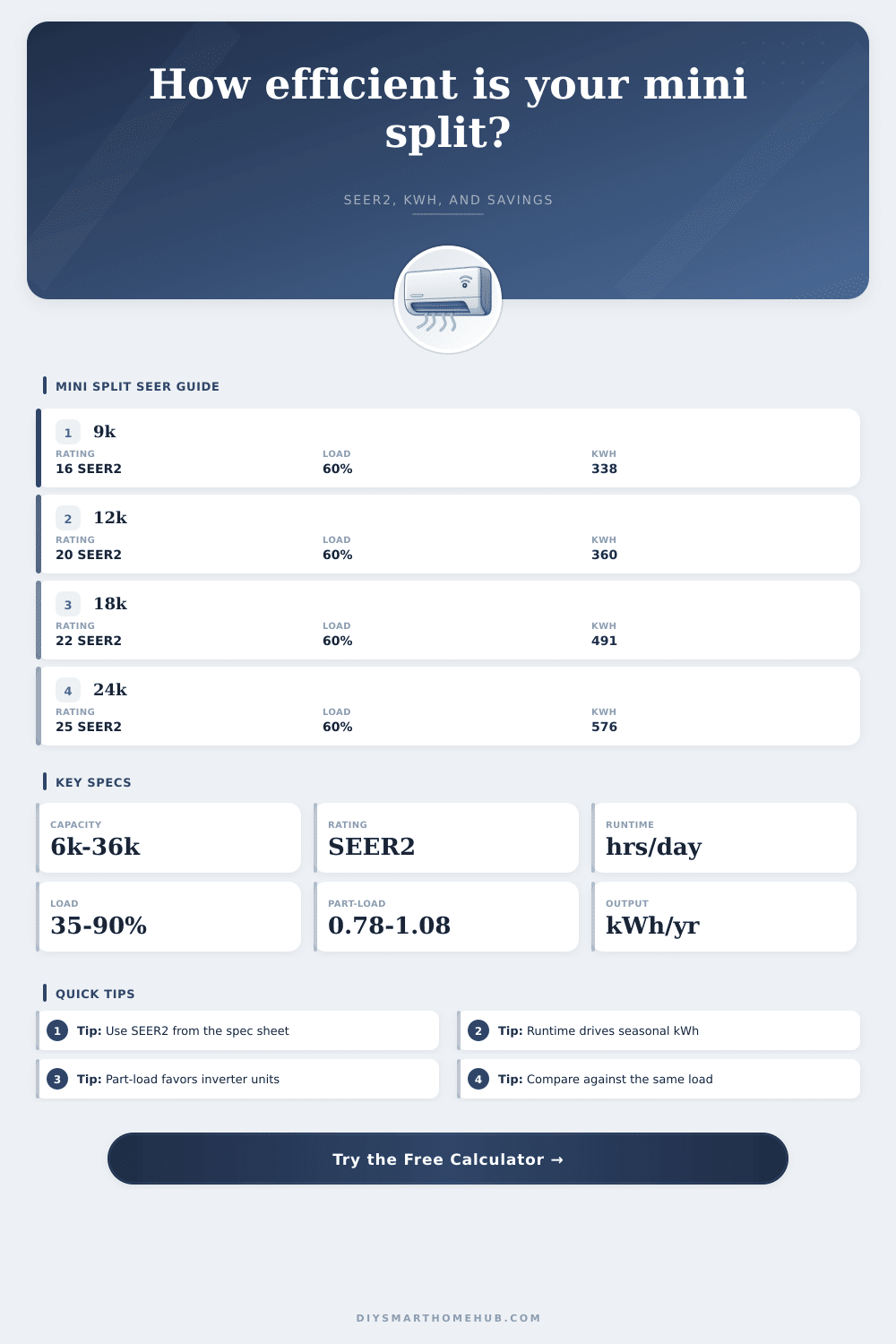
| 9,000 BTU/h | 5,400,000 BTU/year | 338 kWh before part-load correction | 225 kWh before part-load correction |
| 12,000 BTU/h | 7,200,000 BTU/year | 450 kWh before part-load correction | 300 kWh before part-load correction |
| 18,000 BTU/h | 10,800,000 BTU/year | 675 kWh before part-load correction | 450 kWh before part-load correction |
| Profile | Average load factor | Part-load factor | Best modeling use |
|---|---|---|---|
| Low-load inverter cruise | 45% of capacity | 0.78 x rated watt-hours | Steady low-speed rooms with long gentle cooling calls. |
| Normal variable-speed cooling | 60% of capacity | 0.86 x rated watt-hours | Typical occupied rooms with stable inverter modulation. |
| Mixed sun and occupancy | 72% of capacity | 0.92 x rated watt-hours | Living areas with solar gain and people load. |
| Hot afternoon peak load | 88% of capacity | 0.98 x rated watt-hours | Warm climates, glass-heavy rooms, or garage zones. |
| Oversized short-cycling room | 35% of capacity | 1.08 x rated watt-hours | Low-load spaces where cycling losses offset the rating. |
| Baseline rating | Baseline kWh/year | Savings kWh/year | Savings per year |
|---|---|---|---|
| 13.4 | 0 | 0 | $0 |
| 16.0 | 0 | 0 | $0 |
| 18.0 | 0 | 0 | $0 |
| 20.0 | 0 | 0 | $0 |
💡Mini split SEER calculation tips
When you choose a mini split for your home, you have to consider how much electricity the mini split will use during the full cooling season. The electricity that your mini split will use during this cooling season is not dependent upon the nameplate number on the mini split’s box. Instead, the seasonal energy that will be used is more important than the mini split’s ability to remove a large amount of heat from the room.
The ratings that is used to convey the seasonal energy efficiency of the mini split are the SEER ratings. The SEER ratings indicate the amount of cooling output in BTU units divided by the amount of electricity in watt-hours that the mini split use during that period. A higher SEER rating indicates that the mini split will use less energy to remove the same amount of heat from the room during seasonal climates then a model with a lower SEER rating.
How SEER Ratings Affect Mini Split Energy Use
The higher the SEER rating of a mini split, the less energy that will be used during the summer cooling season. Thus, models with higher SEER ratings will reduce the number of kilowatt-hours that are used during the summer. The fewer kilowatt-hours that a mini split uses, the less that the mini split will cost for that households electric bill.
The total number of kilowatt-hours that will be saved is dependent upon both the number of hours that the mini split’s compressor will need to run during the summer cooling season, as well as the amount of speed at which the compressor will need to run. Many inverter-driven mini splits does not run their compressor at full power all of the time. Instead, inverter-driven mini splits will run most of the time at part load.
This part-load factor is factored into the model’s SEER rating. The SEER ratings take into account both the number of hours that the mini split will need to run, as well as how efficiently it will burn electricity when running at different levels of power. Another factor that will play a role in the electricity cost of your mini split is the load profiles of the room.
Each room will have a different load profile depending upon the amount of heat that must be removed from that room. For instance, a bedroom that is only to be cooled for eight hours each day will have a different load profile than a living area that may require heavy cooling during the summer afternoon. A load profile calculator allows an individual to choose different load profiles for there home.
Each profile includes both the percentage of the load that the mini split is to remove and a correction factor. This correction factor will take the SEER rating that is published for the mini split and change that number to reflect the actual electricity that the mini split may use during the summer cooling season. Many individuals will want to compare the energy use of a mini split to that of their existing mini split.
In order to make this proper comparison, one must obtain the SEER ratings of the two models using the same standard. For instance, the legacy SEER numbers may represent the SEER ratings of mini splits manufactured in the past. Today’s mini splits will have a SEER2 rating.
These two ratings are not to be mixed. If both mini splits is represented using the same rating standard, however, then the differences in the cost of each mini split’s electric bill will be clear. The length of the cooling season each year and the number of hours that the mini split will need to run each day will have an impact upon the outcome of the energy calculations for that mini split.
Coastal climates that experience longer periods of cooling each year will experience different electric bills than those in inland climates with fewer cooling days each year. Increasing the number of hours that a mini split will need to run each year will increase the amount of energy used by that mini split. However, the inverter systems of mini splits will counteract some of the energy required of those appliances that are forced to run longer hours.
The load profile calculator allows individuals to test the energy use of their mini split under different runtimes and lengths of the cooling season. The published SEER rating for the mini split will not account for how the mini split is installed in the room. Poor installation of the mini split can reduce the efficiency of that mini split.
For instance, if the mini split’s filters are dirty, the compressor will have to work harder to circulate the air through the mini split. Thus, the compressor will use more energy if the mini split is forced to work harder. This increase in energy will increase the cost of the homeowner’s electric bill.
The SEER ratings are established as the mini split manufacturer’s models with clean filters and proper installation. As a result, the electric bill of the mini split will only equal the SEER rating if the mini split is properly installed and has clean filters. In choosing the best mini split for your home, you want to find the lowest amount of kilowatt-hours that will be required of the mini split for the cooling season.
A mini split load profile calculator allows you to find how each of the features of the mini split impact each of the other features. By understanding each of these factors and how they relate to your home, you can make the best choice for your mini split installation. You should of researched the models better before buying.
Its important to check how much electricity the units will consume. Most people dont realise how much a unit can cost. When you are looking at different models, you’re going to see alot of variation in the ratings.
Making sure you have a moddern unit with the right specs is key. You’ll want to recieve a good deal on your installation too. Some people thinks the installer is easy, but it isnt always.
A minimun amount of research will help you avoid any unwanted costs.