Furnace Duct Size Calculator
Estimate furnace airflow, target duct area, equivalent round diameter, rectangular duct sides, friction rate, and branch-versus-trunk static pressure status.
📌Furnace Duct Presets
Pick a realistic starting point, then adjust the heat output, temperature rise, airflow share, duct role, velocity, length, and available static pressure.
⚙Duct Sizing Inputs
🧱Duct Shape / Spec Comparison Grid
Round duct has the lowest perimeter for its area, making it efficient for branches and exposed mechanical rooms.
A 2:1 rectangular duct fits joist bays better while keeping equivalent diameter reasonably close to its area size.
Wide shallow duct saves depth but adds surface friction, noise risk, and usually needs more area than round duct.
Return ducts are usually sized larger and slower to reduce grille noise and keep furnace blower pressure under control.
📊Reference Tables
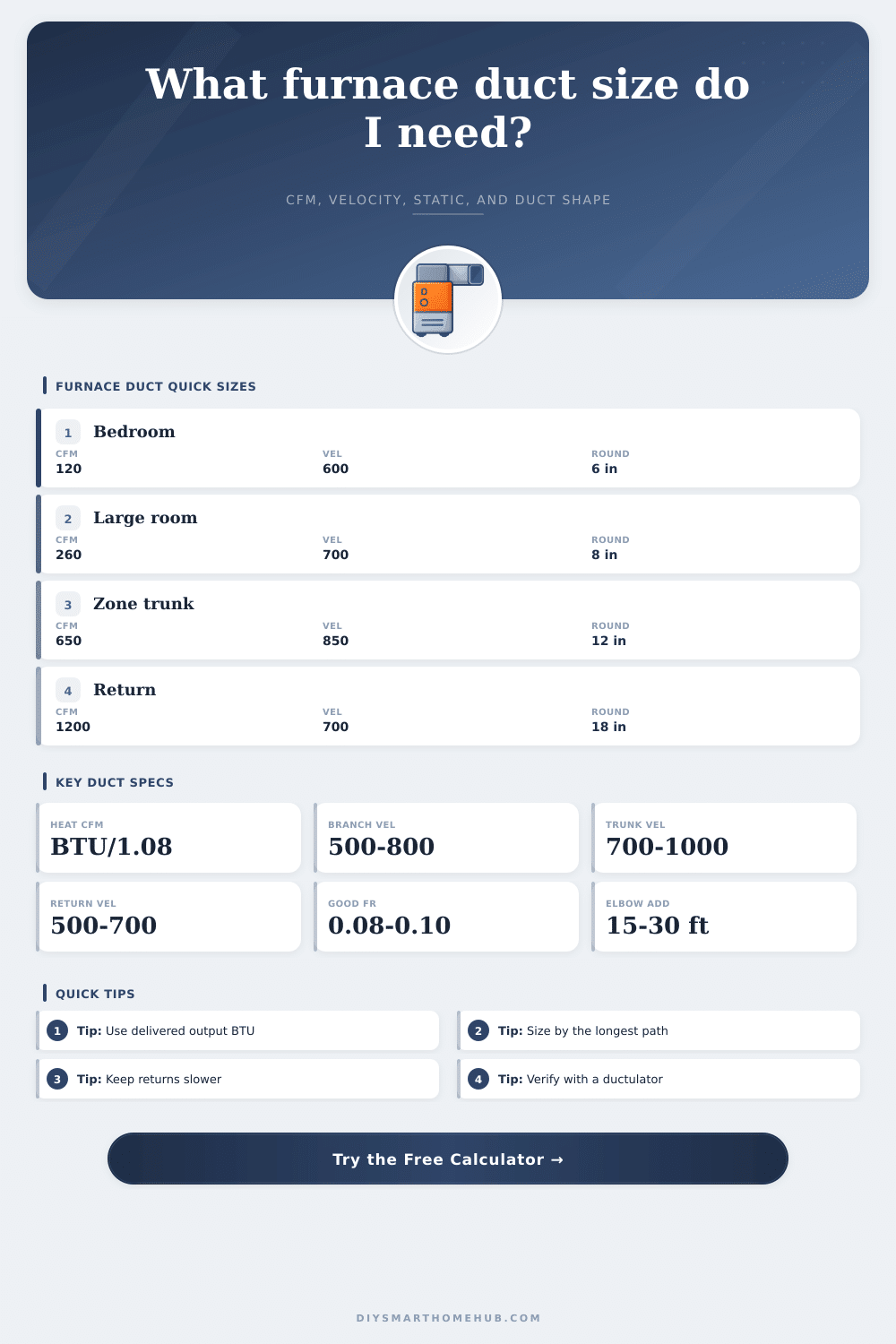
| Duct role | Quiet target | Typical range | Watch point |
|---|---|---|---|
| Supply branch | 500 to 650 FPM | 500 to 800 FPM | Above 800 FPM can be noisy at registers |
| Supply trunk | 700 to 850 FPM | 700 to 1000 FPM | Above 1000 FPM raises friction quickly |
| Return duct | 500 to 600 FPM | 400 to 700 FPM | High return velocity often sounds loud |
| Filter grille face | 300 to 450 FPM | 300 to 500 FPM | Keep lower than duct velocity |
| Available duct static | Effective length | Friction rate | Interpretation |
|---|---|---|---|
| 0.10 in. w.c. | 100 ft | 0.10 in./100 ft | Common residential target |
| 0.12 in. w.c. | 150 ft | 0.08 in./100 ft | Good for quieter long runs |
| 0.18 in. w.c. | 180 ft | 0.10 in./100 ft | Workable if fittings are smooth |
| 0.20 in. w.c. | 250 ft | 0.08 in./100 ft | Long system needs larger duct |
| Round size | Area | 600 FPM | 900 FPM |
|---|---|---|---|
| 6 in | 28.3 sq in | 118 CFM | 177 CFM |
| 8 in | 50.3 sq in | 209 CFM | 314 CFM |
| 10 in | 78.5 sq in | 327 CFM | 491 CFM |
| 12 in | 113.1 sq in | 471 CFM | 707 CFM |
| 16 in | 201.1 sq in | 838 CFM | 1257 CFM |
| Rectangular size | Area | Eq. round formula | Best use |
|---|---|---|---|
| 8 x 4 in | 32 sq in | 6.5 in | Small branch, low profile |
| 10 x 6 in | 60 sq in | 8.4 in | Room branch or short trunk |
| 14 x 8 in | 112 sq in | 11.5 in | Light trunk path |
| 18 x 8 in | 144 sq in | 13.0 in | Main trunk where height is limited |
| 20 x 10 in | 200 sq in | 15.0 in | Large return or supply trunk |
💡Duct Sizing Tip Boxes
In order to size furnace ductwork, you must balance airflow, duct length, and air pressure in order to even distribute heat to every room of a house. If the duct is too small for the amount of air that it must move, the air pressure will become too high for the duct and create noisy airflow. If the duct is too large for the amount of air that it can handle, the velocity of the air will decrease, leaving the rooms at the end of the duct run cooler than the thermostat indicates.
Each of these three factor must be considered in order to determine whether the ductwork is sized correctly. Duct sizing begins with determining the cubic feet per minute (cfm) of air that the furnace must move. You must calculate the heat output of the furnace, not the input rating of the furnace as listed on the specification sheet.
How to Size Furnace Ducts
The cfm is calculated by dividing the delivered heat output of the furnace by the temperature rise of the air. With the total cfm of the furnace determined, you must calculate the percentage of air that must move through each individual duct. Main trunk ducts move a large percentage of the total air, but bedroom branch ducts, for example, will move a small percentage of the total air.
The percentage of air that moves through each duct is used to calculate the size of that specific duct. The percentage ensures that the duct is not too large and that it does not allow the air to move too slow through the duct. Duct velocity, or the rate of movement of air through the ductwork, must be considered during the sizing of the ducts.
If the velocity is too high within the ducts, the air will move too quickly through the duct, leading to noise radiating from the registers. If the velocity is too low, the air will not move far enough from the supply grille to adequately heat the rooms. Branch and return ducts should have lower velocity than main ducts in order to remain quiet.
The duct sizing calculator will calculate the area of the duct based off the required cfm. Duct effective length is another consideration in the sizing of the ductwork. Effective length is the actual length of the duct plus the length created by each fitting in the duct system.
Duct designers often make the mistake of forgetting that each elbow, takeoff, and transition joint in the duct system creates effective length for the system. The effective length of the duct system determines the total amount of pressure drop that will develop in the duct system. If the effective length is long, a high amount of static pressure will be lost in moving the air through the duct.
In order to prevent high static pressure drops along the duct system, large ducts is required. The available static pressure of the furnace blower divided by the effective length of the system is referred to as the friction rate. This friction rate indicates whether or not the system is within the available static pressure of the furnace blower.
The shape of the duct system will also impact the static pressure within the ducts. Round ducts will move air at a lower rate of friction than rectangular ducts, for example. Round ducts are generally the most efficient in moving hot air from the furnace to the supply registers.
Rectangular ducts, in contrast, people usually utilize because they typically fit better within the joists and walls of the building. Rectangular ducts that are very flat, however, will allow for an increase in friction. A duct sizing calculator will allow you to calculate the diameter of round ducts or the proportions of rectangular ducts needed to move the required amount of air.
One more factor to consider in the sizing of the furnace duct system is static pressure. The total static pressure created by the furnace blower has a limited supply; various components of the HVAC system use some of that available static pressure. The static pressure left over after the furnace components is the static pressure budget for the duct system.
The friction rate for the system must not be higher than the static pressure budget for the system. Otherwise, you must increase the area of the ducts or decrease the effective length of the system. Increasing the area or diameter of the ducts will reduce the friction rate.
Decreasing the effective length will also reduce the friction rate. Ducts should be sized according to the longest run of ducts in the house. The longest run in the system will determine the friction rate for the system.
By sizing the duct system according to the longest run, the other parts of the system will work correctly. Additionally, return ducts should be sized carefuly. High velocity in return ducts will lead to noise being created at the return grille.
The goal in sizing the furnace duct system is to create a system that moves the correct amount of air through the system at the correct velocity, while using no more than the available static pressure that is created by the furnace blower. If the duct system is sized correctly, each room will reach the required temperature, and the furnace blower will not work harder than it needs to in order to heat the house. Properly sized ductwork will keep the heating system steady and ensure that each room receives the same amount of heat from the furnace system.