Makeup Air Calculator
Size replacement airflow for range hoods, dryers, bath fans, combustion appliances, and tight homes using exhaust CFM, leakage credit, pressure target, duct diameter, and velocity limits.
🏠Makeup Air Presets
Choose a real exhaust pattern, then adjust the house leakage, appliance load, pressure target, duct size, and air delivery strategy.
⚙Airflow, Leakage, And Duct Inputs
📊Formula Cards And Key Assumptions
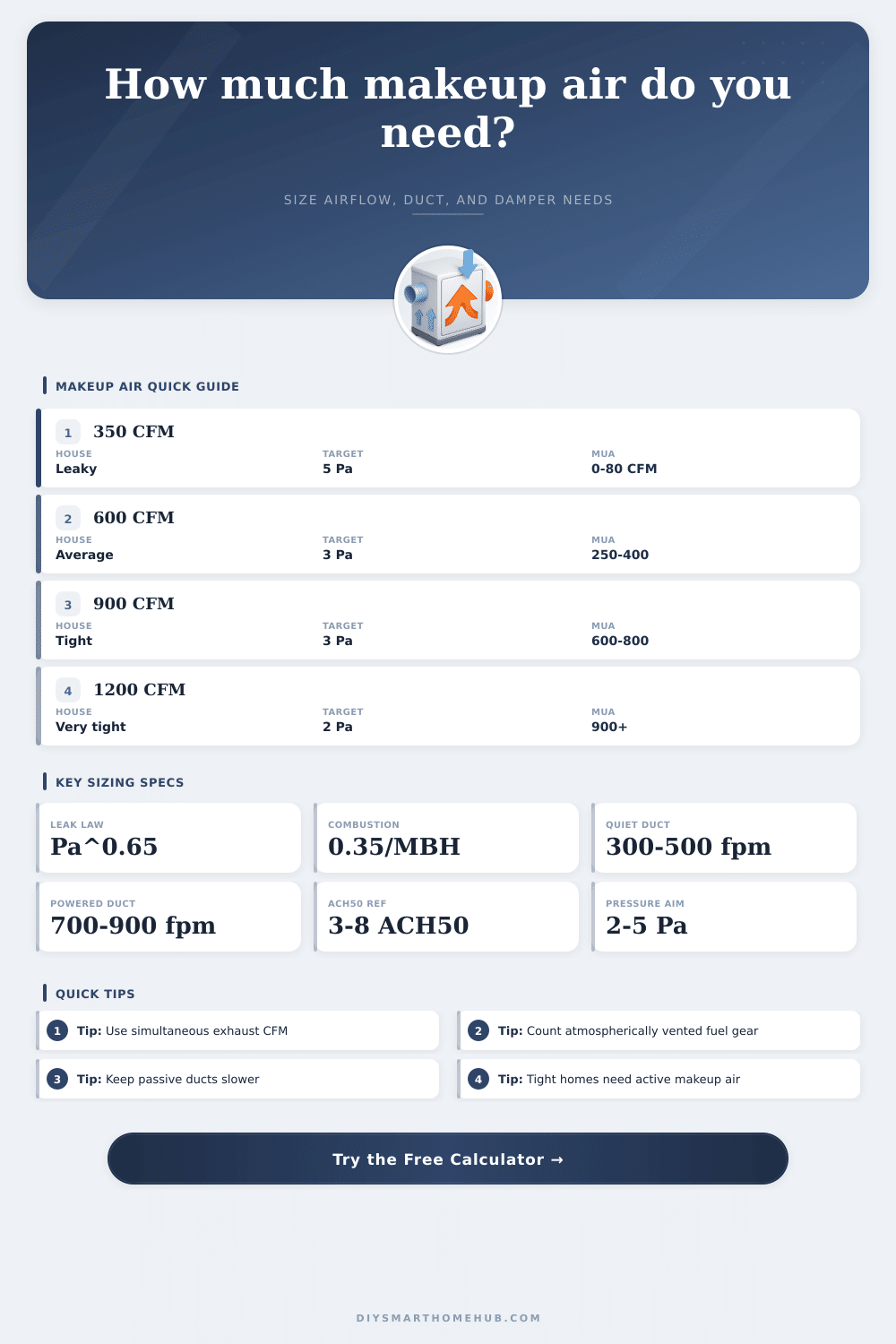
Q50 equals ACH50 multiplied by house volume and divided by 60 minutes.
The calculator estimates natural leakage at target pressure using a 0.65 flow exponent.
Combustion reserve adds airflow for open-combustion equipment in the same pressure zone.
CFM divided by round duct area gives fpm, then the duct size is checked against the limit.
📘Pressure, Leakage, And Duct Reference Tables
These references show the assumptions behind the calculator so exhaust, combustion air, leakage, and duct sizing remain visible.
| ACH50 range | Envelope description | Leakage behavior at 3 Pa | Makeup air implication |
|---|---|---|---|
| 1.0 to 2.5 | Very tight new construction or deep energy retrofit. | Small natural leakage credit even in large homes. | Powered or interlocked makeup air is commonly needed for large exhaust. |
| 2.5 to 5.0 | Modern home with decent air sealing and normal penetrations. | Some infiltration helps, but not enough for high-CFM hoods. | Motorized damper or powered assist often fits mid-size hoods. |
| 5.0 to 8.0 | Average existing home with mixed sealing quality. | Leakage can cover small exhaust but pressure can still spike. | Check combustion appliances and simultaneous fan operation carefully. |
| 8.0 plus | Leaky older home, garage, or workshop shell. | Large leakage credit, but paths may be uncomfortable or dirty. | Dedicated intake can still improve comfort and control airflow source. |
| Pressure target | Typical use | Draft sensitivity | Calculator effect |
|---|---|---|---|
| 2 Pa | Tight home with fireplaces, draft hood appliances, or attached garage concern. | High sensitivity; keep pressure very small. | Lower leakage credit, higher active makeup air result. |
| 3 Pa | Conservative general screen for many homes with combustion equipment. | Good default when appliances share indoor air. | Balances infiltration credit with draft safety margin. |
| 5 Pa | Less sensitive exhaust zone or electrically heated home. | Moderate; still check actual appliance draft. | Higher leakage credit reduces active makeup requirement. |
| 8 Pa | Workshop or non-combustion zone where pressure tolerance is higher. | Lower, but door operation and comfort may suffer. | Can make leakage look generous, so use cautiously indoors. |
| Round duct | Area | CFM at 500 fpm | CFM at 800 fpm |
|---|---|---|---|
| 6 in | 0.20 sq ft | 98 CFM | 157 CFM |
| 8 in | 0.35 sq ft | 175 CFM | 279 CFM |
| 10 in | 0.55 sq ft | 273 CFM | 436 CFM |
| 12 in | 0.79 sq ft | 393 CFM | 628 CFM |
| 14 in | 1.07 sq ft | 535 CFM | 855 CFM |
| 16 in | 1.40 sq ft | 698 CFM | 1,117 CFM |
| Exhaust scenario | Simultaneous CFM | Risk driver | Likely makeup approach |
|---|---|---|---|
| Standard range hood only | 300 to 450 CFM | Pressure in tight homes and nearby fireplaces. | Passive damper may work in leaky homes; active assist in tight homes. |
| Pro-style hood plus dryer | 650 to 900 CFM | Combined exhaust can overwhelm leakage credit quickly. | Interlocked damper or powered makeup air is often appropriate. |
| Kitchen, bath, and central exhaust | 800 to 1,100 CFM | Long duration exhaust can pull from flues and envelope leaks. | Powered makeup with clear outdoor air path is the practical screen. |
| Large custom kitchen exhaust | 1,100 to 1,500 CFM | High airflow, comfort, tempering, and duct velocity all matter. | Tempered powered makeup air usually deserves engineering review. |
🔧Fan, Damper, And Spec Comparison Grid
| System type | Practical CFM range | Duct velocity target | Best calculator match |
|---|---|---|---|
| Passive barometric damper | 50 to 250 CFM | 250 to 500 fpm | Small exhaust deficit, leaky shell, mild pressure target. |
| Motorized outdoor air damper | 100 to 500 CFM | 350 to 650 fpm | Range hood interlock where house pressure pulls some intake. |
| Inline powered makeup air fan | 250 to 1,000 CFM | 600 to 900 fpm | Tight houses, large hoods, and reliable active replacement air. |
| Tempered makeup air unit | 600 to 2,000 CFM | 700 to 1,000 fpm | Large exhaust where cold or hot intake air must be conditioned. |
| ERV-assisted balanced intake | 80 to 350 CFM | 300 to 600 fpm | Continuous low-flow balance, not a full replacement for huge hoods. |
💡Makeup Air Sizing Tips
Add the fans that can realistically run together: hood speed, dryer, bath fans, central exhaust, and workshop exhaust. A full connected-fan total can overstate the need, but ignoring the dryer or bath boost can understate pressure risk.
Atmospherically vented water heaters, boilers, furnaces, and fireplaces are more sensitive to depressurization. Use a lower Pa target and keep the combustion reserve in the calculation when those appliances share the same air zone.
When you operate a powerful exhaust fans, air must enter the house. In older houses that are not tightly sealed, air can typically enters the house through the cracks around the windows and electrical outlets in the walls. However, in a new house that is constructed to be tightly sealed, powerful exhaust fans can actualy pull air from the house through a chimney or dryer vent.
If a powerful exhaust fan can pull air through a chimney or dryer vent, this can cause safety problem. One way to calculate the amount of air that will need to be supplied to the house to compensate for the air that the exhaust fan will pull out is to use a makeup air calculator. To use a makeup air calculator, you must first calculate the total exhaust that will occur simultaniously in the house.
How to Calculate Makeup Air for Your House
This total exhaust is the sum of the exhaust from each range hood, dryer, and bath fan that will be installed in the house. The total exhaust that will occur in the house may be greater than the amount of air that can normally enter the house through natural leakage. The makeup air calculator calculates the total exhaust that will occur in the house, and then it subtracts the amount of air that naturally enters the house through leakage.
The result is the amount of active makeup air that needs to be supplied to the house to counterbalance the amount of air that the exhaust fan will remove. The amount of air that naturally enters the house is not a constant; it varies with the tightness of the house and the amount of pressure difference that is allowed into the house. To calculate the amount of leakage in the house, many individuals will perform a blower-door test on the house.
A blower-door test measures the airflow in the house at 50 pascals of pressure difference. However, exhaust vents typically allow air to escape at much lower pressure differences. The makeup air calculator adjusts the measurement of the natural leakage in the house that is calculated from a blower-door test to reflect the airflow at a lower pressure difference using a flow exponent.
This adjustment is necessary because air moves different than through holes in a wall at different pressures. Many people believe that the house will exhibit the same amount of leakage at low pressure as high pressure, but the house does not exhibit the same amount of leakage at both different pressures. It is also important to consider the combustion appliance that are to be installed in the house.
Combustion appliances, like atmospherically vented water heaters and furnaces, require a safety margin to ensure that the appliances will not spill there combustion products into the livig space. A makeup air calculator takes into account the requirement of this safety margin for combustion appliances. By taking into account the exhaust from a range hood, for instance, but also the exhaust from a furnace that shares the same room as the range hood, the makeup air calculator can calculate the total makeup air requirement for the house in such a way that it remains accurate even if both the range hood and furnace are operating simultaniously.
Once you have determined the amount of makeup air that is required for your house, you must decide how to deliver that makeup air to the house. A passive barometric damper may be used to deliver makeup air if the makeup air deficit is small and the house is leaky. However, if the house is a tight and newly-constructed building, the passive barometric damper may not be able to move enough air to compensate for the amount of air that the exhaust fan removes.
Powered makeup air units that are interlocked with the exhaust fan may be used in place of the passive damper. The powered makeup air units move air at a higher velocity than passive dampers. The makeup air calculator will determine the velocity of the air that the powered units will move.
The air velocity must not exceed a limit that the makeup air calculator sets. Additionally, the makeup air calculator will calculate the diameter of the duct that will be used to move the makeup air. If the duct is too small, the makeup air system will begin to whistle; therefore, the makeup air system and duct must be sized appropriately to prevent this whistling noise.
If the duct is too large, it can become more expensive and difficult to construct. Furthermore, the location of the makeup air can impact the comfort of the individuals in the house. If cold air from the makeup air system is directed near a cooking range, for instance, the air will be uncomfortable for the cook.
To avoid this issue with cold air, many construction plans utilize tempered units or exhaust air systems that are assisted by exhaust ventilation (ERV) intake systems. However, these types of systems will increase the cost of construction of the house. Thus, the makeup air calculator will not select the type of hardware that will be used to deliver the makeup air.
However, the makeup air calculator will calculate the size of the duct in which that makeup air will travel, based off the type of hardware that is chosen. Many construction projects often treat makeup air as an afterthought. However, if there is a high exhaust rate in the house during the winter months (when exhaust fans are typically used the most), problems can result from the lack of air being supplied to the house.
The calculation of the amount of makeup air that is required for a house is a quick calculation, and the inputs for that calculation are the same measurements that are used for energy audit calculations for the house. Additionally, the makeup air calculation should of be performed prior to installing the exhaust fans in the house. By calculating the makeup air requirements prior to installing the exhaust fans, any problems in the system can be fixed during the planning stage of construction, rather than during the construction stage.