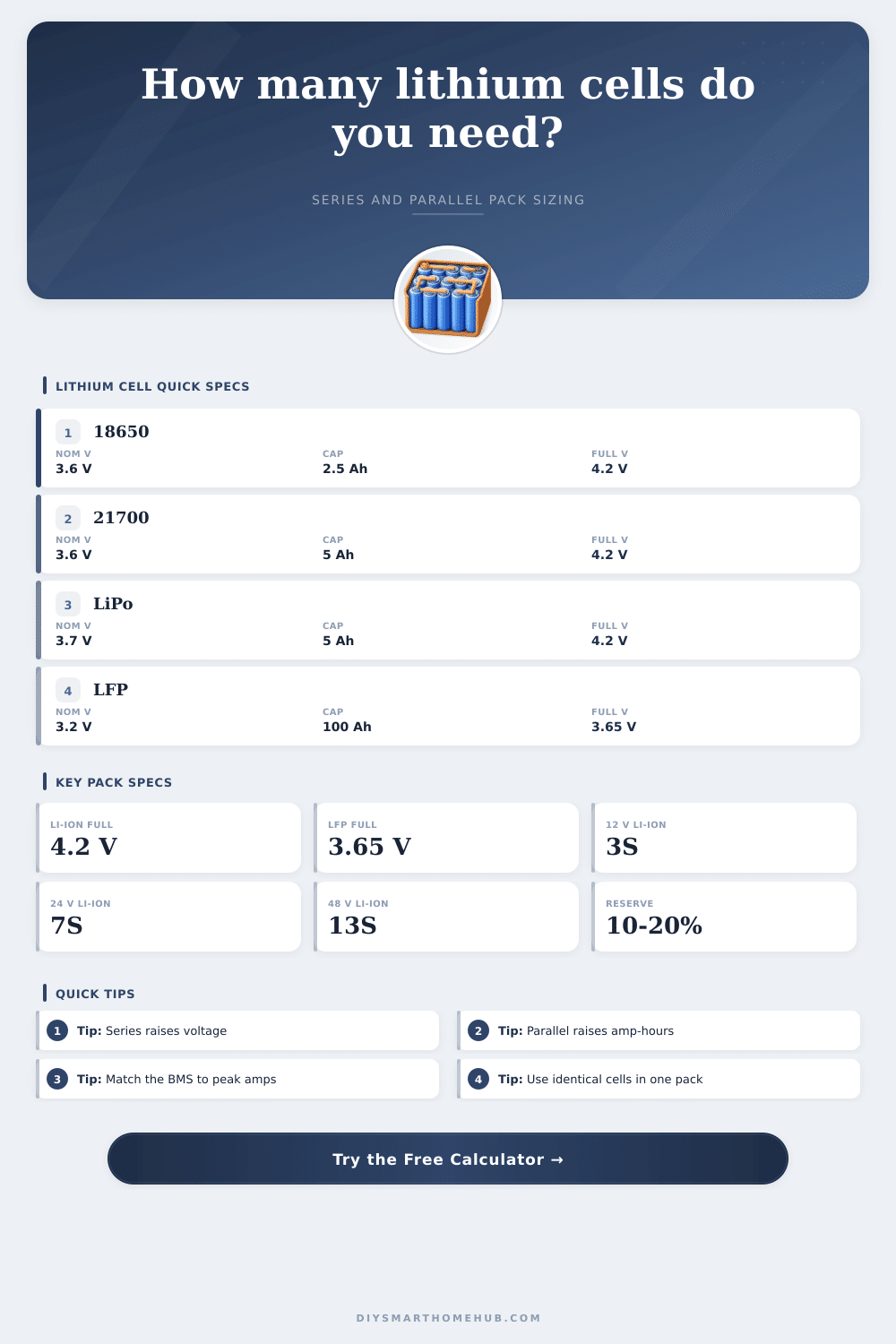
Lithium Ion Battery Series Parallel Calculator
Build a lithium battery pack estimate from real cell voltage, cell capacity, discharge current, target voltage, usable energy, reserve, and load current requirements.
| Cell format | Nominal voltage | Full charge | Low cutoff | Typical capacity | Typical continuous amps |
|---|---|---|---|---|---|
| 18650 NMC energy cell | 3.6 V | 4.20 V | 2.50 to 3.00 V | 2.5 Ah | 5 A |
| 18650 NCA high-capacity cell | 3.6 V | 4.20 V | 2.50 to 3.00 V | 3.5 Ah | 8 A |
| 21700 NMC high-capacity cell | 3.6 V | 4.20 V | 2.50 to 3.00 V | 5.0 Ah | 10 A |
| 21700 NMC power cell | 3.6 V | 4.20 V | 2.50 to 3.00 V | 4.0 Ah | 30 A |
| RC lithium polymer pouch | 3.7 V | 4.20 V | 3.00 V | 5.0 Ah | 25 A |
| 32700 LiFePO4 cylindrical cell | 3.2 V | 3.65 V | 2.50 V | 6.0 Ah | 18 A |
| Prismatic LiFePO4 storage cell | 3.2 V | 3.65 V | 2.50 V | 100 Ah | 100 A |
| Lithium titanate cell | 2.4 V | 2.80 V | 1.50 V | 40 Ah | 120 A |
| Pack class | Li-ion 3.6 V cells | LiPo 3.7 V cells | LiFePO4 3.2 V cells | LTO 2.4 V cells |
|---|---|---|---|---|
| 12 V class | 3S, 10.8 V nominal, 12.6 V full | 3S, 11.1 V nominal, 12.6 V full | 4S, 12.8 V nominal, 14.6 V full | 5S, 12.0 V nominal, 14.0 V full |
| 24 V class | 7S, 25.2 V nominal, 29.4 V full | 7S, 25.9 V nominal, 29.4 V full | 8S, 25.6 V nominal, 29.2 V full | 10S, 24.0 V nominal, 28.0 V full |
| 36 V class | 10S, 36.0 V nominal, 42.0 V full | 10S, 37.0 V nominal, 42.0 V full | 12S, 38.4 V nominal, 43.8 V full | 15S, 36.0 V nominal, 42.0 V full |
| 48 V class | 13S, 46.8 V nominal, 54.6 V full | 13S, 48.1 V nominal, 54.6 V full | 16S, 51.2 V nominal, 58.4 V full | 20S, 48.0 V nominal, 56.0 V full |
| 52 V class | 14S, 50.4 V nominal, 58.8 V full | 14S, 51.8 V nominal, 58.8 V full | 16S, 51.2 V nominal, 58.4 V full | 22S, 52.8 V nominal, 61.6 V full |
| 72 V class | 20S, 72.0 V nominal, 84.0 V full | 20S, 74.0 V nominal, 84.0 V full | 24S, 76.8 V nominal, 87.6 V full | 30S, 72.0 V nominal, 84.0 V full |
| Target use | Common layout | Energy range | Continuous load | Design note |
|---|---|---|---|---|
| USB power bank | 1S2P to 1S6P plus boost converter | 20 to 100 Wh | 10 to 60 W | USB output current is set by the converter, not cell voltage alone |
| Router or camera backup | 3S or 4S lithium pack | 80 to 300 Wh | 20 to 150 W | Match charger and DC regulator to full-charge voltage |
| Power-tool pack | 5S lithium-ion | 70 to 180 Wh | 300 to 900 W | Power cells need low resistance and a high-current BMS |
| E-bike 36 V pack | 10S4P to 10S8P | 350 to 900 Wh | 500 to 1,200 W | Parallel count is usually driven by current as much as range |
| E-bike 48 V pack | 13S4P to 13S10P | 500 to 1,500 Wh | 750 to 2,000 W | Controller amp limit must stay below pack and BMS ratings |
| Server or solar UPS | 16S LiFePO4 or 13S lithium-ion | 1,000 to 5,000 Wh | 500 to 3,000 W | Use equipment rated for the pack full voltage, not only nominal voltage |
| Pack architecture | What changes | Formula | Resulting effect |
|---|---|---|---|
| More cells in series | Voltage rises | Pack V = cell V x S | Lower current for the same watts, higher charger voltage required |
| More cells in parallel | Amp-hours rise | Pack Ah = cell Ah x P | Longer runtime and higher current capacity |
| More total cells | Watt-hours rise | Wh = nominal V x Ah | More stored energy and more BMS balance channels or groups |
| Higher DoD setting | Usable Wh rises | Usable Wh = Wh x DoD | Longer runtime with less cycle-life margin |
| Higher BMS headroom | Rated amps rise | BMS A = load A x margin | Less nuisance cutoff under surge or warm conditions |
Energy Cells
High-capacity 18650 and 21700 cells give more watt-hours per cell, but their continuous amp rating may require extra parallel groups for high-load packs.
Power Cells
Power-oriented lithium-ion cells trade some capacity for lower voltage sag and higher current. They fit tools, scooters, and motor controllers better.
LiFePO4 Storage
LiFePO4 uses 3.2 V nominal cells, so series counts differ from 3.6 V lithium-ion. It is common in 12 V, 24 V, and 48 V storage systems.
In order to create a battery pack from individual lithium cells, those cells must be arranged into a specific configuration. Each lithium cell is the basic building block of a battery pack. However, the voltage and the capacity of a single lithium cell are typicaly not enough to power the device that are desired.
In order to increase the voltage of the battery cells, you can arrange the cells in series configurations. In order to increase the capacity of the battery cells, those cells can be arranged in parallel configurations. If the cells are not arranged correct within the battery pack, the battery may provide too much voltage to the devices, which could lead to damaging those devices, or it may provide too little capacity to the device, which would prevent the device from being powered for sufficient period of time.
How Series and Parallel Cells Change Battery Voltage and Capacity
When you arrange the cells in series configurations, the total voltage of the battery pack increase. For instance, if each lithium cell has a voltage of 3.6 volts, using ten of those cells in series will create a battery pack with a total voltage of 36 volts. The voltages of each individual cell within the series configuration are simply added together to create the total voltage of the battery pack.
However, the voltage of the battery pack does not increase if the cells are arranged in series configurations. The capacity of the battery pack will be the same than the capacity of each individual lithium cell. When the cells are arranged in a parallel configuration, the total capacity of the battery pack increase, but the total voltage of the battery pack remains the same.
If series configurations containing the same cells are placed in parallel with each other, the total capacity will increase. For instance, if a battery pack has ten lithium cells in series, and five of those series configurations are placed in parallel with each other, the capacity of the battery pack will be five times that of a single series configuration. The increase in capacity allows for the battery pack to provide more energy to the devices, and increases the amount of current that the device can receive without placing excessive stress upon the cells of the battery pack.
Most battery packs will use an S and P configuration, meaning that the battery pack will use both series and parallel configurations to achieve the required voltage and capacity of the battery pack. When designing a battery pack, you must account for the difference between the nominal voltage and the full voltage of a lithium cell. The nominal voltage of a lithium cell is around 3.6 volts, but the full charge voltage can reach 4.2 volts.
If you design a battery pack using only the nominal voltage, the voltage of the battery pack may be too high for the device that the battery pack is to be powered by. In addition to considering the voltage of the battery pack, you must also consider the usable energy of the battery pack. Lithium batteries cannot be discharged to 0% of their charge; instead, a depth of discharge limit is establish to keep the cells healthy.
This means that the usable energy of the battery is less than the total energy that can be provided by the lithium cells. In addition to considering the voltage and usable energy of the battery, you must also consider the current limitations of the lithium cells. Each lithium cell has a maximum continuous discharge rating.
If too much current is drawn from the battery pack, each cell will heat up. To prevent the cells from overheating, more parallel group of batteries can be added to the battery pack. By increasing the number of paths for the current to travel, the stress on the individual cells is reduced.
Finally, each battery pack must also include a Battery Management System (BMS). The BMS monitors the voltage of each series group to ensure that no individual lithium cell exceed its maximum voltage or goes below its minimum voltage. You must select the BMS to ensure that it can handle the peak current draw of the device that is to be powered by the battery pack.
If the BMS is too small for the current draw of the device, the BMS may shut off the power to the device when the device reaches peak levels of current draw. Thus, understanding how series and parallel configurations impact battery voltage and capacity, respectively, allows for the creation of a battery pack that meets the requirements of the device that utilizes such a battery pack.