Lead Acid Battery Charging Time Calculator
Estimate lead acid charge time using battery capacity, charger current, state of charge, chemistry, temperature, age, and the slower absorption stage.
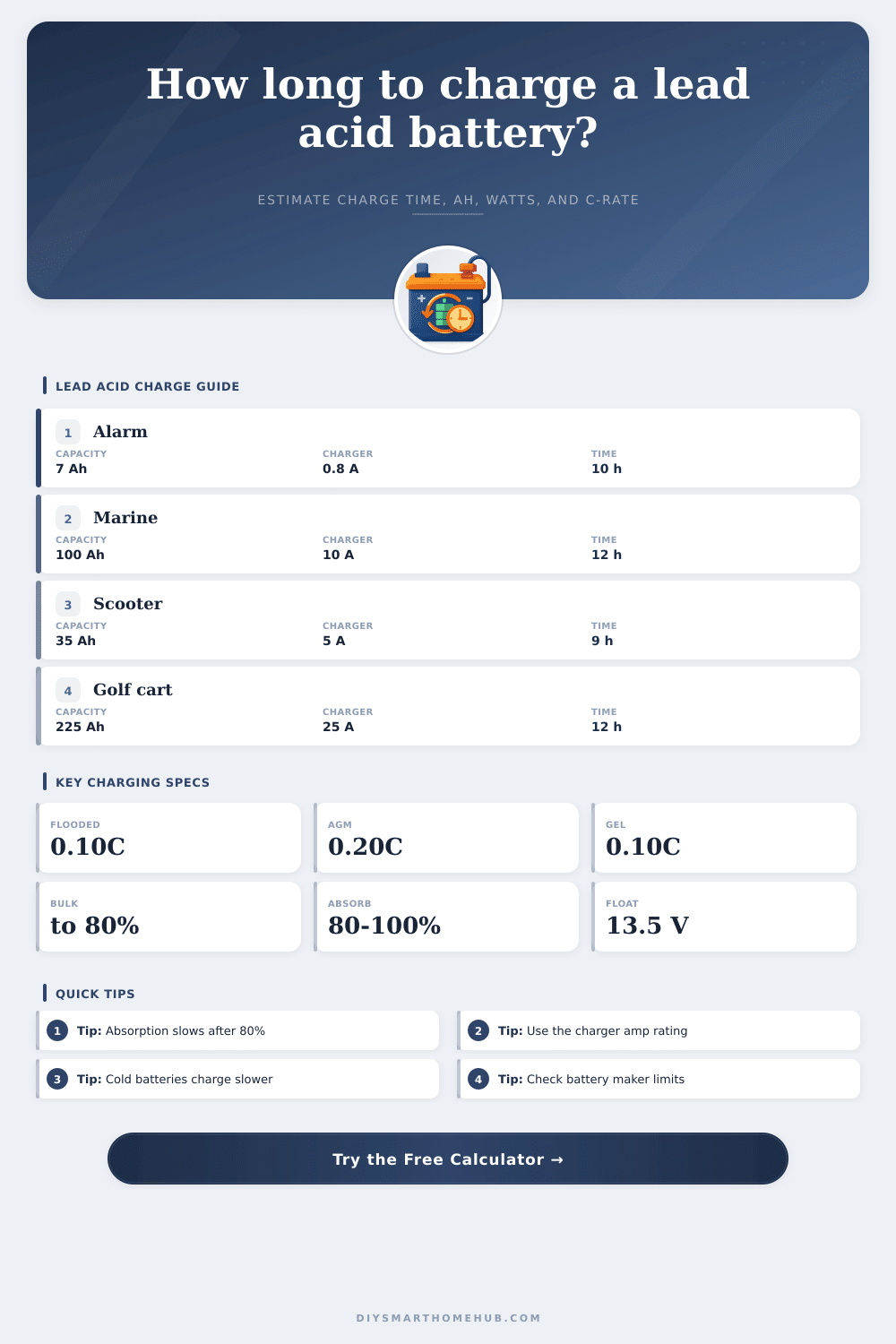
🔋 Real Lead Acid Battery Presets
⚙ Battery And Charger Inputs
This calculator estimates charge time from practical lead acid behavior. Final charging should always follow the battery and charger manufacturer's voltage, current, ventilation, and temperature limits.
📊 Lead Acid Spec Grid
⚡ Charging Voltage Reference
| Battery type | 12V absorption range | 12V float range | Charge behavior |
|---|---|---|---|
| Flooded deep-cycle | 14.4-14.8 V | 13.2-13.5 V | Good capacity recovery, needs ventilation during high-rate charging. |
| AGM sealed | 14.4-14.7 V | 13.5-13.8 V | Accepts higher current than many flooded batteries when specified. |
| Gel sealed | 14.0-14.3 V | 13.5-13.8 V | Lower voltage limit; over-voltage can damage gel electrolyte paths. |
| Small SLA standby | 14.4-15.0 V cyclic | 13.5-13.8 V | Often charged slowly in alarm, access control, and UPS standby systems. |
🧮 Recommended Current Range
| Battery type | Conservative rate | Typical max | Example on 100Ah |
|---|---|---|---|
| Flooded deep-cycle | 0.05C | 0.10C-0.15C | 5-15 A |
| AGM deep-cycle | 0.10C | 0.20C-0.30C | 10-30 A |
| Gel deep-cycle | 0.05C | 0.10C-0.15C | 5-15 A |
| Starter battery | 0.05C | 0.10C | 5-10 A |
| Traction / golf cart | 0.10C | 0.15C-0.20C | 10-20 A |
📈 Rested 12V Lead Acid SOC Guide
| Rested voltage | Approx SOC | Charge stage | Calculator use |
|---|---|---|---|
| 12.7-12.8 V | 100% | Full / float ready | Use as target for full recharge. |
| 12.4-12.5 V | 75% | Late bulk | Expect some absorption delay. |
| 12.1-12.2 V | 50% | Bulk charging | Common deep-cycle recharge point. |
| 11.8-11.9 V | 25% | Deep discharge | Charge promptly to reduce sulfation risk. |
| 11.6 V or less | 0-10% | Very depleted | May charge slowly or need charger recovery mode. |
📋 Common Battery Charging Examples
| Battery setup | Usual capacity | Common charger | Notes for time estimate |
|---|---|---|---|
| Alarm or access panel SLA | 7-18 Ah | 0.5-2 A | Small standby chargers are intentionally slow. |
| Motorcycle or mower battery | 12-30 Ah | 1-4 A | Lower amps reduce heat in compact cases. |
| Marine deep-cycle battery | 75-125 Ah | 10-20 A | Full charge usually takes longer than Ah/current math. |
| Golf cart battery bank | 170-260 Ah | 20-40 A | Absorption time is significant near 100% SOC. |
| Off-grid flooded bank | 200-800 Ah | 20-100 A | Temperature and age can dominate final charging time. |
💡 Charging Tips
Lead acid batteries does not charge in a linear fashion. Additionally, lead acid battery dont behave in the same way as if one was simply adding water to a container. A lead acid battery may show the charge time as the battery capacity divided by an amperage of the charger; however, the chemistry of the lead acid battery shows that the charge time calculations is incorrect due to the concept of diminishing returns for charging.
Lead acid batteries initially accept the charge at a high rate when charging (bulk stage). However, as the lead acid battery fill with the electrical charge, the lead acid battery creates internal resistance against the charging process, slowing the lead acid batterys rate of charging (absorption taper). As a result, the lead acid battery takes the same amount of time to charge the last 20% of its battery as it does to charge the first 80% of the batterys capacity.
How Lead Acid Batteries Charge and Why Charging Slows Down
A person must consider the type of lead acid battery that are being used. For instance, flooded lead acid batteries must be able to vent the gases that the lead acid battery releases while charging. Absorbent Glass Mat (AGM) batteries allow for a higher rate of charging than other type of lead acid batteries.
Finally, gel lead acid batteries are another type of lead acid battery, but they are sensitive to the voltage that is provide to them. If the voltage is too high, the lead acid battery may being damaged. The C-rate for lead acid batteries is the rate at which the battery is being charged in relation to the total capacity of the battery.
For instance, a C-rate of 0.1 indicate that the battery is being charged at a rate of 10% of the total Amp-hour rate of the battery. If an individual attempt to use a high amperage charger to provide more current at a higher C-rate, the battery will become heated. Excess heat can significantly reduce the lifespan of the lead acid battery.
Therefore, charging the battery at a slower rate help preserve the battery hardware. Cold lead acid batteries will take longer to charge than warm lead acid batteries. Additionally, the age of the lead acid battery may also impact the batterys ability to accept a charge.
Lead acid batteries that are old may develop the process of sulfation that reduce the batterys ability to fully accept the current that the charger provides to it. For instance, a charger that provide a 20 amp charge may only allow for an old or cold lead acid battery to accept a 5 amp charge. The state of charge of the lead acid battery can be estimated by measuring the rested voltage of the battery.
If an individual know the state of the lead acid battery at which it started charging, they can better understand the length of time that it will take to fully charge the lead acid battery. For instance, if the lead acid battery start at a 50% rate of charge, it has passed part of the bulk stage in charging, but it still must complete the absorption stage to reach the float stage. The float stage is when the charger gives the battery the minimal amount of current to maintain the charge in the battery without overcharge the battery.
If the lead acid battery is allowed to sit in the absorption stage for long periods of time, the battery may lose water due to gassing. If the lead acid battery is not allowed to reach the float stage, the battery will remain in a partially discharged state. A battery that remains in a partially discharged state will experience sulfation more quick than one that has a higher state of charge.
Although the chemistry of the lead acid battery indicate the estimated time for charging the battery, there are a few variables in the real world that may impact the actual charge time for the battery. For instance, the thickness of the cables for the lead acid battery, the amount of corrosion of the battery connectors, and the efficiency of the charger can impact the charge time. However, the fact that the charge time will be longer than the estimated time based off the chemistry of the lead acid battery allow an individual to better understand what to expect in relation to the battery charging process.
Thus, understanding the charging process of a lead acid battery will ensure that the battery is use for as long as possible.