Hot Water Boiler Size Calculator
Estimate hydronic hot-water boiler output from design heat loss, then check boiler input, supply-return delta-T, loop GPM, expansion tank hint, buffer volume, and zone load split.
🏠Hydronic Hot-Water Presets
Choose a common hydronic heating layout, then tune the envelope, supply and return water temperatures, boiler efficiency, water volume, and zone split.
📏Boiler Sizing Inputs
⚙Hot Water Boiler Spec Grid
Approximation for pounds per gallon, minutes per hour, and water heat capacity in BTU/hr flow math.
Radiant floors often use tighter splits, while baseboard and hydro-air loops may use wider splits.
Enough to round to a boiler size without replacing a real heat-loss calculation with guesswork.
A small calculated buffer need is still shown as a practical minimum planning volume for micro-zones.
📊Reference Tables
Hydronic flow by output and delta-T
| Boiler output | 15 F delta-T | 20 F delta-T | 30 F delta-T |
|---|---|---|---|
| 30,000 BTU/hr | 4.0 GPM | 3.0 GPM | 2.0 GPM |
| 50,000 BTU/hr | 6.7 GPM | 5.0 GPM | 3.3 GPM |
| 75,000 BTU/hr | 10.0 GPM | 7.5 GPM | 5.0 GPM |
| 100,000 BTU/hr | 13.3 GPM | 10.0 GPM | 6.7 GPM |
| 125,000 BTU/hr | 16.7 GPM | 12.5 GPM | 8.3 GPM |
Emitter temperature planning
| Emitter | Supply range | Return range | Boiler note |
|---|---|---|---|
| Radiant slab | 90-120 F | 80-105 F | Low output density and high efficiency potential |
| Panel radiators | 120-150 F | 100-130 F | Often pairs well with outdoor reset |
| Cast radiators | 130-160 F | 110-140 F | Water volume helps reduce cycling |
| Fin-tube baseboard | 160-180 F | 140-160 F | Capacity drops quickly at lower water temperatures |
| Hydro-air coil | 170-190 F | 140-165 F | Check coil rating, airflow, and pump flow |
Boiler output and input examples
| Net output | 80% efficiency | 86% efficiency | 95% efficiency |
|---|---|---|---|
| 40,000 BTU/hr | 50,000 input | 46,500 input | 42,100 input |
| 60,000 BTU/hr | 75,000 input | 69,800 input | 63,200 input |
| 80,000 BTU/hr | 100,000 input | 93,000 input | 84,200 input |
| 100,000 BTU/hr | 125,000 input | 116,300 input | 105,300 input |
| 125,000 BTU/hr | 156,300 input | 145,300 input | 131,600 input |
Common hot-water boiler scenarios
| Scenario | Area | Design load | Planning check |
|---|---|---|---|
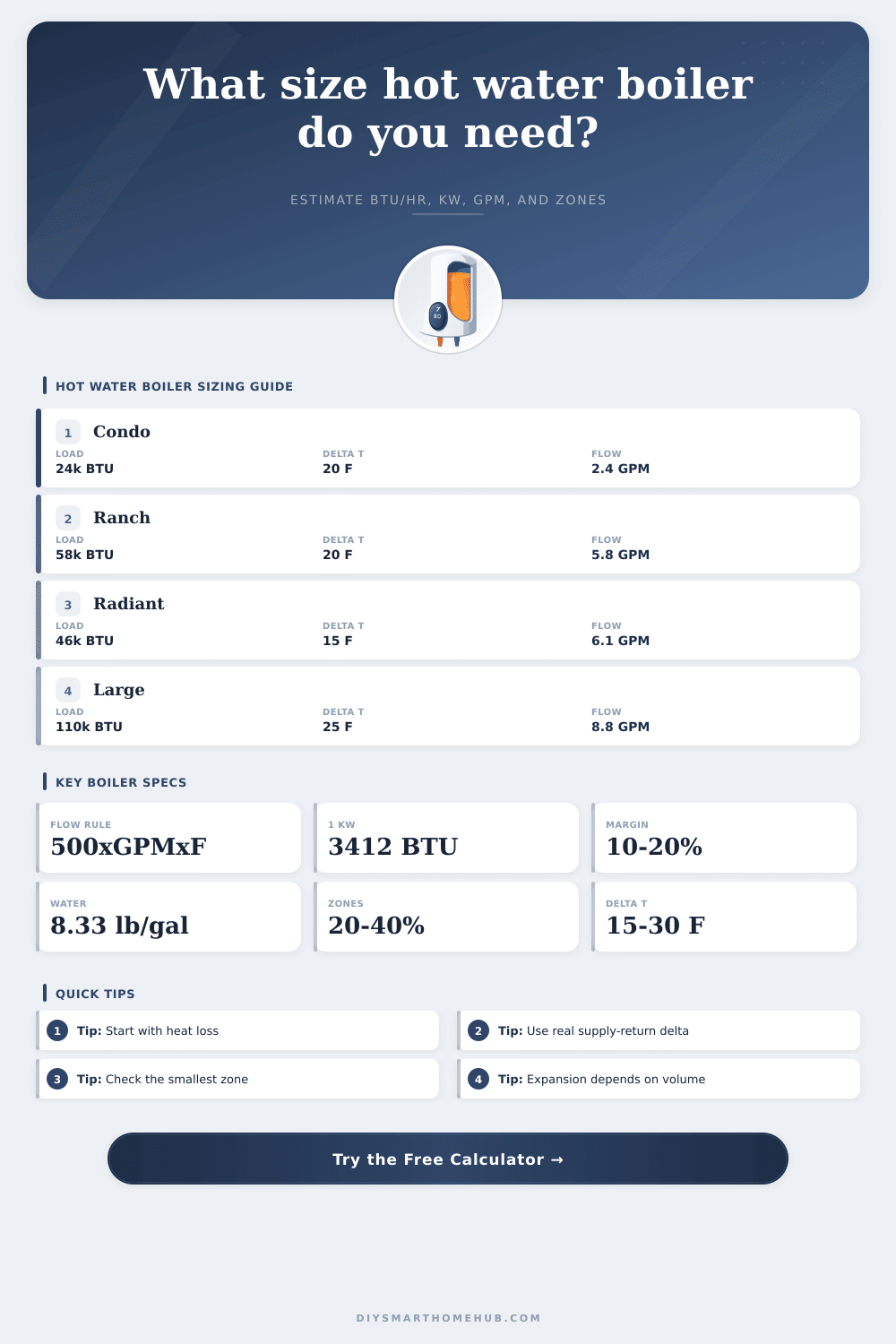
| Condo panel radiators | 900 sq ft / 84 sq m | 20k to 30k BTU/hr | Minimum firing rate and small zones |
| Average ranch fin-tube | 1,850 sq ft / 172 sq m | 52k to 70k BTU/hr | Baseboard output at design water temp |
| Radiant slab house | 2,100 sq ft / 195 sq m | 38k to 58k BTU/hr | Low water temperature and narrow delta-T |
| Large two-story mixed zones | 3,000 sq ft / 279 sq m | 90k to 125k BTU/hr | Zone split and pump flow balance |
💡Hot-Water Boiler Sizing Tips
The old boiler input is often larger than the home now needs. This calculator sizes the new hot-water boiler from estimated heat loss, then converts required output into boiler input using the selected efficiency.
For hydronic heating, GPM changes directly with the supply-return temperature drop. A narrow delta-T needs more flow, while a wider delta-T lowers flow but can change emitter output and comfort.
Selecting the correct sizes for an hot water boiler is a necesary step in the installation of a boiler for a home. The size of the hot water boiler determine how much heat the hot water boiler can produce for a homes. If the hot water boiler are too small for the home, the hot water boiler will not be able to produce enough heat to adequately warm the home on cold day.
If, however, the hot water boiler is too large for the home, the hot water boiler will continually turn on and off to compensate for the temperature within the home; this process of continually turning on and off is referred to as short cycling. If a hot water boiler short cycles, that boiler waste fuel; additionally, short cycling can cause the radiators and water pipes within the home to make noisily. Although a hot water boiler does not heat the air within a home directly, a hot water boiler heats the water that is circulated through the emitters that warm the rooms within the home.
How to Size a Hot Water Boiler
Therefore, the size of a hot water boiler must take into account the amount of heat that the home lose, the way that the emitters release heat, and the way that the water move through the system. Homes with old windows and old forms of home insulation will lose more heat then homes with new windows and new forms of home insulation. Thus, homes that lose more heat than others requires more heat to warm those homes to the desired temperatures, and, therefore, require larger hot water boiler.
The supply and return temperatures of the water that is circulated through a home’s radiators also play a role in the required size of the hot water boiler. Homes with radiant floor heating systems use water at lower temperatures than homes with baseboard heater or hydro-air coils. Additionally, because the temperature difference between the supply and return water is smaller within floor systems than other forms of heating systems, the flow rate of the water must be higher within floor heating systems to transfer the same amount of heat to the floor as other forms of heating systems use.
Thus, these profiles can be changed within the calculator to reflect how the required flow rate and hot water boiler output changes according to the type of emitter use within a home. Another factor that you should consider within calculating the size of a hot water boiler is the efficiency of the hot water boiler. Hot water boilers of 86% efficiency will produce more heat than boilers that are only 78% efficient.
Thus, you will purchase fuel according to the energy input of the boiler, but the energy output of the boiler will be used to heat the home. Additionally, a margin should be included within the calculations to provide for the cold weather months. If the margin is not included, the hot water boiler may be sized to its maximum output for the coldest months of winter; however, if too much margin are provided, short cycling may occur.
Another factor that you should consider is zone balance. Some zones within a home may lose more heat than other zones within the same home. Thus, the installer must set the minimum firing rate of the hot water boiler to meet the heat requirement of the zone that requires the largest amount of heat; if the boiler is set to meet the need of that zone, the requirements of the other, smaller zone may be underheated.
In such a case, the installation of a buffer tank will allow for heat loss in the smaller zones without overheating those zone. The total volume of water contained within the system should also be considered. Different type of emitters hold different amounts of water.
For instance, cast iron radiators contains more water than thin panel units. Additionally, the installer must also consider the expansion volume of the water within the system; water expands when the temperature of the water increase. The calculator can estimate the expansion volume of the system; the calculator can use the total volume of water that circulates through the home and the type of emitters to calculate the expansion volume.
Overall, providing heat at a steady rate without short cycling is the goal for heating system. If the output of a hot water boiler matches the heat loss of a home, the boiler will efficiently provide heat to the home. If the output of the hot water boiler matches the heat loss of the home and the smallest zone within the home does not require heat output beyond the minimum firing rate of the hot water boiler, the system will provide steady heat to the home.