Boiler Stove Size Calculator
Estimate a wood or solid-fuel boiler stove from room heat demand, radiator circuit load, water-jacket split, thermal store allowance, safety margin, and likely fuel reload interval.
🔥Boiler Stove Presets
Load a real boiler-stove scenario, then tune the room volume, radiator load, water-jacket ratio, buffer volume, fuel type, and safety margin for the actual heating circuit.
📏Boiler Stove Inputs
These outputs are planning estimates for comparing boiler-stove sizes. Confirm final appliance selection, venting, relief valve, gravity heat-leak circuit, and thermal store requirements with the stove maker and local code.
🧱Stove and Water-Jacket Spec Comparison Grid
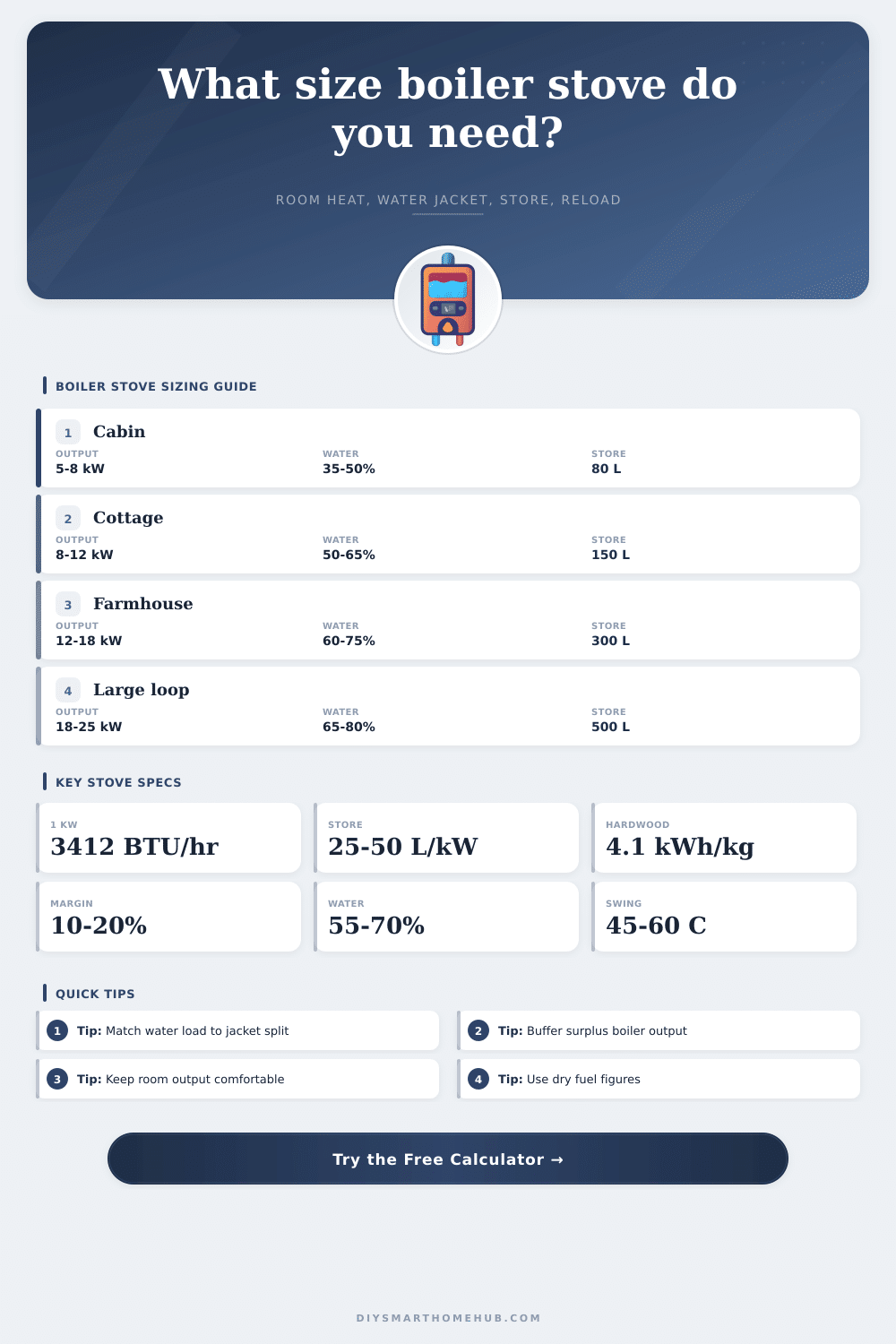
Best for small cabins, narrowboats, or one to three radiators where room overheating is the main limit.
Common cottage range with direct room heat and a moderate radiator circuit or towel rail group.
Works with larger radiator loops when the water split is high and a real thermal store is fitted.
For large hydronic loads, high buffer volume, and rooms that can tolerate lower direct output.
⚙Water-Jacket Output Patterns
Room-biased
- Water share30-40%
- Room share60-70%
- Best use1-3 rads
- Store needLow
Balanced
- Water share45-55%
- Room share45-55%
- Best useCottages
- Store needMedium
Water-biased
- Water share60-75%
- Room share25-40%
- Best useMany rads
- Store needHigh
Range boiler
- Water share35-65%
- Room shareMixed
- Best useDHW coil
- Store needVaries
📊Reference Tables
Room Heat-Demand Factors
| Room condition | BTU/hr per ft³ | Approx W/m³ | Use when |
|---|---|---|---|
| Very good | 2.5 | 27 | Modern insulated room with tight glazing |
| Good | 3.5 | 38 | Upgraded cottage or average modern room |
| Average | 5.0 | 54 | Mixed insulation and normal infiltration |
| Poor | 7.0 | 75 | Solid walls, drafts, or high exposure |
| Glazed/exposed | 9.0 | 97 | Conservatory, large glass, or cold corners |
Thermal Store Allowance
| Application | Liters per water kW | Typical swing | Reason |
|---|---|---|---|
| Small back boiler | 20-30 L/kW | 40-50°C | Short burns and low overshoot |
| Balanced cottage stove | 30-40 L/kW | 45-60°C | Radiator load varies through the burn |
| Batch-fired boiler stove | 40-55 L/kW | 50-65°C | Captures surplus water output safely |
| High-output jacket | 50-70 L/kW | 55-70°C | Large fuel loads and high water share |
Radiator Circuit Load Guide
| Circuit served | Typical useful load | Metric equivalent | Boiler-stove note |
|---|---|---|---|
| One towel rail plus small rad | 4,000-7,000 BTU/hr | 1.2-2.1 kW | Often fits a compact jacket stove |
| Three to five cottage radiators | 12,000-22,000 BTU/hr | 3.5-6.4 kW | Needs balanced output and heat leak protection |
| Six to nine mixed radiators | 24,000-38,000 BTU/hr | 7.0-11.1 kW | Usually favors 60% or greater water output |
| Ground-floor hydronic zone | 35,000-55,000 BTU/hr | 10.3-16.1 kW | Thermal store sizing becomes critical |
| DHW cylinder coil assist | 8,000-18,000 BTU/hr | 2.3-5.3 kW | Add only when simultaneous recovery is expected |
Fuel Reload and Heat Energy
| Fuel basis | Energy value | Useful at 75% | Planning note |
|---|---|---|---|
| Seasoned hardwood | 4.1 kWh/kg | 3.1 kWh/kg | Stable reference for most log stoves |
| Seasoned softwood | 4.4 kWh/kg | 3.3 kWh/kg | Often burns faster at the same air setting |
| Wood briquette | 4.8 kWh/kg | 3.6 kWh/kg | Dense reloads can raise water-side overshoot |
| Mixed logs | 3.6 kWh/kg | 2.7 kWh/kg | Use when moisture or species are uncertain |
| Anthracite fuel | 8.0 kWh/kg | 6.0 kWh/kg | Only for appliances approved for this fuel |
✅Boiler Stove Sizing Tips
A high total kW stove can still be wrong if too much output enters the room. If the room output card is much higher than room heat demand, choose a higher water-jacket split, a smaller appliance, or a larger thermal store strategy.
Solid-fuel boiler stoves can continue releasing heat after controls close. Confirm thermal store volume, heat-leak radiator, open-vent or sealed-system kit, relief valve, and pump-overrun details with the appliance instructions.
When choosing an boiler stove, you must consider how the boiler stove distribute its heat to the different areas of the home. A boiler stove must be able to provide heat to the room in which it is installed, but the boiler stove also must provide heat to the water system within the home. Thus, a boiler stove must find a balance between providing heat to the room yet providing enough heat to the water system to prevent the boiler stove from losing all of its energy too quick.
In the calculator, an arithmetic method can be used to determine the size of the boiler stove that is required to supply these various area of the home with heat. Determining the heat demand of the room is the first calculation that must be performed. The size of the room, the height of the ceilings within the home, and the insulation profile of the home determine the heat demand of the room.
How to Choose the Right Boiler Stove Size
For instance, moddern homes often have ceilings and walls with high levels of insulation, while cottages and older homes may have solid materials with single glazing to windows that permit heat to leave the home. The design temperature lift that you enter into the calculator will be used to calculate how much the heat loss from the room will need to decrease to compensate for the coldest temperatures within the area in which the home are located. Based off these factors, the heat output that should go into the room can be determined.
Within that same calculation is the split between how much heat should go into the room versus how much heat should go into the water system. Most boiler stoves are manufactured with a specific amount of heat that is released into the room versus the amount of heat that should go into the boiler stove and water system. If the radiator within the home are expected to have high loads, the boiler stove will have to release more heat into the water system, which may indicate that the room will be less comfortable with the current settings of the boiler stove.
These values will be displayed within the calculator so that individuals can determine if the comfort of the room is likely to be satisfied with the parameters that is set within the calculator. Another factor to consider within the calculation of the required size of the boiler stove is the thermal store volume. When fuel is loaded into the boiler stove, it will continue to release heat even after the air controls within the boiler stove are closed.
This thermal store, which may be in the form of a buffer tank, will allow the system to absorb the surplus heat from the boiler stove so that the system can better handle scenarios in which the water heater within the house may stop or the house may cool quick. The calculator will output a minimum size for this thermal store based off the water output from the boiler stove and the overheat margin for the system. By comparing this output to the size of the thermal store that is planned for the boiler stove, the individual can ensure that there will be enough room for the thermal store to handle surplus heat from the system.
Finally, the fuel for the boiler stove and the reload interval for that fuel are two additional factor that must be considered. Dense hardwood fuel typically produce more heat over time than softwood fuel of the same mass, though only if it is dry. The efficiency of the fuel, as entered by the individual within the calculator will be used to convert the fuel mass to useful kilowatt hours.
By dividing the useful kilowatt hours by the output of the boiler stove, the calculator will output a burn time for the fuel that will help to avoid selecting a boiler stove that must be refueled too many times each day. Each of these factors an individual must consider to determine which is the best size for the boiler stove. Each of the three main outputs of the boiler stove can be compared to each other.
If the heat demand within the room is the main consideration, the boiler stove may become overheated on cold night. If the load for the water system within the home is greater than the demand for heat within the room, the system will be hotter to that water yet the room may not require as much heat. Using these calculation, an individual should always incorporate some safety margin into these measurements.
Many individuals purchase boiler stove that are too large for the individuals requirements for heat within the home. These boilers can overheat the rooms or the thermal store can become overstressed. In contrast, many individuals undersize their boiler stove if they later decide to install a radiator circuit system.
Thus, by using the calculator prior to installing the boiler stove, the individual can determine the tradeoff between the heat that should go into the room versus the water system. The correct size for the individuals home will be the smallest boiler stove that can handle both the heat demand of the room and the water system while allowing for a realistic thermal store volume and reload time for the fuel.