Home Energy Calculator
Estimate daily kWh, monthly electricity use, peak demand, and efficiency from home size, occupants, HVAC profile, appliances, and standby loads.
Home Energy Results
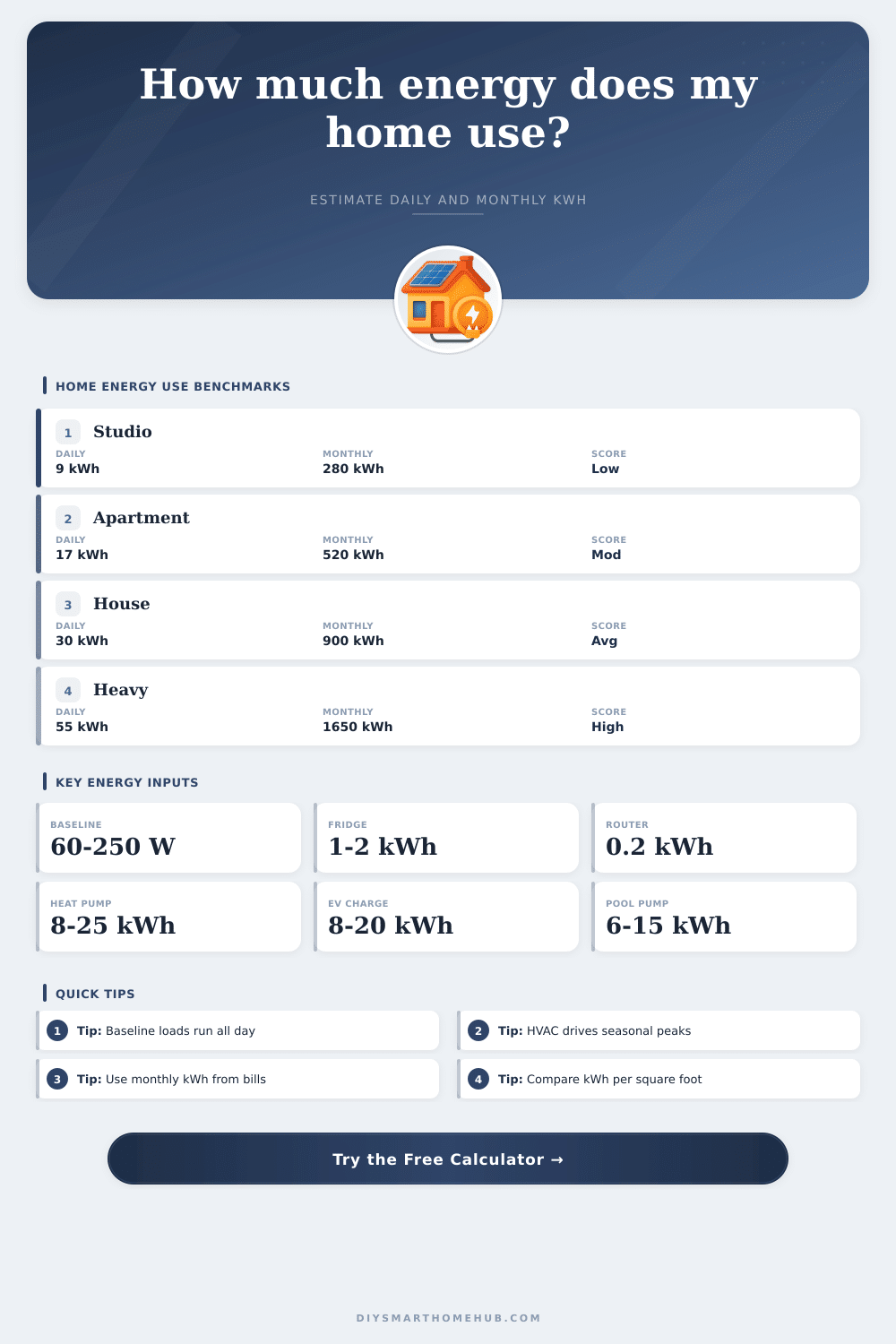
| Home profile | Typical daily kWh | Typical monthly kWh | kWh per sq ft monthly | Calculator meaning |
|---|---|---|---|---|
| Efficient studio or small apartment | 6-12 kWh | 180-360 kWh | 0.30-0.55 | Low HVAC load, compact area, modest plug loads |
| Apartment or townhouse | 12-25 kWh | 360-750 kWh | 0.45-0.85 | Typical mixed electric loads with shared walls |
| Average detached home | 25-40 kWh | 750-1200 kWh | 0.55-1.10 | Broader HVAC exposure and more appliances |
| All-electric or severe climate home | 40-70 kWh | 1200-2100 kWh | 0.85-1.60 | Heating, cooling, water heating, or charging dominate |
| High-load smart home | 55-90 kWh | 1650-2700 kWh | 1.10-2.00+ | Large area, pumps, EV charging, servers, or long HVAC runtime |
| Load category | Typical watts or kWh | Daily energy range | Peak demand effect | How calculator uses it |
|---|---|---|---|---|
| Always-on electronics | 60-250 W | 1.4-6.0 kWh | Low but continuous | Baseline watts multiplied by 24 hours |
| Plug loads and lighting | 150-900 W active | 1.0-10.8 kWh | Moderate | Active watts multiplied by occupied hours estimate |
| Refrigeration | 80-200 W average | 1.0-2.5 kWh | Short startup surge | Included in appliance profile and baseline context |
| Electric water heating | 3-5 kW element | 4-12 kWh | High when heating | Added by electric water heater profiles |
| Pool or spa pump | 500-1800 W | 5-15 kWh | Moderate to high | Added by pool pump profile |
| EV charging | 1.4-11.5 kW | 8-30 kWh | Can be very high | Added by EV appliance profiles |
| HVAC profile | Planning intensity | Typical runtime | Peak load factor | Best use in calculator |
|---|---|---|---|---|
| Minimal HVAC / temperate home | 0.002 kWh/sq ft/day | 0-3 h/day | 0.4 kW per 500 sq ft | Shoulder seasons and mild coastal climates |
| Mild climate with gas heat | 0.004 kWh/sq ft/day | 2-6 h/day | 0.6 kW per 500 sq ft | AC plus furnace blower electricity |
| Efficient mini-split heat pump | 0.0055 kWh/sq ft/day | 4-9 h/day | 0.7 kW per 500 sq ft | Zoned heat pump homes and additions |
| Central heat pump | 0.0065 kWh/sq ft/day | 5-12 h/day | 0.9 kW per 500 sq ft | Typical all-electric heating and cooling |
| Hot climate central AC | 0.0085 kWh/sq ft/day | 8-16 h/day | 1.1 kW per 500 sq ft | Long cooling seasons and high afternoon load |
| Electric resistance winter | 0.014 kWh/sq ft/day | 6-18 h/day | 1.8 kW per 500 sq ft | Baseboard, strip heat, or older electric furnaces |
| Scenario | Area | Occupants | Typical monthly kWh | Likely driver |
|---|---|---|---|---|
| Efficient studio | 450 sq ft / 42 m² | 1 | 200-350 kWh | Baseline electronics and compact cooling |
| Two-bedroom apartment | 900 sq ft / 84 m² | 2 | 450-750 kWh | Plug loads, laundry, and summer AC |
| Suburban family home | 1800 sq ft / 167 m² | 4 | 800-1300 kWh | HVAC, water heating, cooking, and laundry |
| Large all-electric home | 2600 sq ft / 242 m² | 4 | 1500-2400 kWh | Heating, cooling, water heating, and long runtime |
| EV commuter household | 2200 sq ft / 204 m² | 3 | 1300-2200 kWh | Vehicle charging plus ordinary home loads |
You look at your monthly utility bill and wonder where your electricity goes. However, it is difficult to track your electricity going into your appliances because electricity are invisible. You cant see how many kilowatt hour of electricity go into your appliances the same way you can see the amount of gas in your gas tank or the amount of water that passes through your water meter.
Therefore, electricity remains an invisible resource. Your utility bill will show you the total number of kilowatt hours that were used during the month and the total price that you paid for that electricity. However, the total kilowatt hour number and the total price on the bill will not show you the reason why your electricity bills is high for your household.
How Your Home Uses Electricity
In order to understand the reasons for your high electricity bill, you must understand your energy use in the home. Energy use in the home can be divided into two different types of load. The two types of loads are the baseline load and the active loads in your home.
The baseline load for your home is the amount of energy that your home use while you are sleeping or while you are away from the home. These appliances that use baseline loads include your internet router, your microwave clock, and your refrigerator. Your baseline load will never go away.
Therefore, your baseline load is the minimum amount of energy that your home will use each day. You will always have to pay for your baseline load because it is the energy that your home uses in order to remain a functioning home while you are sleeping or away. The active loads in your home are different than your baseline load.
Your active loads include energy use by lights in your home, your computers, and your laundry machines. The amount of active loads that live in your home will vary based on the number of people that lives in your home. If you have more people that live in your home, your active loads will be higher because there will be more hot water usage, and there will be more activity with the appliances in your home.
Another appliance that could lead to higher energy use in your home is your HVAC system. Your HVAC system will lead to higher energy use during the winter or summer months due to the amount of effort that the system must perform to heat and cool your home. If your home has poor insulation and old windows, the HVAC system will have to work harder in order to maintain the temperature in your home.
Thus, your HVAC system will use more kilowatt hours, leading to more higher energy costs for your household. Other appliances that could impact your energy use include your water heater. If you change from using a gas water heater to an electric water heater, your energy use will change.
Additionally, if you add an electric vehicle charger to your home, this will also change the way that you use energy in your home. The addition of an electric vehicle charger to your home will alter your energy use because electric vehicles requires a significant amount of power to charge the batteries in those vehicles. You must also understand the difference between the total kilowatt hours that are used in your home and the peak demand for energy.
Peak demand is the amount of power that your home uses in a single moment while total kilowatt hours measure the total amount of power that is used over a period of time. If you are using the dryer, the dishwasher, and the air conditioner at the same time, your peak demand will be high. Understanding your peak demand will help you to understand whether or not you should install solar panels or a battery backup system for your home.
In order to lower your electricity bill, you must identify the specific appliances that use the most energy in your home. Some people may try to replace the windows in their homes in order to lower their energy bill. However, it is possible that the electricity bill is high due to the baseline loads of old electronics in there home.
Additionally, changing the thermostat in your house may help to lower your electricity bill. If you change the thermostat to a temperature that allows your HVAC system to run for fewer hours each day, you will lower your kilowatt hours, leading to a lowering of your electricity bill. These benchmarks will provide you with an estimation of your energy use.
However, your specific home and the way in which you use your home will alter these results. The location of your home and the habits that you establish will change the energy that your home uses. For instance, you could use more fewer lights in your home, leading to a reduction in your baseline load.
Your goal is to go from guessing the energy use of your home to being able to estimate that number. By being able to determine if your home is an efficient home or a high load home, you will be able to use your utility bill as a set of data to manage the way in which you use electricity in your home.