Home Appliance Power Consumption Calculator
Estimate active energy, standby energy, monthly kWh, average load, and circuit current for common home appliances using rated watts and real use patterns.
Power Consumption Results
| Appliance | Typical active watts | Normal use pattern | Calculation note |
|---|---|---|---|
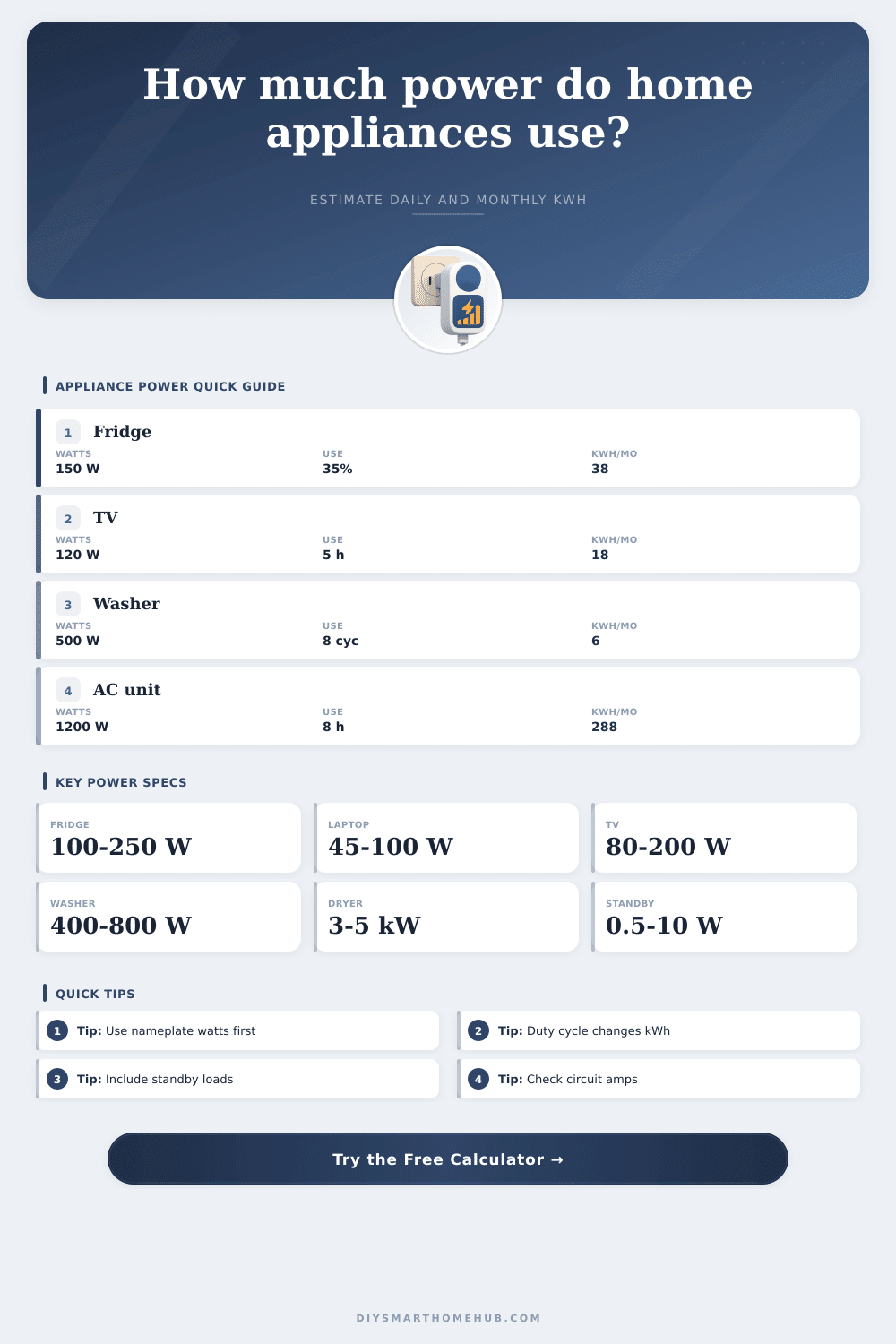
| Refrigerator | 100 to 250 W | Runs all day at 25% to 45% duty | Use compressor duty cycle |
| Chest freezer | 100 to 300 W | Runs all day at 20% to 40% duty | Room temperature changes load |
| LED television | 80 to 200 W | 2 to 8 active hours per day | Add standby if plugged in |
| Washing machine | 400 to 800 W | 0.5 to 1.5 hours per cycle | Motor and water heating vary |
| Electric dryer | 3000 to 5000 W | 0.5 to 1 hour per cycle | Use 240 V for current |
| Dishwasher | 900 to 1800 W | 1 to 2 hours per cycle | Heated dry raises watts |
| Window AC | 600 to 1500 W | Thermostat cycling for cooling | Duty cycle depends on weather |
| Network cabinet | 20 to 120 W | Always on at near constant load | Use 100% duty cycle |
| Load behavior | Example appliances | Typical duty cycle | When to adjust |
|---|---|---|---|
| Constant electronics | Router, hub, modem | 95% to 100% | Use 100% unless sleep mode is known |
| Thermostat compressor | Fridge, freezer, AC | 20% to 60% | Raise it in hot rooms or heavy use |
| Cycle appliance | Washer, dishwasher | 100% during cycle time | Enter only actual cycle hours |
| Intermittent motor | Sump pump, disposal | 5% to 25% | Estimate active minutes per day |
| Resistive heating | Kettle, heater, dryer | 60% to 100% | Use measured time when possible |
| Device state | Typical standby watts | Daily kWh at 24 h | Monthly kWh at 30 d |
|---|---|---|---|
| Modern TV standby | 0.5 to 3 W | 0.012 to 0.072 | 0.36 to 2.16 |
| Game console standby | 1 to 10 W | 0.024 to 0.240 | 0.72 to 7.20 |
| Microwave clock | 2 to 5 W | 0.048 to 0.120 | 1.44 to 3.60 |
| Smart speaker idle | 2 to 6 W | 0.048 to 0.144 | 1.44 to 4.32 |
| Router and modem | 10 to 25 W | 0.240 to 0.600 | 7.20 to 18.00 |
| Scenario | Entered watts and use | Estimated monthly kWh | Best input to refine |
|---|---|---|---|
| Kitchen refrigerator | 150 W, 24 h, 35% | 37.8 kWh | Duty cycle percent |
| Living room TV | 120 W, 5 h, 100% | 18.3 kWh | Active hours per day |
| Network cabinet | 65 W, 24 h, 100% | 51.5 kWh | Total plug watts |
| Window AC summer | 1200 W, 8 h, 55% | 174.2 kWh | Cooling duty cycle |
| Electric dryer | 4200 W, 0.75 h, 100% | 26.0 kWh | Loads per month |
Despite the fact that many person keep close observation of there electric bills, few understand how the bills is generated. Furthermore, many people feel that they are unable to make any changes to the amount of money that they pay for electricity. Appliances does not always simply use electricity in a binary way; some appliances actualy utilize power in ways other than simply being on or off.
For instance, appliances like refrigerators has to cycle on and off in order to maintain a proper temperature within the refrigerator, and televisions actually use some power even when there screens is black. In order to understand how appliances actually uses electricity, it is necessary to understand the difference between the rated power of those appliances compared to how much power those appliances actualy consume. The rated power of an appliance is the power that that appliance is rated to use when performing its most demanding task.
How Appliances Use Electricity
As such, appliances do not always use all of their available power. One way of understanding how often that appliance use its available power is through the concept of the appliance’s duty cycle. Appliances like refrigerators has specific wattage ratings.
However, the refrigerator only use its power when the temperature within the refrigerator rise. By using a calculator to estimate the power that appliances in a home use, it is possible to utilize the duty cycle input on the calculator. By entering the duty cycle of each appliance, it is possible to accurately calculate how much power each appliance use.
If an appliance is incorrectly entered as running constantly rather than enter its actual duty cycle, the power bill that the calculator calculates will be higher than the actual bill. Another concept of power consumption by appliances in a home is the concept of standby power, or what is also referred to as phantom load. Appliances like smart hubs, televisions that can be controlled from remote locations, and microwave clocks all use some of the electricity in the home even when those appliances isnt being actively used.
While the power used by each appliance is relatively low, the amount of power used by all of the appliances in the home that use standby power can be significant. By accounting for the standby hours and standby watts of the appliances in the home, it is possible to understand how much power those appliances use while the resident of the home are sleeping or away from the home. While the concept of kilowatt hours is one that is used in calculating the cost of electricity, there is another metric that is used in relation to the power that is used in a home: amperage.
While amperage is not a metric that can be used to calculate the cost of electricity for a home, that metric is used in ensuring the safety of the home that is being used. Kilowatt hours is a measurement of the total electricity used in a home, while amperage is a measurement of the amount of electrical current that is flowing through the appliances in the home. In order to determine how many amps the appliances in a home will draw, it is first necessary to provide the voltage of the circuits within the home.
For instance, an appliance like a high wattage dryer may be present on a 240 volt circuit, while another appliance may be on a 120 volt circuit. In this way, too many appliances that use a significant amount of amperage can be plugged into one extension cord may result in increased stress on the copper wires within the walls of the home. The increased stress on that copper in the walls may lead to the circuit breaker for those outlets trip.
In addition to these concepts, it is also beneficial to include a planning buffer within the calculations of the power that is used within the home. By including a planning buffer in the calculation of the power that will be used in a home, it is possible to allow for some variability in that estimate. For instance, the number of times that a dishwasher is used in a week may increase during the holidays when people cook more dinner for the holidays.
Additionally, the number of times that the refrigerator is opened may increase due to other reasons. By including a planning buffer, it is better for the estimate of the power consumption in the home to be higher than the actual bill for that home. Another tool that can be used in understanding the actual duty cycle of appliances in the home is the use of a smart plug.
A smart plug is a device that measures the number of kilowatt hours that a specific appliance use in a period of time. By measuring the number of kilowatt hours that each appliance uses, it is also possible to determine the actual duty cycle for each appliance. By determining the actual duty cycle for each appliance, it is possible to understand if new appliances need to be purchased for the home.
Furthermore, by understanding each appliances active loads and standby loads, it is also possible to understand where each resident’s money is going when they pay their electric bill to the power company.