Grow Tent Exhaust Fan Calculator
Estimate target exhaust CFM from tent volume, air exchange interval, light heat, carbon filter drag, duct layout, static pressure, and fan headroom.
Full Calculation Breakdown
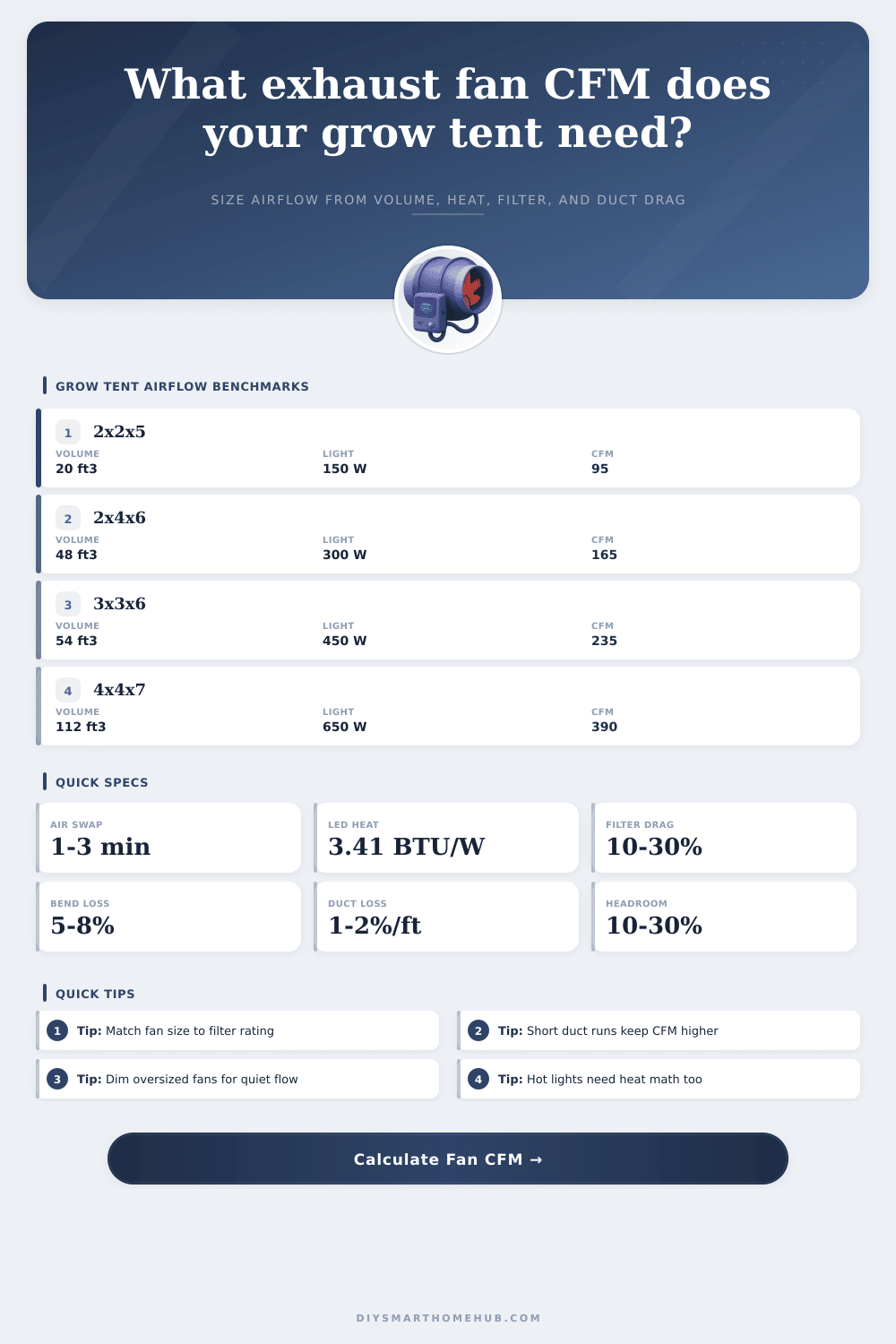
| Preset | Tent Volume | Light Heat | Typical Target |
|---|---|---|---|
| 2x2 seedling LED | 20 ft³ / 0.57 m³ | 150 W / 512 BTU/hr | 85-120 CFM with filter |
| 2x4 vegetative tent | 48 ft³ / 1.36 m³ | 300 W / 1,024 BTU/hr | 145-200 CFM with filter |
| 3x3 flower LED | 54 ft³ / 1.53 m³ | 450 W / 1,535 BTU/hr | 210-280 CFM with filter |
| 4x4 standard flower | 112 ft³ / 3.17 m³ | 650 W / 2,218 BTU/hr | 330-450 CFM with filter |
| 4x8 dual fixture | 224 ft³ / 6.34 m³ | 1,300 W / 4,436 BTU/hr | 650-950 CFM with filter |
| Restriction | Light | Standard | Heavy |
|---|---|---|---|
| Carbon filter | 8-12% | 18-25% | 28-35% |
| Flexible duct per ft | 0.8% | 1.2% | 1.8% |
| 90-degree bend | 4% | 6% | 8% |
| Small intake | 3% | 8% | 14% |
| Light Watts | BTU/hr | CFM at 5°F | CFM at 10°F |
|---|---|---|---|
| 150 W | 512 | 95 | 47 |
| 300 W | 1,024 | 190 | 95 |
| 650 W | 2,218 | 411 | 205 |
| 1,000 W | 3,412 | 632 | 316 |
| Fan Class | Nameplate Range | Best Matched Filter | Planning Note |
|---|---|---|---|
| 4 inch inline | 80-200 CFM | 4 inch filter rated at or above target | Small tents, short duct, low heat LEDs |
| 6 inch inline | 200-450 CFM | 6 inch filter rated at least 25% above delivered CFM | Most 2x4, 3x3, and modest 4x4 tents |
| 8 inch inline | 450-800 CFM | 8 inch deep bed filter with smooth reducer-free path | High heat 4x4, 5x5, or 4x8 tents |
| 10 inch inline | 800-1,200+ CFM | Large filter or paired filters to avoid choking flow | Multi-light tents and long exhaust paths |
Use the larger result between air exchange CFM and heat load CFM. Volume-only sizing can be too small when high-wattage lights are packed into a short tent.
Check the carbon filter airflow rating against the delivered CFM, not just the fan label. A filter that is too small becomes the real airflow limit.
The tent setup is perfect. The lights is highly efficient, the soil is clean, and the plants look happy on day one. But by week three, temperatures creep upward during afternoon heat. Your stems begin to soften under heavy weight of wet foliage. You pull out the thermostat and now you realize you’re no longer in a controlled environment but really a greenhouse.
It’s not usually a planning failure, it’s understanding the physics of airflow. Growers put all their attention into pulling cool air in, but fail to remember that hot stale air has to go somewhere. If you don’t have adequate exhaust capacity your tent becomes a pressure cooker, even if your inputs is great.
How to Keep Your Grow Tent Cool and Airy
With those figures input, the calculator (above) do the rest. No guesswork needed: either it’s heating up too fast or too much, or it isn’t; no need for guessing which one.
It’s tempting to think “bigger must be better,” when it comes to fans, but that reasoning fall apart quickly inside an enclosed space. A huge industrial fan will produce a wind tunnel in the canopy, damaging vulnerable flower sites by literally stripping oxygen from the environment faster than plants can consume it. You’re not looking for maximum fan speed; rather, precise control over air pressure. You need enough airflow to keep things cool, but not enough to blow your crops dry each hour under the lights.
The hidden variable in all of those calculations is typicaly heat load. Whatever watts your grow light consumes gets translated into thermal energy within the closed space. Old school HID fixtures generate more heat than LEDs, true, but even LEDs is pumping out substantial BTUs into a small volume. You’ll fail to account for that thermal contribution if you simply base your fan-sizing on tent size alone. You’ll likely wind up under-cooled when your plants is blooming most.
To compensate for that omission, the calculator factors in both basic air exchange needs and the additional cooling necessary to remove heat produced by your lighting. Then it selects the larger of the two numbers. And that makes a difference: A crowded flower room may always be thermally constrained while an empty seedling tent could possibly be volume-limited.
The other thing many forget about until it’s too late is duct work. There are restrictions where air doesn’t flow as freely. Carbon filters also reduce the amount of air being delivered to the room because they create air resistance. A standard carbon filter will reduce the amount of airflow actualy reaching the room by as much as twenty percent or more (depending on how full the media is). That loss is added to long runs of flexible ducting and sharp bends which add additional friction to the moving air. This is where you can have a fan rated at four hundred CFM on paper but in the real world it move only three hundred CFMs.
Understanding these losses means sizing your inline fan correctly based off nameplate ratings. For example, a four-inch model handles small seedling operations nicely, but chokes under larger loads. Six and eight inch fans serves most common grow areas assuming fairly straight duct runs. To see how your set up fits into the wider range of options, check reference table on the page which pairs fan diameters with typical tent configurations.
Just know that you can oversize a bit and still meet your airflow targets with quieter operation by running the fan at lower speeds. Having headroom also gives you room to dial in just enough breeze to maintain stable conditions. This prevents unnecessary stress on the fan and avoids noise from running at full blast.
Then there’s a wrinkle of added humidity control. Heavy canopy releases water into the environment, which, if not vented away with sufficient air flow, can result in excess humidity (mold hazard). Sure, the first focus is usually on temperature, but appropriate vapor pressure deficit depend on effective airflow.
If you have a narrow exhaust or intake path, it can’t help but fight its own backpressure. To counteract this, make sure your passive intakes remains wide open to bring fresh air in. Negative pressure can pull air inward and distort tent seams, which warps zipper teeth.
To sum things up: Respect the physics of how air works, because ultimately, you’re trying to create a proper habitat for your plants. You’re going against nature. And understanding that air is lazy and heavy will help you create a good climate. This climate will be more than just survivable; it will be thriving, unlike a grow tent that feels like a stifling box. To put it another way, balancing out the physical drag of your filtration system with the heat from your lights creates a space that allows your plants to grow instead of simply surviving. It doesn’t require you to become an HVAC engineer, but it does requires you to understand the physics at play. Once you find the right pressure and the right speed of moving air, your grow tent no longer feels like a stifling box. Instead it behaves like a proper habitat. That balance makes all the difference between a struggling setup versus it is a flourishing one.