Room Exhaust Fan Calculator
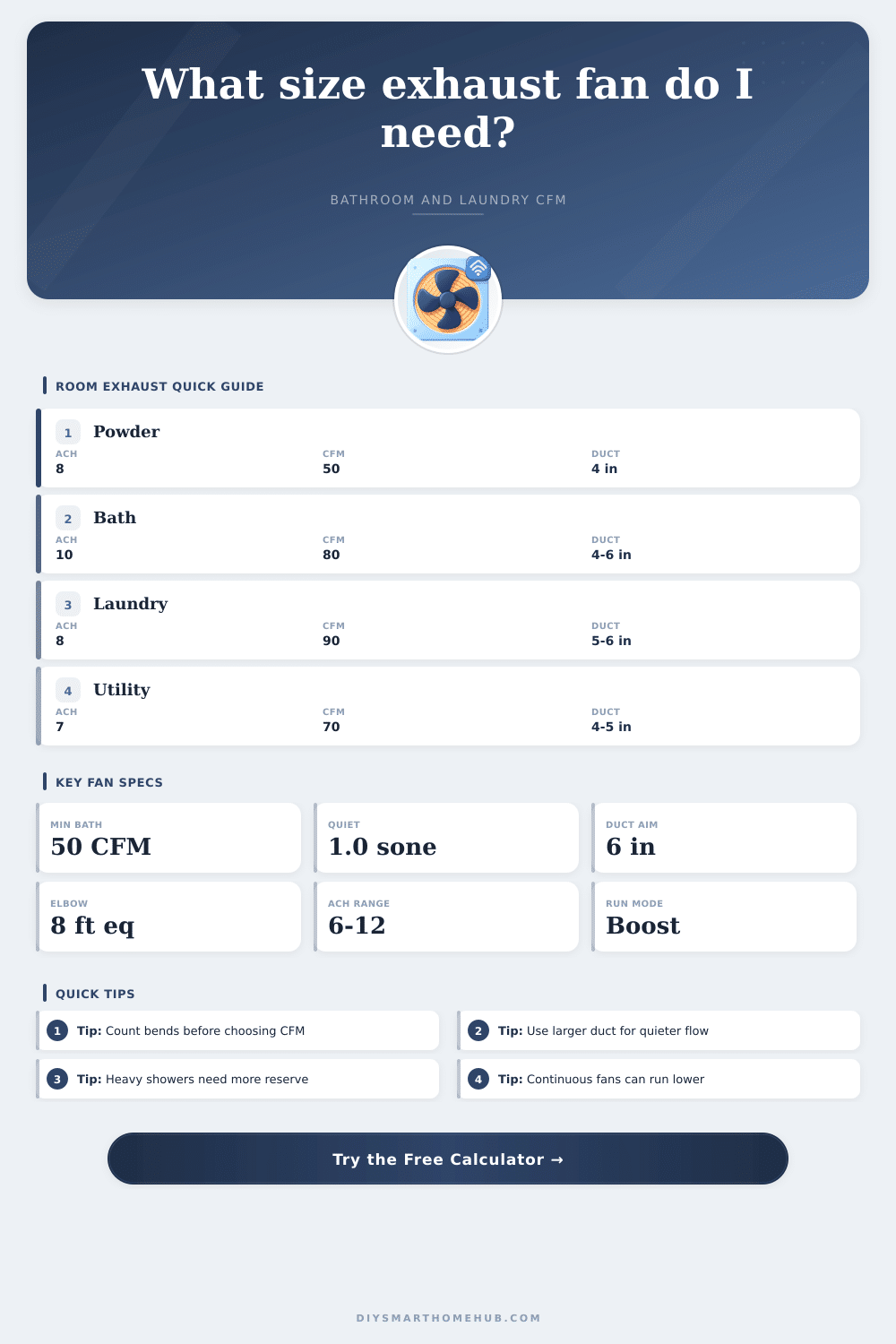
Estimate the fan CFM a bathroom, laundry, or utility room needs after room volume, ACH target, fixtures, moisture, odor, duct length, elbows, and fan style are all counted.
🏠Room presets
📏Room and fan inputs
Count toilet, shower, tub, laundry pair, sink, utility basin, or similar odor/moisture sources.
Use minutes per hour during active moisture or odor removal.
Exhaust fan sizing result
⚙Fan/spec grid
📊Room airflow targets
| Room type | ACH planning band | Common minimum | Best use |
|---|---|---|---|
| Powder room / toilet | 6 to 8 ACH | 50 CFM | Odor removal in a compact room. |
| Bathroom with shower | 8 to 10 ACH | 70 to 80 CFM | Daily shower moisture control. |
| Large bath suite | 10 to 12 ACH | 100 CFM+ | More volume, multiple fixtures, long showers. |
| Laundry room | 6 to 9 ACH | 70 to 100 CFM | Humidity and detergent odor dilution. |
| Utility room | 6 to 8 ACH | 60 to 90 CFM | Mop sinks, cleaning supplies, damp tasks. |
🌪Duct derate reference
| Duct condition | Equivalent length cue | Typical effect | Planning note |
|---|---|---|---|
| Short wall exit | Under 15 ft | Small derate | Usually fine with 4 in duct for modest fans. |
| Two elbows | Add 16 ft | Noticeable pressure | Upsize duct if target exceeds about 80 CFM. |
| Roof cap route | Add 12 ft | More resistance | Choose high-static housing for taller runs. |
| Soffit path | Add 18 ft | Higher risk | Avoid restricted caps and sharp turns. |
| Long run | Over 50 ft eq | Large derate | Inline or high-static fans usually fit better. |
🔌Fan class comparison
| Fan class | Approx watts per CFM | Sone baseline | Where it fits |
|---|---|---|---|
| Quiet DC bath fan | 0.18 to 0.28 W/CFM | 0.4 to 1.0 | Bathrooms where low noise matters. |
| Standard AC bath fan | 0.35 to 0.55 W/CFM | 1.5 to 3.0 | Short ducts and simple powder rooms. |
| High-static bath fan | 0.28 to 0.42 W/CFM | 0.8 to 2.0 | Longer ducts, roof caps, several elbows. |
| Remote inline fan | 0.25 to 0.40 W/CFM | 0.5 to 1.8 | Larger rooms or remote-mounted noise control. |
📝Common room examples
| Example | Room volume | Intermittent target | Likely fan label |
|---|
💡Practical sizing tips
When it’s hot and muggy, and your bathroom mirror is covered with condensation, you’ve probably also wondered why your exhaust fan doesn’t do its job (even though it looks like a powerhouse on paper). In reality, most fans is purchased based off the shiny number printed on box. But they can stay stuck inside the room. Duct resistance determines whether your bathroom will be dry or moldy.
Before flipping the switch, let’s review how duct resistance kills the fan. But how much? The math isn’t complicated and once you know your dimensions.
How to Pick the Right Bathroom Fan
Since we’re talking about moving air, air displacement is where it begins: you want the air in the room moved enough that it’s replaced with new, dry air as many times per hour as necessary. As a general rule-of-thumb for a regular shower, that means approximately 10 air changes per hour. That sounds like it should of been a very small fan if your bathroom is on the small side, but it doesn’t matter if it has a lot of square footage. The amount of moisture doesn’t care about square footage; a busy powder room can require more airflow than large, open vanity space used only to apply makeup.
The problem is most fans are rated in an ideal scenario; smooth, direct air flow in a lab setting where there’s no air friction. Real houses do not operate that way. Anytime you bend around an elbow, it becomes a partial obstruction, this robs static pressure from the fan. In fact, a 90 degree turn takes away airflow performance more equal to up to 10 more feet of straight duct. So if your return has many elbows or makes a long trip to a roof cap, then the actual CFM of the fan are greatly reduced. How does it know? It measures a derate factor based on distance and number of elbows in your ducts. It gives you an estimate of how much performance your fan will lose fighting its way against these physical barriers.
The other variable many people forget about (until they notice); is noise. Fans that makes more noise may seem to be more powerful, but moddern designs have mostly separated sound from performance. A quality direct current motor can pushes a lot of air and operate near-silently, in terms of sones (a measurement of sound). In a bathroom that’s also used as a home office, or one for the primary suite, noise becomes more important then brute force. By combining both the airflow information and the acoustics, the calculator will help you find the right balance between these two requirement. You don’t want a jet engine in your ceiling tile; you do want it to clear the room of steam fast.
Consider also how much moisture is produced. If you’re doing only one shower a month in a guest bath it’s a different story from a family bathroom used three times a day. And if it’s a lot of water (heavy showers) there will be massive amounts of humidity being released that will soak into your walls and insulation if allowed to linger. Here, peak flow rate isn’t everything, the length of time the fan operates is equally important.
I know some people who leave their fans on for an hour after they get out of the shower, which wastes electricity and wears out the motor. Others turn them off the exact moment they exit the shower, allowing moist air to build up and then condense on cool surfaces. Somewhere in between is where the magic happens, and a humidity sensing unit or a timer might do the trick, operating until the air has dried enough on its own.
The last factor in the equation here is duct size. If you’re forcing air through narrow ducts, it’s going to create backpressure which chokes the fan. Larger diameter ducts allow air to move more freely with less friction, which lets more air flow through while staying quieter. This is a small structural detail but it is very important for maintaining comfort over time.
Look at the results… Look not just at the rated capacity but also at the delivered airflow. That delivered is what it actualy accomplishes within your walls. Understanding the effect of physical resistance on performance will make choosing the proper fan feel less like gambling and more like an engineering decision. After all, you just want air moving. Quietly and efficiently, so there’s no opportunity for moisture to settle in.