Grow Room Exhaust Fan Calculator
Estimate exhaust fan CFM for a full grow room from room volume, canopy density, CO2 exchange, light heat, temperature rise, carbon filter drag, duct layout, and equipment headroom.
📌Grow room presets
These are room-scale starting points, not tent sizes. Adjust canopy area, plant count, CO2 strategy, and duct path to match the real room envelope.
⚙Room and equipment inputs
Exhaust fan sizing result
Calculation breakdown
📊Fan and filter spec grid
📋Grow room exchange targets
| Room profile | Typical interval | ACH range | Use in calculator |
|---|---|---|---|
| Fresh-air leafy greens | 1.5 to 3 min | 20 to 40 ACH | Use fresh-air or balanced CO2 mode. |
| High-light bloom room | 1 to 2.5 min | 24 to 60 ACH | Let heat CFM override exchange CFM. |
| Mother and clone room | 3 to 5 min | 12 to 20 ACH | Lower heat, higher humidity watch. |
| CO2 enriched room | 2 to 4 min purge | 15 to 30 ACH | Size for purge, even if sealed most of the time. |
🔧Carbon filter and duct derate guide
| Component | Planning drag | What changes CFM | Best use |
|---|---|---|---|
| Oversized carbon filter | 10% | Large media bed, low face velocity | Quiet room exhaust with odor control. |
| Matched carbon filter | 18% | Common inline filter at rated airflow | Default room sizing assumption. |
| Deep-bed filter | 28% | More media depth and static pressure | Odor-heavy rooms needing reserve. |
| Long flex duct | 2.6% per ft | Ribbed wall and sagging bends | Use only when routing requires it. |
🌡Light heat conversion table
| Fixture draw | Heat load | CFM at 8°F rise | CFM at 5°F rise |
|---|---|---|---|
| 600 W | 2,047 BTU/hr | 237 CFM | 379 CFM |
| 1,200 W | 4,094 BTU/hr | 474 CFM | 758 CFM |
| 2,400 W | 8,189 BTU/hr | 948 CFM | 1,517 CFM |
| 3,600 W | 12,283 BTU/hr | 1,422 CFM | 2,275 CFM |
🌱Common grow room sizing examples
| Room | Canopy density | Likely driver | Fan note |
|---|---|---|---|
| 6 x 8 herb room | 0.20 to 0.35 plants/sq ft | Exchange interval | Usually a quiet 6 inch inline fan. |
| 8 x 10 spare room | 0.20 to 0.30 plants/sq ft | Light heat | Use speed control for night airflow. |
| 12 x 16 garage room | 0.18 to 0.28 plants/sq ft | Heat and duct loss | Plan filter area before fan choice. |
| 16 x 20 production room | 0.15 to 0.25 plants/sq ft | Static pressure | May need dual exhaust paths. |
A dead plant won’t be the first clue something’s wrong with your grow room ventilation. More likely it’ll be when your space becomes an oven in the middle of the day, or the unmistakable aroma fill the area. Even the best genetics and lights money can buy won’t matter unless air move properly across canopy at optimal speeds.
Determining what size exhaust fan to choose isn’t necessarily about grabbing largest one off the shelf. Instead, it’s a question of understanding how volume, heat, and resistance interact in your sealed box.
How to Choose the Right Fan Size
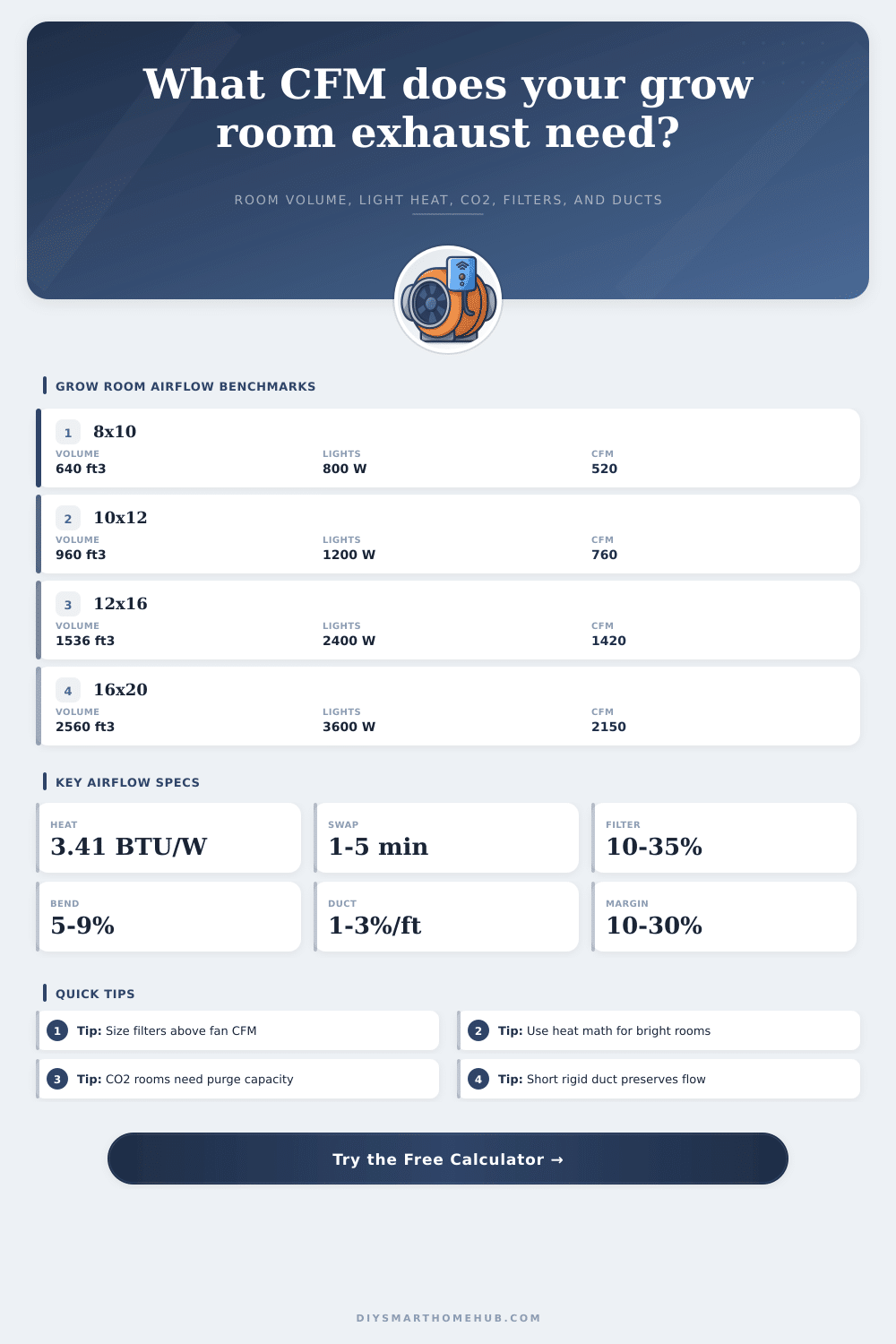
Everyone begins with the volume of their room. Multiply length x width x height. Divide by 2 or 3 and you have an approximate CFM number. That’s a good beginning guideline if the room is bare concrete shed, but the second you throw some equipment into the mix, this start breaking down. Because our calculator factors in actual thermal load of your lights, and not simply the empty space in your room, it will run numbers for you.
3.41 BTUs of heat per watt. Where does all that energy go? It raise the temp. Unless there’s sufficient air movement to remove that heat from the space, the temperature will rise. And as the temperature of the air increases so too does its ability to hold moisture; which encourages mold and stresses your plant. The catch is finding how much airflow is needed to keep room cool versus how much is needed to refresh the air.
Next is resistance. This is where the majority of DIY setups goes wrong. Even though your fan may be rated at 500 CFM on paper, it will probably only output 350 CFM in real life due to the resistance between the fan and outside world. While carbon filters are necessary for controlling odors, they act like sponges for airflow. The thicker the filter bed, the higher the static pressure they exert. In order to get air through that resistance without choking, you want a fan capable of pushing it past that resistance.
That’s why flexible ducting exacerbates this issue, those ribs on its sides cause turbulent airflow which slows the air down while decreasing overall efficiency. Long runs of flexible ducting with several elbows will have you fighting against yourself. Rigid metal ducting is much better as it provides a smooth pathway for air to travel along.
These are the kinds of real world frictions you can adjust for within the tool’s inputs. Canopy densities matters. Heavy transpiring canopy? Sparse vegetative room where there isn’t as much humidity load? Account for it. What is a CO2 enrichment strategy? When your cycle concludes, your room must purge well so it doesn’t have stale air building up. Too low an exchange rate and a sealed room goes stale fast. The calculator will help you visualize the tradeoff.
Want fewer CFMs? Run at a higher temp increase. Save yourself energy and noise. But don’t push that limit too far or you’ll kill off any sensitive crop. It’s a balancing act: efficiency for your wallet versus comfort for your plant.
Common errors include forgetting duct length and undersizing the filter. A lot of people purchase a fan capable of moving as much air as the room holds, only to hook up a filter designed to handle just half that amount. You now have a filter that’s struggling to breathe. Size your carbon filter above your desired CFM; it will serve as a performance buffer over time as the media collects odor particles and dust.
Don’t underestimate the effect of bends. Each flexible duct elbow, such as a 90, can use up a lot of flow capacity.
Ultimately, all that matters is control. Fresh oxygen. Manageable humidity. Keep the temperature consistent. Ventilation is not simply a matter of air movement. It’s a matter of getting enough air moved with the right amount of power to compensate for what’s standing between you and your goal.
Get that equation right and you’ll notice: the leaves are standing tall, the heat will dissapears before becoming an issue, and the smell will vanish within the filter. Now your focus shifts from the environment to the harvest. That is when you know you have it right.