Grow Room Dehumidifier Calculator
Estimate daily moisture removal for sealed or exhausted grow rooms using canopy coverage, plant stage, source-air humidity, and free-water load so the recommended dehumidifier size matches the actual room cycle.
📌Quick grow room presets
Each preset loads a full room profile including shape, plant stage, canopy fill, room mode, free-water load, and available daily runtime, then auto-calculates the suggested nominal capacity.
💧Grow room inputs
📘Sizing notes
📊Calculated dehumidifier sizing
Sizing notes will appear here after calculation.
🔧Grow room dehumidifier classes
These reference cards summarize nominal removal, efficiency, and the type of room each class usually fits once plant load and air exchange have been translated into liters per day.
🌱Plant-stage moisture benchmarks
| Plant stage | Leaf load | Typical RH target | Best use case |
|---|
🌡Room mode exchange comparison
| Room mode | Added air change | Best fit | Moisture note |
|---|
📏Common project size outcomes
| Preset room | Floor area | Steady load | Nominal size |
|---|
💡Calculation tips
Bench aisles, mechanical corners, and work zones do not transpire. If only 70% of the room is actually leaf-covered, entering 100% canopy fill will overstate moisture removal needs.
When lung-room or outdoor air is already wetter than your target room condition, ventilation can create more latent load than the plants themselves, especially during lights-off cycles.
A dehumidifier are a machine that remove water vapor from the air. Using a dehumidifier in a grow room are necessary because the plant will release moisture into the air through the process of transpiration. Through transpiration, the plants will release water vapor through its leaves.
If the relative humidity in the grow room increase to too higher of a level due to the moisture released by the plants, mold can form in the grow room as well as bud rot can develop in the cannabis plants. In order to avoid these issue, it is essential to utilize a dehumidifier to maintain the relative humidity within the grow room to the specific percentage that is targeted to avoid mold and bud rot altogether. When selecting a dehumidifier for the grow room, it is critical that the dehumidifier have the appropriate capacity in relation to the amount of moisture that the plants will release.
How to Choose and Use a Dehumidifier in a Grow Room
Several factor can impact the amount of moisture that the plants will release. One factor is the size of the plant canopy. The more larger the plant canopy, the more moisture the plants will release as compared to a smaller plant canopy.
Another factor is the temperature within the grow room. The higher the temperature within the grow room, the more water vapor the air can hold. This means that the moisture level within the room will be higher, and, therefore, the dehumidifier will need to work harder to remove the water vapor from the air within the grow room.
In addition to the amount of moisture released by the plants, there are other source of moisture within the grow room. Moisture can come from the runoff that collect in the trays of the plants. Additionally, moisture can come from the air that come into the grow room from outside the grow room or from a lung room.
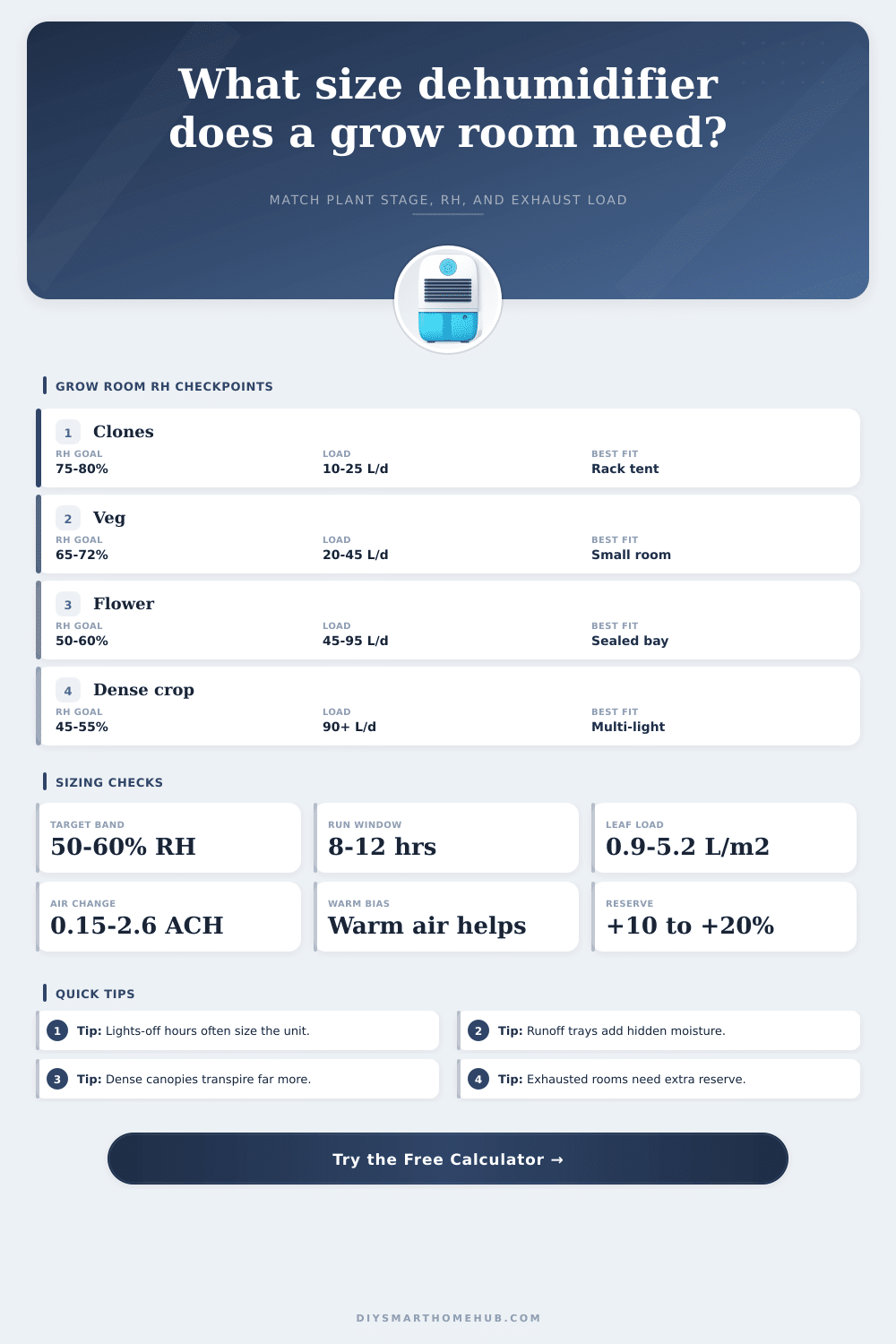
If the air that enter the grow room contains humidity, the dehumidifier will have to remove that humidity as well as the humidity from the plants. For these reason, it is best to select a dehumidifier whose capacity is larger than the minimum amount of moisture that the plants alone will produce. Providing the dehumidifier with a reserve buffer of 10 to 20 percent of its capacity will allow it to handle any unexpected increase in the amount of moisture that is released into the grow room.
Another factor to consider when selecting a dehumidifier for the grow room is the stage of the plants within the grow room. The stage of the plants impact the amount of relative humidity that is required within the grow room. During the clone stage of the plants while they are within the dome, the relative humidity levels in the grow room should be higher at around 75 to 80 percent.
However, during the flowering stage of the plants, the relative humidity levels should be lower at around 45 to 55 percent. During the flowering stage of the plants, the dehumidifier will have to be able to remove the moisture from the air at a more aggressive rate. Additionally, it is important to note that the amount of humidity within the grow room tend to peak during the lights-off portion of the cycle of the plants.
In order to utilize the dehumidifier properly, it is recommended to place the dehumidifier in a low position within the grow room. This is because the moist air will naturally settle near the floor of the grow room. It is also essential to utilize a hygrostat to control the dehumidifier.
The hygrostat will allow the dehumidifier to automatically turn on if the relative humidity within the grow room increase. Using a timer in place of a hygrostat may cause the dehumidifier to not turn on when the relative humidity within the grow room begin to rise. Finally, in order to effectively utilize the dehumidifier to control the relative humidity within the grow room, it is essential to monitor the relative humidity within the grow room.
The relative humidity levels should be log for a period of one week after installing the dehumidifier. By monitoring the relative humidity within the grow room, youll be able to determine if the selected dehumidifier is of sufficient size to handle the amount of moisture that the plants release.