Desiccant Dehumidifier Calculator
Estimate wheel-based drying capacity for low-temperature spaces using room volume, humidity ratio gap, air leakage, run time, and reactivation heat instead of relying on compressor-style pint charts.
📌Quick desiccant presets
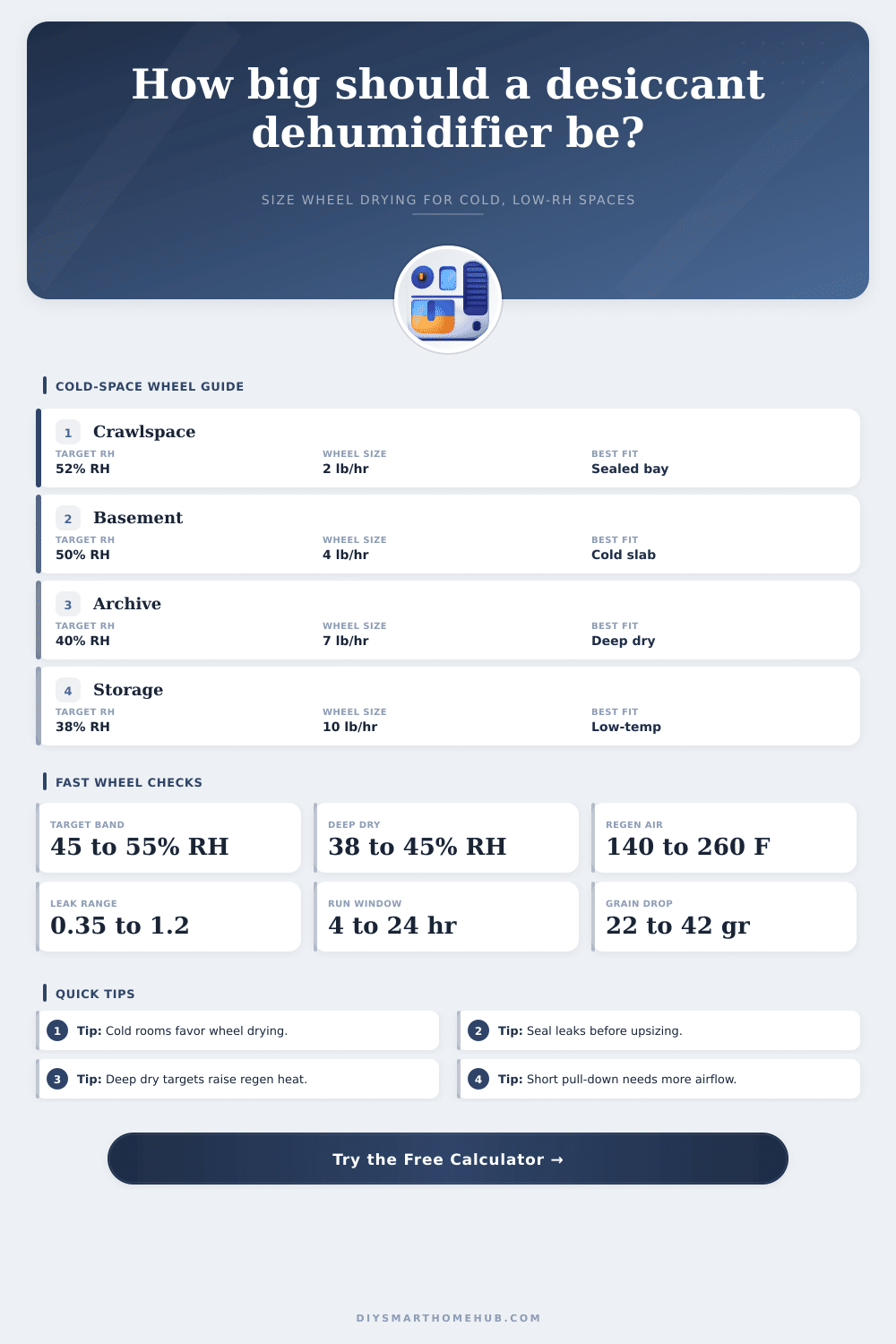
Each preset combines leakage, wheel style, target RH, and runtime so you can compare mild drying against deep-dry process work without using generic pint-per-day charts.
📏Project inputs
💡Why this calculator is different
📘Wheel package quick bands
These cards summarize how grain depression, regeneration temperature, and best-fit applications shift as you move from recovery wheels to deep-dry process rotors.
📋Application profiles
| Application | Typical temp | Default target | Base load | Why desiccant fits |
|---|
⚙Rotor comparison table
| Rotor | Grain drop | Regen temp | Fan draw | Best use |
|---|
📊Scenario benchmark table
| Preset | Area | Target RH | Removal | Airflow |
|---|
🛠Practical notes
When outdoor humidity ratio is above the target room ratio, leakage can become the largest hourly moisture load. Better sealing often reduces both the process CFM and the regeneration heat needed.
If you only run the unit for part of the day, the same total water has to be removed faster. That raises the required wheel airflow even if the daily moisture total stays unchanged.
Desiccant wheels is used for dehumidification in environments with low temperatures. Standard compressor dehumidifiers tend to fail in temperatures below 65 degree, but desiccant wheels continue to working in these environments. A desiccant wheel utilize a spinning wheel that contains moisture-grabbing materials.
The process air come in contact with the desiccant wheel to extract moisture from air. A hot air stream then goes through the desiccant wheel to dry it out. Because there is no use of refrigeration coil or refrigerants in a desiccant wheel, the desiccant wheel will not freeze in low temperatures.
How to Size and Use a Desiccant Wheel in Cold Rooms
To size a desiccant wheel correctly, you have to consider the total amount of moisture that you must remove from the space. Consider the air volume and the height of the ceiling in the space. These two factor will allow you to calculate the pull-down load for the space.
The pull-down load is the total mass of water that is in the space when the dehumidification process start. Additionally, consider the relative humidity of the space. If the desired relative humidity is low, such as 40% or 50%, the desiccant wheel will have to work more harder to remove the grain of moisture from the air in the space.
Another factor to consider is the possibility of moisture entering the space. Any opening in the doors of a space will allow humid air from outside the space to enter the space. Any addition of water sources to the space, such as laundry or damp concrete slab, will contribute to the moisture in the space.
In the case of only running a desiccant wheel for 8 hour a day, there will have to be an increased airflow to the desiccant wheel to remove the moisture from the space during these 8 hours. The type of desiccant wheel to use will depend on the desired relative humidity of the space as well as the amount of energy that you want to use to extract the moisture. Standard silica gel desiccant wheel work best for relative humidity around 50%.
For spaces with a desired relative humidity of 38%, use deep-dry rotor or low-temperature desiccant sieves. Deep-dry rotors run at 220 to 260 degrees Fahrenheit. The capacity of the desiccant wheel to extract moisture from the air is refer to as the grain depression.
This factor will dictate the amount of process airflow that is necessary to achieve the desired relative humidity in the space. Another factor to consider when sizing a desiccant wheel is to include a reserve margin so that the desiccant wheel will work and perform correct. A 10% margin is sufficient for spaces with stable relative humidity.
If the pull-down load is aggressive and high, and you wish to reach the relative humidity target quickly, use a 20% margin. Several factor have to be monitored to ensure the desiccant wheel works optimally. These factors include the moisture that must be removed in pounds per hour, the process airflow in CFM, and the reactivation load.
The reactivation load dictate the size of the heater that you must use in the desiccant wheel. Many people make mistake when they are selecting the proper desiccant wheel. Using only the pint-per-day charts to determine the size of the desiccant wheel is a mistake.
The pint-per-day charts is based on the amount of water that compressor dehumidifiers can extract from the air, not desiccant wheel capacity. The desiccant wheel capacity depend on the grain depression of the desiccant wheel and the runtime of the desiccant wheel. Additionally, many people will forget to account for the humidity outside of the space when it enter the space through the doors of the space.
If there is too little reactivation heat provided to the desiccant wheel, it will not be able to purge all of the moisture from the air, and the efficiency of the desiccant wheel will decrease. You have to consider the placement of the desiccant wheel as well as how to maintain the desiccant wheel. The desiccant wheel has to be placed in a way so that the process air will flow towards the sources of moisture in the space.
Place filter in the intake of the desiccant wheel to catch any dust that may enter the desiccant wheel as the air pass through the intake. These filters will prevent any clogging of the desiccant wheel. Additionally, you have to check the seal of the desiccant wheel each year.
If there is a leak in the desiccant wheel seals, it will reduce the output of the desiccant wheel. By making sure that the rate at which the moisture is removed from the air is matched to the amount of moisture in the air in the space, the desiccant wheel will function correct in the cold environment.