Geothermal Horizontal Loop Calculator
Estimate the trench footage, total loop pipe, circuit count, design flow, and land area needed for a horizontal closed-loop geothermal field using soil, depth, pipe, and layout assumptions.
Choose a realistic loop scenario to preload common residential and light-commercial field layouts, then adjust soil, spacing, or circuit limits to fit the site.
The calculator converts metric values internally, adjusts for soil moisture and burial depth, then derives trench footage from the selected pipe layout.
Outputs show both field sizing and hydraulic planning values so you can compare trench count, circuit length, and land footprint at the same time.
These values update after each calculation so the material cards reflect the selected soil, pipe, and trench layout.
Use the tables below to compare how moisture, trench style, and property size can shift the required loop field without changing the equipment tonnage.
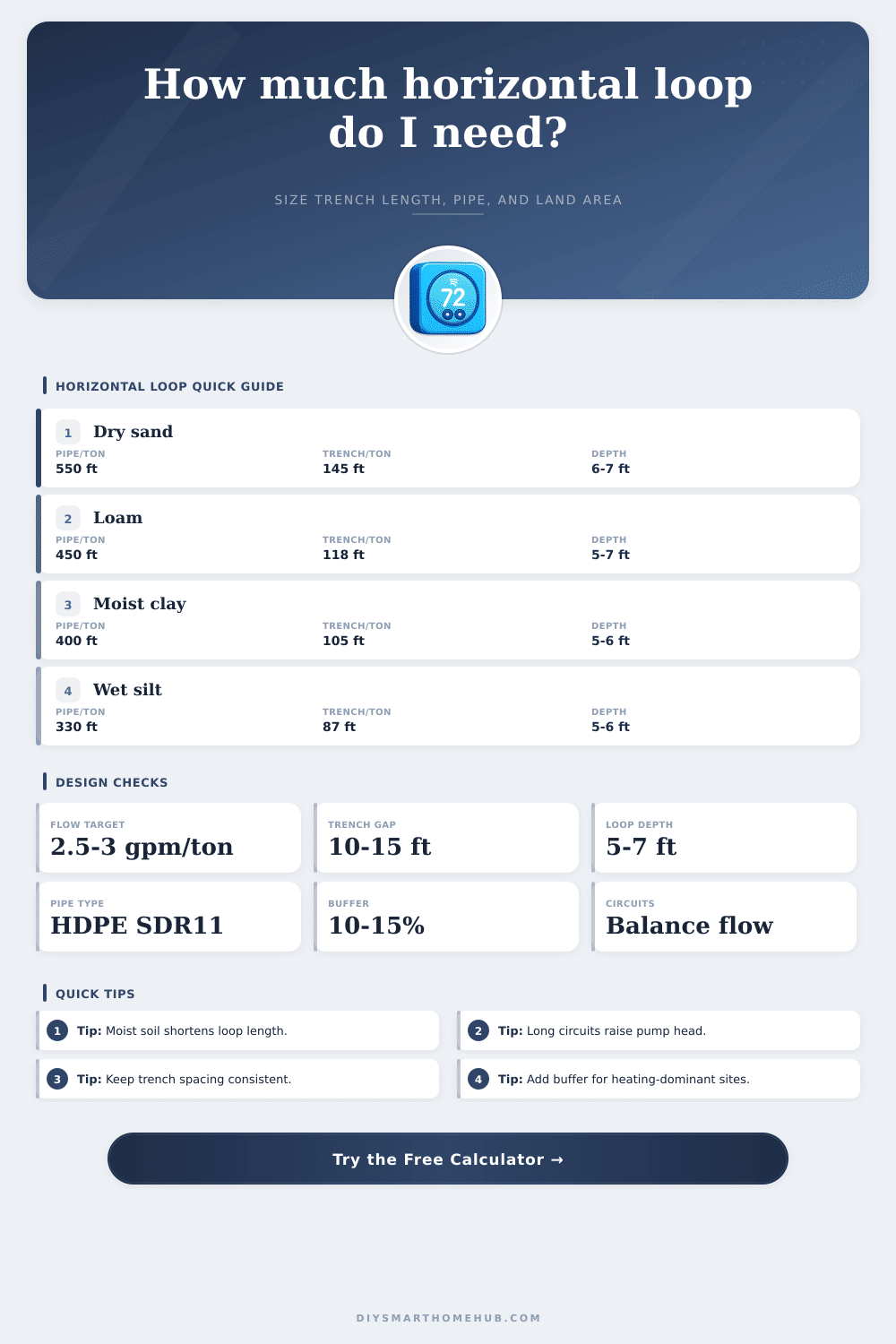
| Soil Condition | Base Pipe ft/Ton | Approx. BTU/h-ft | Typical Use |
|---|---|---|---|
| Dry sand or gravel | 550 | 12 | Needs longer field and wider margin |
| Average loam | 450 | 15 | Common residential baseline |
| Moist clay | 400 | 17 | Good contact and stable moisture |
| Wet silt / high moisture | 330 | 21 | Shorter loops where drainage stays wet |
| Enhanced backfill trench | 300 | 23 | Engineered fill improves transfer |
The calculator uses the selected soil baseline as the starting pipe-per-ton requirement, then applies depth, climate, and design buffer modifiers.
| Loop Layout | Pipe per Trench Foot | Footprint Effect | Best Fit |
|---|---|---|---|
| Straight pair | 2.0 | Largest field | Open lots with simple trenching |
| Compact slinky | 3.0 | Moderate reduction | Mixed yards with some setback limits |
| Standard slinky | 3.8 | Balanced layout | Typical residential retrofit or new build |
| Dense slinky | 4.5 | Smallest field | Tight lots with careful hydraulic checks |
Higher pipe density reduces trench footage, but it can also increase per-circuit pressure drop if the same pipe size is stretched too far.
| Project Size | Loop Load | Typical Trenches | Space Planning |
|---|---|---|---|
| Small ranch home | 2 tons | 2 to 3 | Fits many side-yard or rear-yard lots |
| Average family home | 3 to 4 tons | 3 to 5 | Best with 10 to 15 ft trench spacing |
| Large open plan | 5 tons | 5 to 7 | Reserve room for supply and return headers |
| Mixed-use shop office | 6 tons | 6 to 8 | Hydraulic balancing becomes more important |
These snapshots assume 1 inch or larger pipe, mixed climate, and horizontal closed-loop fields laid out with parallel trenches.
Horizontal loop is common type of geothermal heat pump system. For homes you choose most commonly closed loops. They are made up of coils filled by means of antifreeze solution that reclines one meter depth in horizontal or vertical configurations called loop fields.
You uses most commonly horizontal loop when enough ground is available. For such installations home should recline on at least half of acre.
Horizontal Geothermal Loop Systems
Horizontal loop requires more ground space than vertical. But it usually costs less for farms with sufficient soil. Installation is less expensive than vertical so many homeowners like it instead of vertical.
Occasionally even horizontal loop fields install for fewer money than vertical. Geothermal energy helps to benefits by means of reduced energy costs bigger comfort and economy better home value and it cares about nature.
For lay horizontal system workers use trenchers either backhoes for dig trenches. Those are commonly several feet long according to ground structure and heat load requirements. Trenches usually have 4 until 6 feet depth although some goes 5 until 10 feet below ground.
Some informations say that optimum depth is 6 until 10 feet. Tubes must recline under frost line. For instance in some regions standard depth for horizontal loop are 8 feet.
Here you lays series of plastic pipes for form the geothermal heat exchanger. Those tubes do closed loop and filled by means of heat transfer liquid that circulates in the whole system.
In more soil contact with the loop des more well it operates. Big ground surface between the loops help heat exchange with the soil. Note that horizontal loops can be less good during gross temperatures especially in warm summers or cold winters.
In gentle climates they operate likewise well as vertical. For pond-based geothermal systems submerge you the loops in depth of at least 8 until 10 feet under water. That prevents groundwater contamination and give better heat transfer between tubes and soil.
Although horizontal loops are common they are less used than others because they require long horizontal trenches for lay the piping.