Geothermal Borehole Calculator
Estimate total active bore length, bore count, actual depth per bore, grout quantity, loop fluid volume, and borefield fit for a vertical ground loop. Switch between imperial and metric units, compare geology and grout combinations, and see how bore spacing, EWT targets, and U-bend selection change the first-pass design.
Each preset loads a realistic style starting point for a vertical loop. They are intended for sanity checks only and should still be reconciled against local geology, drilling practice, and the selected heat pump data.
These are first-pass geothermal borehole estimates only. Final vertical loop design should still verify geology, grout spec, casing needs, pump head, flow balance, and the exact heat pump entering water limits.
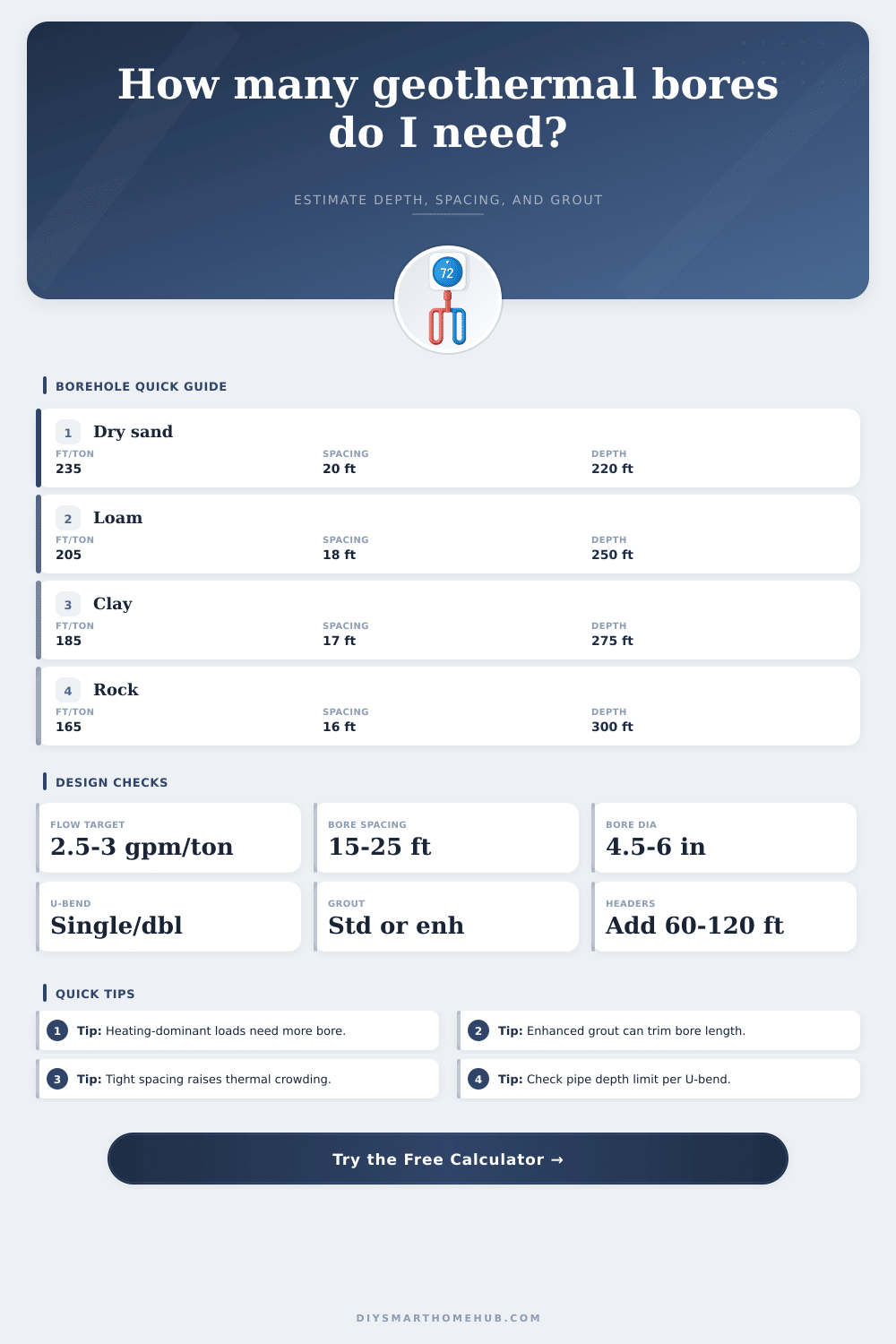
Ground conductivity and moisture drive the biggest bore length swings. Strong grout can help, but the geology assumption still matters more than the grout brand alone.
| Ground profile | Conductivity | Typical ft/ton | Spacing | BTU/h-ft | When it fits best |
|---|
| Configuration | Legs | Max depth | Flow band | Fluid volume | Best use |
|---|
| Project | Load | Typical bore plan | Spacing | Design note |
|---|
A deeper bore can reduce bore count, but only if pipe configuration, grout, and pumping strategy still support the depth you want to drill. The best borefield is balanced across all three.
Driveways, setbacks, underground utilities, and rig maneuvering space often shrink the true drillable footprint more than owners expect, especially on retrofit urban sites.
Geothermal technology helps to spare money each day. It exploits the stable temperature underground, so does not require to work a lot for warm or cool the house. Like this it operates much more effectively and can give until 80 % of economy comparatively with old system.
Choose geothermal solution is wise step. Compare it by means of heating calculator with coefficient of 4.4 or 4.8, will result, that geothermal cost 22, 28 % less each terma unit than natural gas for home heat.
How Geothermal Calculators Help Save Money and Plan Heat Systems
Many resources are available for design. Geo-Flo Products Corp. Bid six free calculators for geothermal systems on its website. They back geothermal and hydronic planning, especially the hydronic part.
Professional calculator for geothermal HVAC size helps with ground source heat pumps. It estimates apt equipment size, system specifications and required ground loops. Even horizontal systems receive precise specifications.
Calculations matter for install the apt system. Algorithm determines the maximum number of boreholes that answers for soil. It considers the building and the territory of the area.
Deeper boreholes cost more but must be used when space lacks. The calculator for grout volume and cost quickly finds the involved amount of grout or sand for the draft. You can add basic costs for work transfer and materials for estimate total expense.
Various methods apply for those works. NPro help to estimate size of geothermal probe fields. Some programs use simplified procedure while others as EWS or Earth Energy Designer are simulators.
They follow standard rules for probe design. One method applies the Ramey-equation in three phases: upward flow in the producer lateral flow and downward flow in the injector. Other counts probe length according to VDI 4640 and find the right depth for boreholes.
Deep boreholes give pure energy. Good calculator estimates how many heat eltraŭblas from them.