Geothermal Vertical Loop Calculator
Estimate total active bore length, bore count, actual depth per bore, grout quantity, loop fluid volume, and field fit for a vertical closed-loop geothermal design. Switch between imperial and metric units, compare ground profiles and grout packages, and see how spacing, EWT targets, and pipe choices change the first-pass vertical loop plan.
Each preset loads a realistic style starting point for a vertical loop. They are intended for sanity checks only and should still be reconciled against local geology, drilling practice, and the selected heat pump data.
These are first-pass geothermal vertical loop estimates only. Final design should still verify geology, grout spec, casing needs, pump head, flow balance, and the exact heat pump entering water limits.
Ground conductivity and moisture drive the biggest bore length swings. Strong grout can help, but the geology assumption still matters more than the grout brand alone.
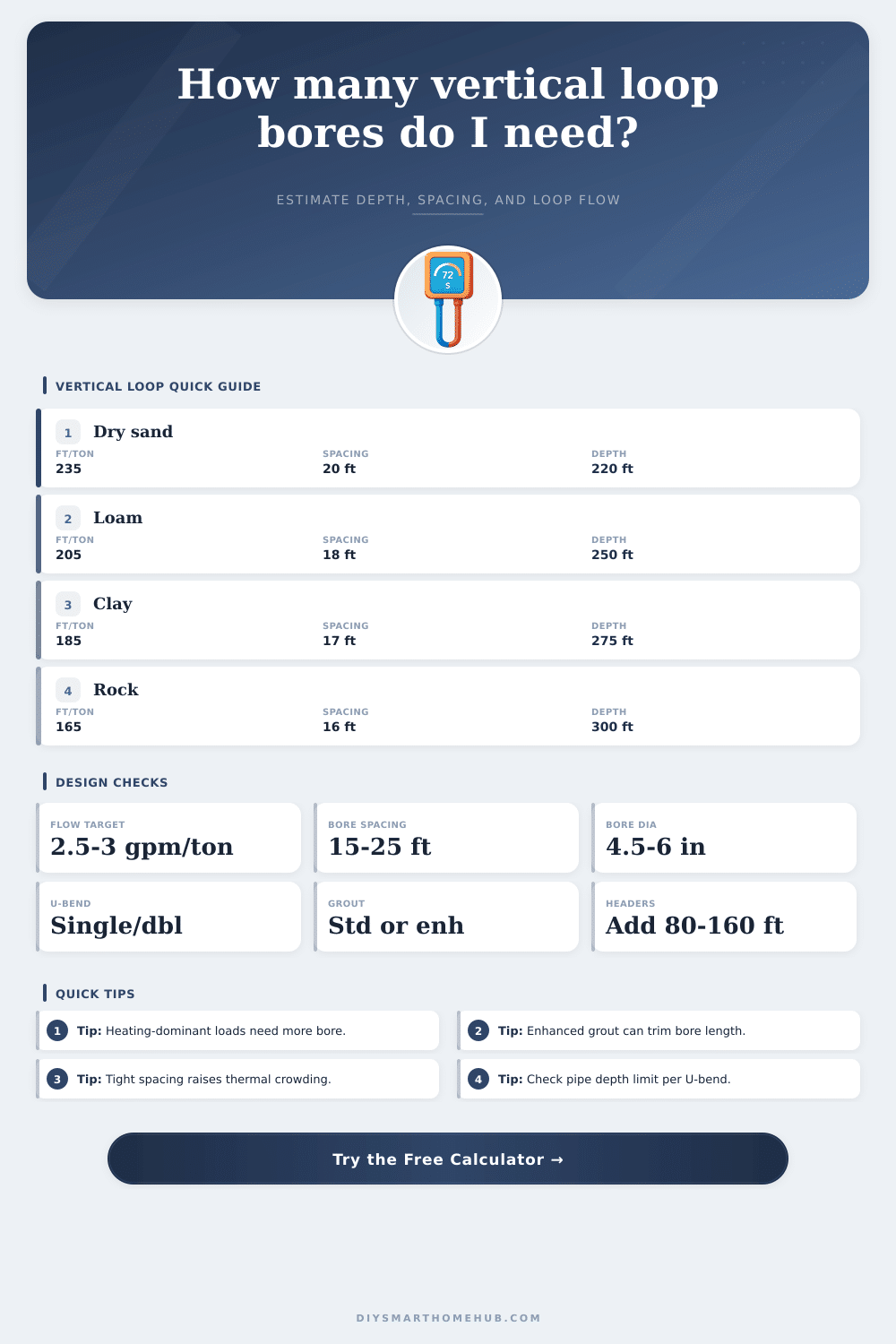
| Ground profile | Conductivity | Typical ft/ton | Spacing | BTU/h-ft | When it fits best |
|---|
| Configuration | Legs | Max depth | Flow band | Fluid volume | Best use |
|---|
| Project | Load | Typical bore plan | Spacing | Design note |
|---|
A deeper bore can reduce bore count, but only if pipe configuration, grout, and pumping strategy still support the depth you want to drill. The best borefield is balanced across all three.
Driveways, setbacks, underground utilities, and rig maneuvering space often shrink the true drillable footprint more than owners expect, especially on retrofit urban sites.
Vertical geothermal ground loops is very common way to install geothermal heating systems. You drill deep wells directly into the ground for this kind of system. The depth of those holes ranges according to the needs of the building for heating and cooling, of 100 until 400 feet.
Some even sources have depths between 200 and 500 feet. Usually you drill the vertical wells in interval of around 20 feet. They have diameter of approximately four inches.
How Vertical Geothermal Ground Loops Work
For typical installation needs one loop for every ton of gear in the system.
For build the loop, you lay U-shaped tubes in every well. Later they connect at the surface for form closed net. Through those tubes circulates solution with antifreeze.
It flows in the holes for absorb heat from the soil. A bit of setups isolate half part of the loop, during the other half stays empty. The empty parts pick heat winter and release it summer.
Vertical loop heat a bit more well than horizontal. You consider vertical ground loops the most efficient in rock, because granite switches heat in 1.1 btu/hr, during overburden only in 0.4 btu/hr.
The soil has big things for the design. Clay soil answers well for geothermal, because it reserves water. That helps the loops operate more effectively as warm reserve.
Sandy soil however can create problems. In such places use vertical loops for reach wet sand. Vertical loops well suit, when the available ground limits or for changes in old houses.
Devices as the drill D22x22FX Series II Navigator can use for vertical and horizontal installations. That unit drills in corners of 18 until 90 degrees.
Are various ways exchange heat. Closed systems operate vertically, horizontally or in pools. Open systems differ, because they pump surface water or use existing wells.
For count the size of the loop require to consider many elements, also the heat conductivity of the soil. Some installations require two wells of 400 feet for 5-ton system. The driller can use the same machine for all holes.
Best install the ground net just after boring, because holes can crash according to the type of rock. That forms nucleus of efficient heating and cooling system.