Generator Amps Calculator
Convert generator watts or kilowatts into running amps, usable continuous amps, surge amps, and split-leg loading for common 120V, 120/240V, and three-phase outputs.
Calculation Breakdown
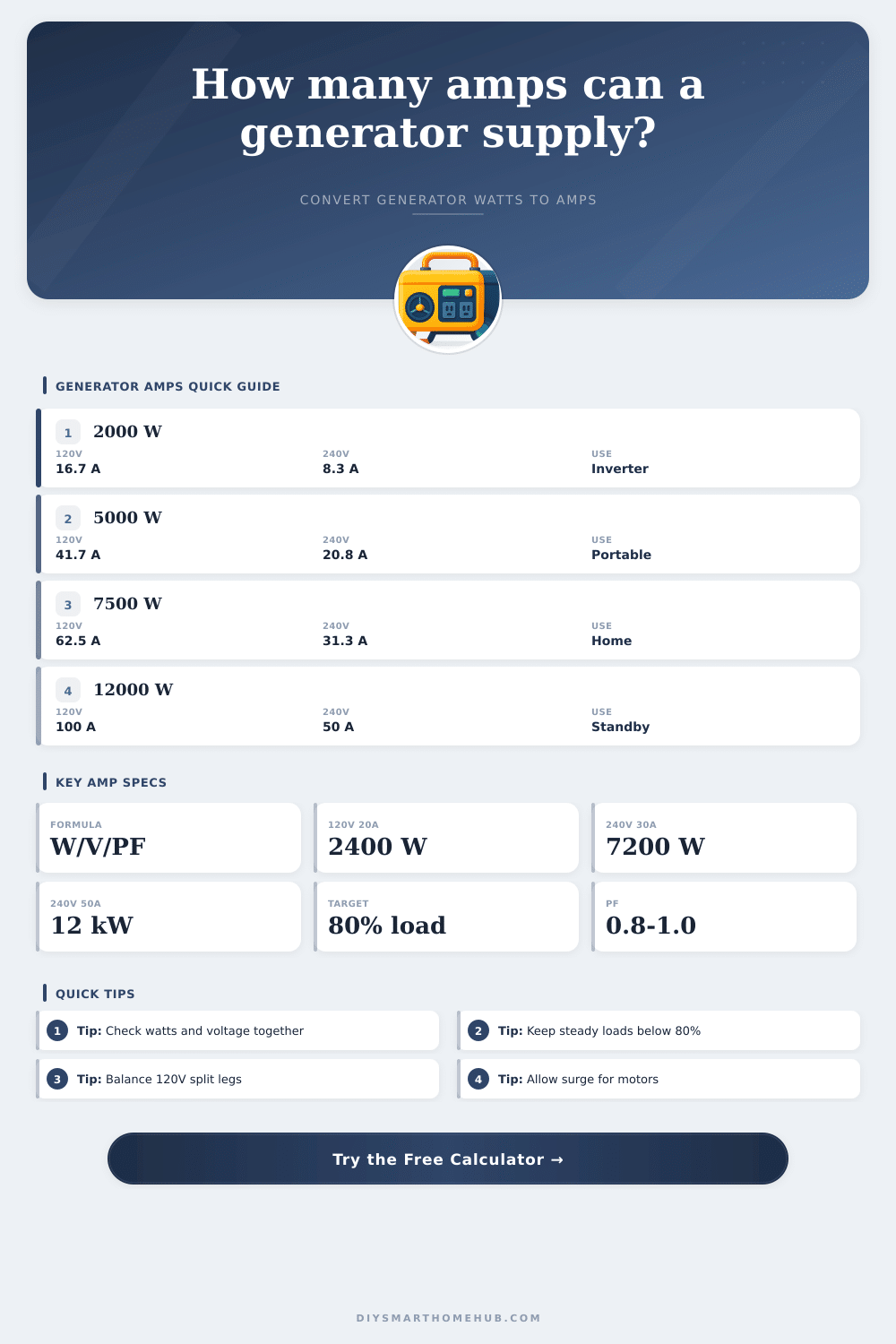
| Generator Output | 120V Amps | 240V Amps | 80% Planning Amps at 240V |
|---|---|---|---|
| 2,000 W inverter | 16.7 A | 8.3 A | 6.7 A |
| 3,500 W portable | 29.2 A | 14.6 A | 11.7 A |
| 5,000 W portable | 41.7 A | 20.8 A | 16.7 A |
| 7,500 W home backup | 62.5 A | 31.3 A | 25.0 A |
| 9,500 W portable | 79.2 A | 39.6 A | 31.7 A |
| 12,000 W standby | 100.0 A | 50.0 A | 40.0 A |
| Generator Class | Typical Running Rating | Typical Outlet or Inlet | Best Amp Check |
|---|---|---|---|
| Small inverter | 1,800 to 2,200 W | 120V 15A or 20A receptacle | Confirm total 120V amps stay under receptacle rating. |
| Mid portable | 3,500 to 5,500 W | 120V 20A plus 120/240V twist-lock | Compare both 120V outlet amps and 240V line amps. |
| Large portable | 7,000 to 9,500 W | 120/240V 30A or 50A outlet | Check 240V running amps and balance 120V legs. |
| Air-cooled standby | 10,000 to 24,000 W | 120/240V transfer equipment | Use continuous amps plus motor starting amps. |
| Light commercial | 25,000 to 45,000 W | Single-phase or three-phase panel feed | Select the proper single-phase or three-phase formula. |
| Configuration | Current Formula | Where It Applies | Planning Note |
|---|---|---|---|
| 120V single-phase | Amps = W ÷ V ÷ PF | Small inverters and 120V-only portables | All current is on the single hot conductor. |
| 120/240V split-phase | 240V amps = W ÷ 240 ÷ PF | Most home backup portable and standby generators | 120V loads must be balanced across both legs. |
| 208V three-phase | Amps = W ÷ 1.732 ÷ V ÷ PF | Small commercial three-phase systems | Line amps are lower than single-phase at the same watts. |
| 480V three-phase | Amps = W ÷ 1.732 ÷ V ÷ PF | Larger commercial generators | Voltage selection changes amps dramatically. |
| Scenario | Rated Output | Calculated Amps | Secondary Check |
|---|---|---|---|
| Fridge and lights inverter | 2,000 W at 120V | 16.7 A running | 20.8 A at 80% surge margin |
| Apartment essentials | 3,500 W at 120V | 29.2 A running | 23.3 A at 80% planning load |
| Portable transfer switch | 5,000 W at 240V | 20.8 A per 240V line | 16.7 A continuous target |
| Well pump backup | 7,500 W at 240V | 31.3 A per 240V line | Compare surge against pump start |
| Whole-house standby | 22,000 W at 240V | 91.7 A per 240V line | 73.3 A at 80% planning load |
When you use a portable generator to power your homes, you must understand how electricity move from the generator to the appliances. While many peoples focus on the watts of a generator, the wires and circuit breaker of a generator respond to the amps of that generator. The watts of a generator represent the total amount of power that is available from that generator.
The amps of a generator represent the rate at which electricity moves through the wires of that generator. If you try to move too many amp through the wires or the generator, the wires will become very hot, and the circuit breakers will trip. A generator does not have an infinite amount of energy.
Generator Basics: Watts, Amps and Safety
A generator also has a limit to the amount of current that it can provide at one time. You need to understand the differance between running watts and surge watts. Running watts represent the power that a generator provide to an appliance while it is running.
Surge watts represent the initial power that a refrigerator provides to start the appliance’s motor. Starting an appliance requires a high amount of surge watts, but the appliance may require a more lower amount of watts while it is still running. If you base the electrical needs for an area on only the surge watts of the appliances that is to be used, you could overload the generator if you use several appliance at the same time.
You must establish a load target for the generator that you are using. The load target establishes the amount of power that you allow your generator to provide to your appliances. By not allowing the generator to exceed its maximum power output, you will not strain the generator engine, and the generator will not use as much fuel as when it is running at a high rate.
Most individual target an eighty percent load target for the generator. This percentage creates a safety buffer for the generator. If an appliance sudden turns on, the safety buffer will ensure the generator does not overload and shut down.
You also need to consider the effect that voltage and phase have on the way in which you distribute the power from your generator. Most residential areas use split phase power. Split phase power uses two twelve volt legs of power to create 240 volts.
If you connect all of your appliances to one leg of split phase power, you could overload that split phase power leg of your generator. To avoid this, you must balance the appliance that you connect to each leg of split phase power. For commercial areas, three phase power is used instead of split phase power.
Three phase power uses three alternating current to power the electrical devices in that area. The advantage of three phase power over split phase power is that it allows for the operation of large motor. Additionally, because three phase power uses three alternating currents, the line amps of three phase power are less than the line amps for single phase power of the same wattage.
Other considerations for three phase power include the power factor. The power factor for an appliance represents how efficient that appliance uses the electricity from the generator. Appliances that use resistive power, such as heat elements, are more efficient than appliances with inductive power, such as motors.
If you dont consider the power factor in relation to the electrical needs of a commercial area, the current that the generator is providing to those appliance will not be accurately calculated.