Generator Breaker Size Calculator
Estimate the breaker size, generator current, inlet capacity check, and continuous load limit for portable, inverter, and standby generator transfer equipment.
30 A L14-30 inlet
Common for 5 kW to 7.5 kW portable generators. At 120/240 V it supports about 7.2 kW before any generator derating.
50 A 14-50 or CS6365 inlet
Common for larger portable and inverter generators. At 120/240 V it supports about 12 kW and needs matching transfer equipment.
60 A standby disconnect
Often paired with roughly 14 kW standby units. The generator manual may specify the exact output breaker and conductor temperature rating.
100 A transfer equipment
Common around 20 kW to 24 kW standby systems. Breaker sizing should stay aligned with listed equipment and nameplate output current.
| Calculated Current Range | Typical Standard Breaker | 120 V Capacity | 120/240 V Capacity |
|---|---|---|---|
| 12.1 to 15 A | 15 A | 1.8 kW | 3.6 kW |
| 15.1 to 20 A | 20 A | 2.4 kW | 4.8 kW |
| 20.1 to 30 A | 30 A | 3.6 kW | 7.2 kW |
| 30.1 to 40 A | 40 A | 4.8 kW | 9.6 kW |
| 40.1 to 50 A | 50 A | 6.0 kW | 12.0 kW |
| 50.1 to 60 A | 60 A | 7.2 kW | 14.4 kW |
| 60.1 to 100 A | 70 to 100 A | 8.4 to 12 kW | 16.8 to 24 kW |
| Generator Output | Voltage Type | Calculated Amps | Common Breaker or Inlet |
|---|---|---|---|
| 2.2 kW inverter | 120 V single-phase | 18.3 A | 20 A 120 V receptacle or inlet |
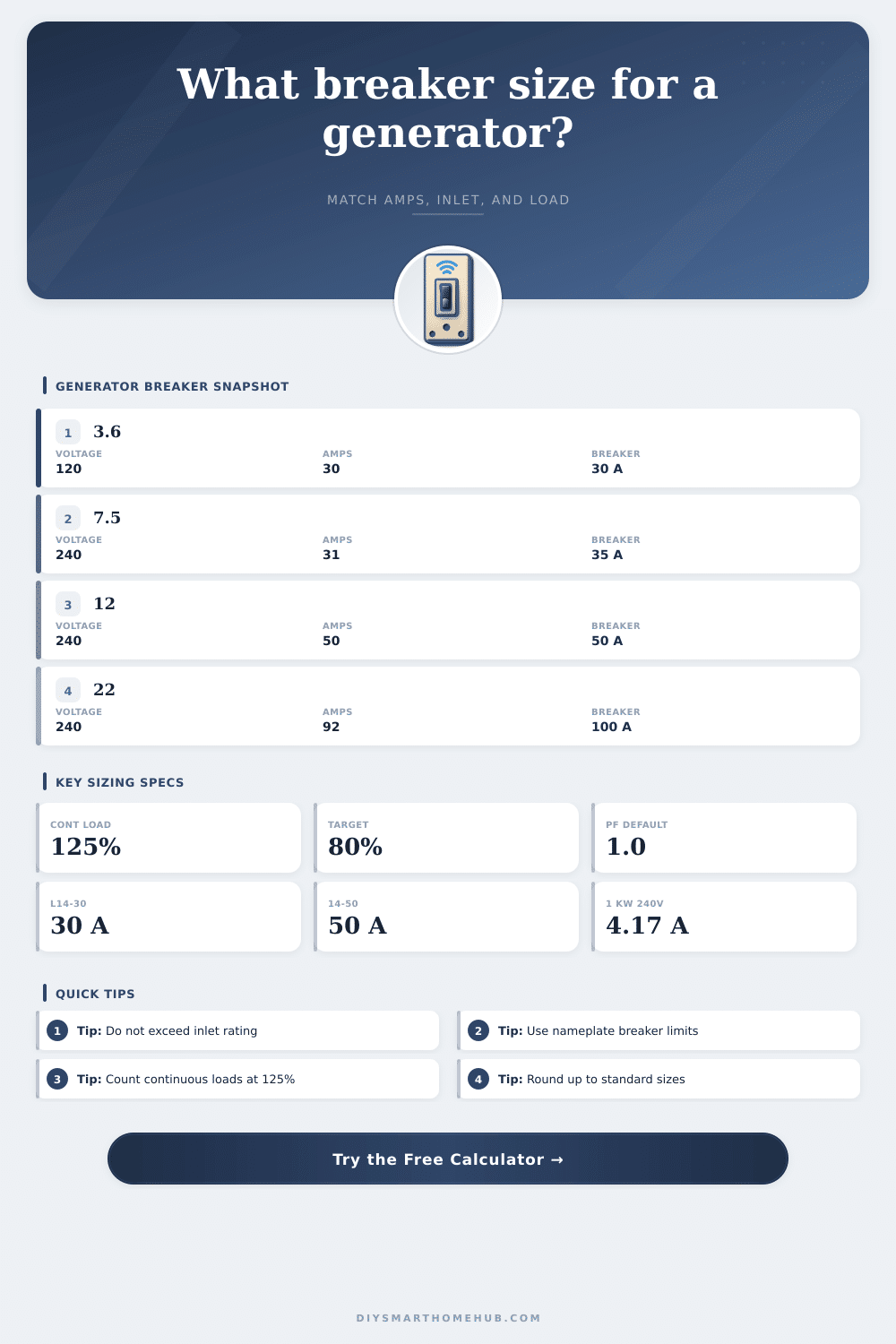
| 3.6 kW RV generator | 120 V single-phase | 30.0 A | 30 A RV or L5-30 connection |
| 5.0 kW portable | 120/240 V split-phase | 20.8 A | 30 A L14-30 inlet |
| 7.5 kW portable | 120/240 V split-phase | 31.3 A | 35 A breaker or 50 A equipment check |
| 12.0 kW portable | 120/240 V split-phase | 50.0 A | 50 A transfer inlet |
| 22.0 kW standby | 120/240 V split-phase | 91.7 A | 100 A generator breaker |
| System | Current Formula | Example | Sizing Use |
|---|---|---|---|
| 120 V single-phase | A = W / (120 x PF) | 3,600 W = 30 A | Small inverter and RV loads |
| 120/240 V split-phase | A = W / (240 x PF) | 7,200 W = 30 A | Most home transfer inlets |
| 240 V single-phase | A = W / (240 x PF) | 12,000 W = 50 A | Dedicated 240 V generator outputs |
| 208 V three-phase | A = W / (1.732 x 208 x PF) | 15 kW = 41.6 A | Small commercial generators |
| Continuous load | Adjusted A = noncont. A + cont. A x 1.25 | 40 A cont. = 50 A | Breaker load check |
| Equipment Rating | Common Connector | Max 240 V kW | Best Match |
|---|---|---|---|
| 20 A | L5-20 or 5-20 | 4.8 kW at 240 V equivalent | Small inverter circuits |
| 30 A | L14-30 or L5-30 | 7.2 kW | 5 kW to 7.5 kW portable |
| 50 A | 14-50 or CS6365 | 12.0 kW | 9 kW to 12 kW portable |
| 60 A | Hardwired disconnect | 14.4 kW | 14 kW standby |
| 100 A | Standby transfer switch | 24.0 kW | 20 kW to 24 kW standby |
| 200 A | Service-rated transfer | 48.0 kW | Large home standby equipment |
A generator breaker may trip unexpected in a situation if you dont have a good understanding of the relationship between the wattage of the generator and the amperage of the generator breaker. While many peoples focus on the total wattage that can be produced by a generator, the amperage of the electrical current is what a breaker regulate. Thus, understanding the difference between wattage and amperage is vital to understanding how a generator breaker will function.
While the wattage of a generator is rated at a peak level, that peak wattage is not the same then the continuous wattage that a generator will produce over an extended period of time. The peak wattage is the amount of power that a generator will output for a short burst of activity. The continuous wattage is the power that will be available to run the devices for an extended period of time.
How to Choose the Right Generator Breaker
In selecting a generator, you should use the continuous wattage to determine the electrical needs for the devices to be run by the generator. Using the peak wattage to calculate the needs of the devices will result in undersizing the equipment for the correct amount of power output. The voltage of the generator is another critical piece of information to understand when determining the amperage of the breaker.
The voltage will impact the amperage of the electrical current that will flow through the wire that are selected for the devices. For instance, 120 volts of power will require more amperage to move the same amount of power as a 240 volt circuit. Additionally, small inverter generators will have a different output voltage than a large standby generator.
If you dont account for the voltage when buying a generator and selecting a generator breaker, either a breaker that is too small for the generator or one that is too large will be selected. A breaker that is too small will continuously trip when the generator is turned on. A breaker that is too large will not provide adequate protection for the wiring of the generator if there is overloads in the devices.
The environment in which a generator will be used can also impact the actual output of the generator. Most generators are rated for ideal laboratory conditions. However, there are many environmental factor that can impact the performance of the generator.
For instance, if the location of the generator is at a high altitude or if propane fuel is used instead of gasoline for the generator, the generator will produce fewer watt of power than the nameplate indicates for the generator. To account for this difference in power output, a derate percentage can be used to calculate the actual electrical load that should be placed on the generator to avoid undersizing the generator according to the calculated load. Another consideration for the electrical load that will be operated by the generator is the continuous load rule.
Many electrical device will run for three hours or more before being turned off. Devices like refrigerators and sump pumps are examples of devices that will be a continuous load on a generator. These types of loads will create heat in the generator breaker and the electrical wire.
To avoid overheating the component of the generator, the generator breaker should be sized at 125% of the continuous load or the continuous load should not be more than 80% of the total rating of the generator breaker. Following the 80% rule will prevent the overheat of the generator breaker and electrical component. The physical limitation of the electrical inlet that will recieve the generator will also impact the electrical system that is created by the generator.
A generator may produce a significant amount of power. However, if the electrical inlet where the generator will be plugged in is an L14-30 inlet, the inlet will limit the power to 30 amps. Thus, the electrical inlet creates a limitation in the amount of power that can be transferred to the electrical devices.
Another consideration for electrical load is the rating of the transfer switch for the generator. If the calculated size for the generator breaker is more than the rating of the transfer switch, then the breaker and switch will be mismatched. Finally, calculations for the size of the generator breaker will need to be rounded.
The wattage and amperage calculations for the electrical device to be operated by the generator will not match the available size for generator breakers. The decision of what to round to will depend on the voltage of the generator and the limits for the transfer switch. Following the specifications in the manufacturers manual for the generator will ensure that the breaker will provide adequate protection for the generator.
In determining the size of the generator breaker, consideration must be given to the heat created by the breaker and electrical components, as well as ensuring the safety of the electrical system create by the generator.