Garage Exhaust Fan CFM Calculator
Estimate garage exhaust airflow from room volume, fume or heat ACH, vehicle bay loading, door-opening infiltration, duct losses, reserve margin, and rated fan size.
🔧Garage presets
📏Garage dimensions and use
Calculation breakdown
📊Garage fan and spec grid
📋Reference tables
| Garage use | ACH used | Best fit | Calculator meaning |
|---|---|---|---|
| Storage air refresh | 4 ACH | Occasional use | Basic stale-air turnover |
| Daily parking | 6 ACH | Attached garages | Odor and humidity dilution |
| Fume purge | 10 ACH | Vehicle entry periods | Faster contaminant dilution |
| Workshop exhaust | 12 ACH | Hobby work and tools | Higher continuous exhaust target |
| Heat purge | 15 ACH | Hot garages | Quick heat and air flushing |
| Fan class | Typical rating | Best use | Duct note |
|---|---|---|---|
| Small through-wall | 150-250 CFM | Single bay storage | Short 4-5 inch runs |
| Utility wall fan | 400-650 CFM | Two-car parking | 6-8 inch duct preferred |
| Inline mixed-flow | 650-1200 CFM | Workshop or fume purge | Use smooth duct and big caps |
| Large exhaust fan | 1200-1600 CFM | Three-car or hot shop | Check makeup air path |
| Duct diameter | Area | Quiet CFM range | High velocity flag |
|---|---|---|---|
| 4 inches | 0.087 ft² | 40-90 CFM | Over 125 CFM |
| 6 inches | 0.196 ft² | 100-220 CFM | Over 300 CFM |
| 8 inches | 0.349 ft² | 180-400 CFM | Over 550 CFM |
| 10 inches | 0.545 ft² | 280-620 CFM | Over 850 CFM |
| 12 inches | 0.785 ft² | 400-900 CFM | Over 1200 CFM |
| Preset example | Volume | Target CFM | Fan rating |
|---|---|---|---|
| Two-car daily garage | 4356 ft³ | 520 CFM | 650 CFM fan |
💡Garage sizing tips
Remember how it feels when you’ve driven home for hours and pull in the garage? You know the feeling like there’s thick stuff hanging in the air? No, it’s not residue from all those years of gathered dust on the boxes. It’s humidity, unburned hydrocarbons and carbon monoxide. But we has exhaust fans because that’s the stinky heavy air we’re trying to get rid of.
Unfortunately, most folks choose an exhaust fan based off what sounded coolest at the hardware store rather than what their actualy space needs. Getting the cubic feet per minute calculation right make the difference between a real exhaust fan (the kind that clears the air within minutes) versus a fan that merely circulates warm stagnant air around the room.
How to Choose the Right Garage Fan
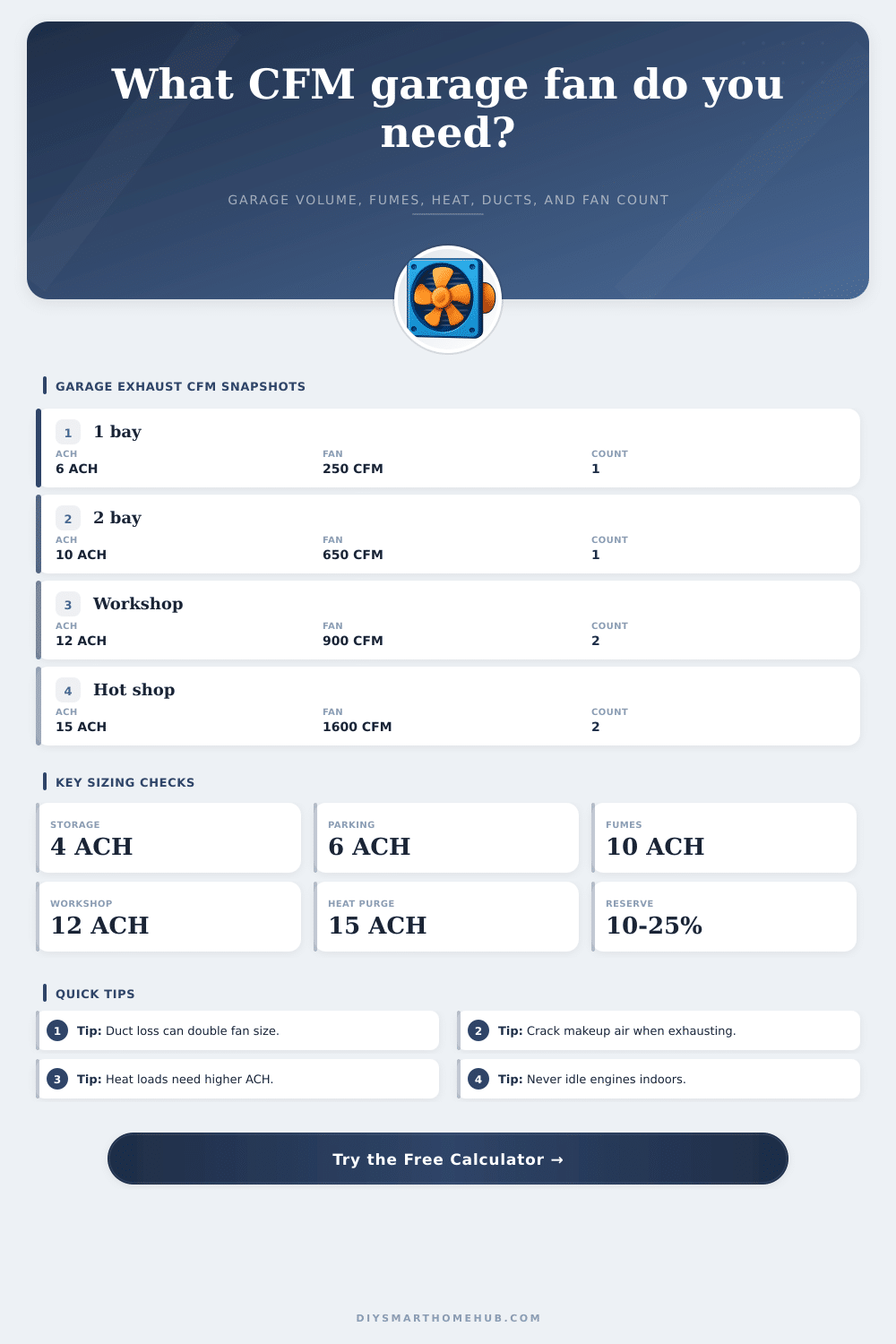
First, let’s talk about volume: How much of that space is air? That’s Length times Width times Ceiling Height. After you know that, you’ll choose an Air Changes per Hour rate based on what you do in there. This is based on how frequently you’d like to replace all the air in the room. Four per day may be sufficient if you just keep some cans of paint in a nice quiet storage shed. Twelve might be needed in an active workshop where you’re mixing solvents or grinding metal. The number increase to fifteen if you idle cars or run gas-powered tools.
Use the calculator above to enter your own numbers, it does the math for you so you don’t have to guess at how many changes per hour will work for you. But that’s where most homeowners trip up. They see a sticker on a fan box that reads eight-hundred CFM and figure, hey, I’m gonna get eight-hundred. Nope. Air doesn’t like going around corners or down skinny tubes. Each louvered vent cap, each bend in an elbow, every foot of flexible hose eat away at the motor’s performance. Run some dinky flexible duct for a few feet and you’ll find its effective airflow cut in half…or worse.
The tool takes that into account with its questions about elbow count, duct diameter and duct length. Then it lower the promised performance so that you know what you’re really going to get after it makes its way down the pipe. Small stuff, yes, but important if you’re trying to suck the fumes out before they has time to settle in your lungs.
The heat is different than the smoke. A garage is a box with lots of surfaces that can radiate heat. If you’re running your wood stove there or have a dark roof and the sun is out, it’s going to be an oven in there. Only moving air will cool it down but only if you move enough of it. So the heat purge calculation take into account how much BTU’s you’re trying to pull out of it and limits the amount of increase in temp while still maintaining a breathable environment. It very well may require much higher volume of air flow than simply masking odors. You may end up wanting multiple small fans rather than a single large fan. You want this to get coverage for a large bay area.
Lastly, remember makeup air. Without an intake grille or something like it (a crack in the door will work just as well), there’s nowhere for your exhaust fan to pull air from and it fights itself. Negative pressure on the garage pulls odor from inside the home or, worse, stalls the airflow altogether. It is that simple. You can’t suck air out of a vacuum seal.
Fan selection is a bit like buying a suit. You can find something off the rack that looks decent at the store, but it won’t fit your life. Running these calculations through the size calculator removes the guessing and lets you think like an engineer. Instead of wondering if the fan will be strong enough, you confidently use it. Your workspace shouldn’t be some temporary luxurius only available when it’s nice outside, your air should be clear by default. Start with the volume, account for the duct losses, and everything else will follow easy.