📶 Frequency to Period Converter
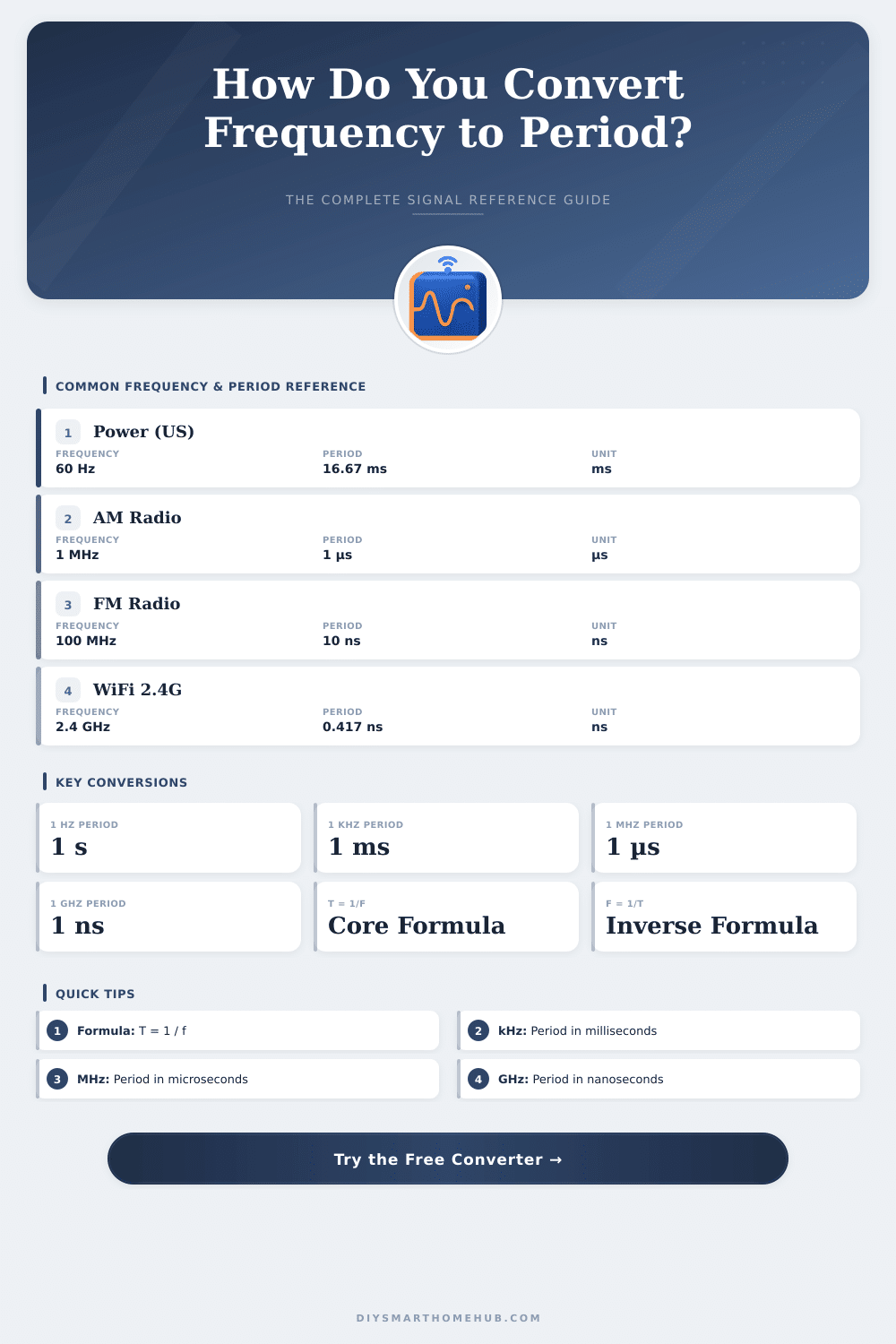
Instantly convert frequency (Hz, kHz, MHz, GHz) to period (s, ms, µs, ns) using T = 1/f
| Signal / Source | Frequency | Period | Period (Alt Unit) |
|---|---|---|---|
| DC (theoretical) | 0 Hz | ∞ (infinite) | — |
| Infrasound Low | 0.001 Hz | 1000 s | 16.67 min |
| Infrasound High | 20 Hz | 50 ms | 0.05 s |
| EU Mains Power | 50 Hz | 20 ms | 0.02 s |
| US Mains Power | 60 Hz | 16.667 ms | 0.01667 s |
| Musical A4 Note | 440 Hz | 2.273 ms | 2273 µs |
| Top of Human Hearing | 20 kHz | 50 µs | 0.05 ms |
| AM Radio (mid) | 1 MHz | 1 µs | 1000 ns |
| FM Radio (mid) | 100 MHz | 10 ns | 0.01 µs |
| WiFi 2.4 GHz | 2400 MHz | 0.4167 ns | 416.7 ps |
| WiFi 5 GHz | 5000 MHz | 0.2 ns | 200 ps |
| CPU 3 GHz Clock | 3000 MHz | 0.333 ns | 333.3 ps |
| Visible Light (mid) | 500 THz | 2 fs | 0.002 ps |
| Unit Name | Symbol | In Seconds | Typical Use |
|---|---|---|---|
| Second | s | 1 s | Very low freq (<1 Hz) |
| Millisecond | ms | 0.001 s (10⁻³) | Audio, power (20–1000 Hz) |
| Microsecond | µs | 0.000001 s (10⁻⁶) | RF, ultrasound (kHz–MHz) |
| Nanosecond | ns | 10⁻⁹ s | GHz signals, CPUs |
| Picosecond | ps | 10⁻¹² s | Microwave, radar |
| Femtosecond | fs | 10⁻¹⁵ s | Optical / laser pulses |
| Band Name | Frequency Range | Period Range | Application |
|---|---|---|---|
| ELF (Extremely Low Freq) | 3–30 Hz | 33–333 ms | Submarine comms |
| SLF (Super Low Freq) | 30–300 Hz | 3.3–33 ms | AC power systems |
| Audio Band | 20 Hz–20 kHz | 50 µs–50 ms | Music, voice |
| LF (Low Freq) | 30–300 kHz | 3.3–33 µs | AM Longwave radio |
| MF (Medium Freq) | 300 kHz–3 MHz | 0.33–3.3 µs | AM broadcast |
| HF (High Freq) | 3–30 MHz | 33–333 ns | Shortwave radio |
| VHF (Very High Freq) | 30–300 MHz | 3.3–33 ns | FM radio, TV |
| UHF (Ultra High Freq) | 300 MHz–3 GHz | 0.33–3.3 ns | WiFi, cell, GPS |
| SHF (Super High Freq) | 3–30 GHz | 33–333 ps | Satellite, radar |
| EHF (Extremely High Freq) | 30–300 GHz | 3.3–33 ps | 5G mmWave |
| Frequency | Period | Wavelength (air) | Application |
|---|---|---|---|
| 60 Hz | 16.67 ms | 5,000 km | US power grid |
| 1 kHz | 1 ms | 300 km | Audio reference |
| 1 MHz | 1 µs | 300 m | AM radio |
| 100 MHz | 10 ns | 3 m | FM radio |
| 2.4 GHz | 0.417 ns | 12.5 cm | WiFi / Bluetooth |
| 5 GHz | 0.2 ns | 6 cm | WiFi 5 GHz |
| 60 GHz | 16.7 ps | 5 mm | WiGig / 5G mmWave |
Whether you need to switch between frequency and period? Here is exactly that, what this converter does. Frequency and period are mirror versions one of the another in math.
Change one of them and you receive the second. At its base, it is very simple: the period shows how much time lasts one single cycle in something that repeats.
How to Convert Frequency and Period
The math that stands behind it is not hard. For counting frequency from period, one uses the formula f = 1/T. Simply take one and share it by your period. For going the other way?
T = 1/f does the task. When dealing with angular frequency, there are some other handy equations that float around, for instance ω = 2π/T for converting period to angular frequency, and T = 2π/ω leads you back the same way.
Frequency measures usually in hertz or Hz, what simply means cycles each second. If you know the frequency value in hertz, then converting it to period in seconds or milliseconds or microseconds is only a question of flipping the number. For instance, a period of 20 microseconds matcesh around 50 000 Hz, or 50 kHz, to keep it neat.
Any such converter turns out more useful than one would think. In technical data kinds of signals are commonly listed by frequency, but during actual testing or simple calculations the period in seconds or there parts are truly what one needs. A quick tool means to end the manual math calculations always, when you must switch between the two.
Here is another way to find frequency from rough knowledge. Share the speed of the wave by its wavelength, and you arrive there. Assume that a wave moves at 5 metres each second with a wavelength of 4 metres, that gives 5 shared by 4, resulting in 1.25 Hz.
Later reverse those frequencies, and you have your period.
Here is a good point: one whole period always matches 360 degrees. Take your time, share it by the period, later multiply the result by 360, and you converted it to degrees. The units erase, leaving you only with degrees.
Code can easily trip folks with such conversion. It commonly appears during calculation of cyclical times, share one by your frequency, later multiply by a million to get microseconds. Those math steps must be exact in your working program.
Basically: conversion of frequency to period maybe sounds abstract, but it is abasic part in science and engineering that stays active.