⚡ Transformer Efficiency Calculator
Calculate efficiency, losses, load factor, and output power for any transformer
| Load Factor | Output kW (PF=0.85) | Total Losses (W) | Efficiency (%) |
|---|---|---|---|
| 25% | 21.25 kW | 394 W | 98.18% |
| 50% | 42.5 kW | 675 W | 98.44% |
| 75% | 63.75 kW | 1144 W | 98.24% |
| 100% | 85 kW | 1800 W | 97.93% |
| 125% | 106.25 kW | 2644 W | 97.57% |
| kVA Rating | Core Loss (W) | Full-Load Cu Loss (W) | Max Eff. at Load (%) |
|---|---|---|---|
| 15 kVA | 65 | 350 | 43% |
| 25 kVA | 85 | 500 | 41% |
| 50 kVA | 150 | 850 | 42% |
| 100 kVA | 300 | 1500 | 45% |
| 250 kVA | 550 | 3000 | 43% |
| 500 kVA | 900 | 5500 | 40% |
| 1000 kVA | 1500 | 9000 | 41% |
| Power Factor | Apparent Power (kVA) | Real Power (kW) | Reactive Power (kVAR) |
|---|---|---|---|
| 0.70 | 75 | 52.5 kW | 53.6 kVAR |
| 0.80 | 75 | 60.0 kW | 45.0 kVAR |
| 0.85 | 75 | 63.75 kW | 39.5 kVAR |
| 0.90 | 75 | 67.5 kW | 32.6 kVAR |
| 0.95 | 75 | 71.25 kW | 23.5 kVAR |
| 1.00 | 75 | 75.0 kW | 0 kVAR |
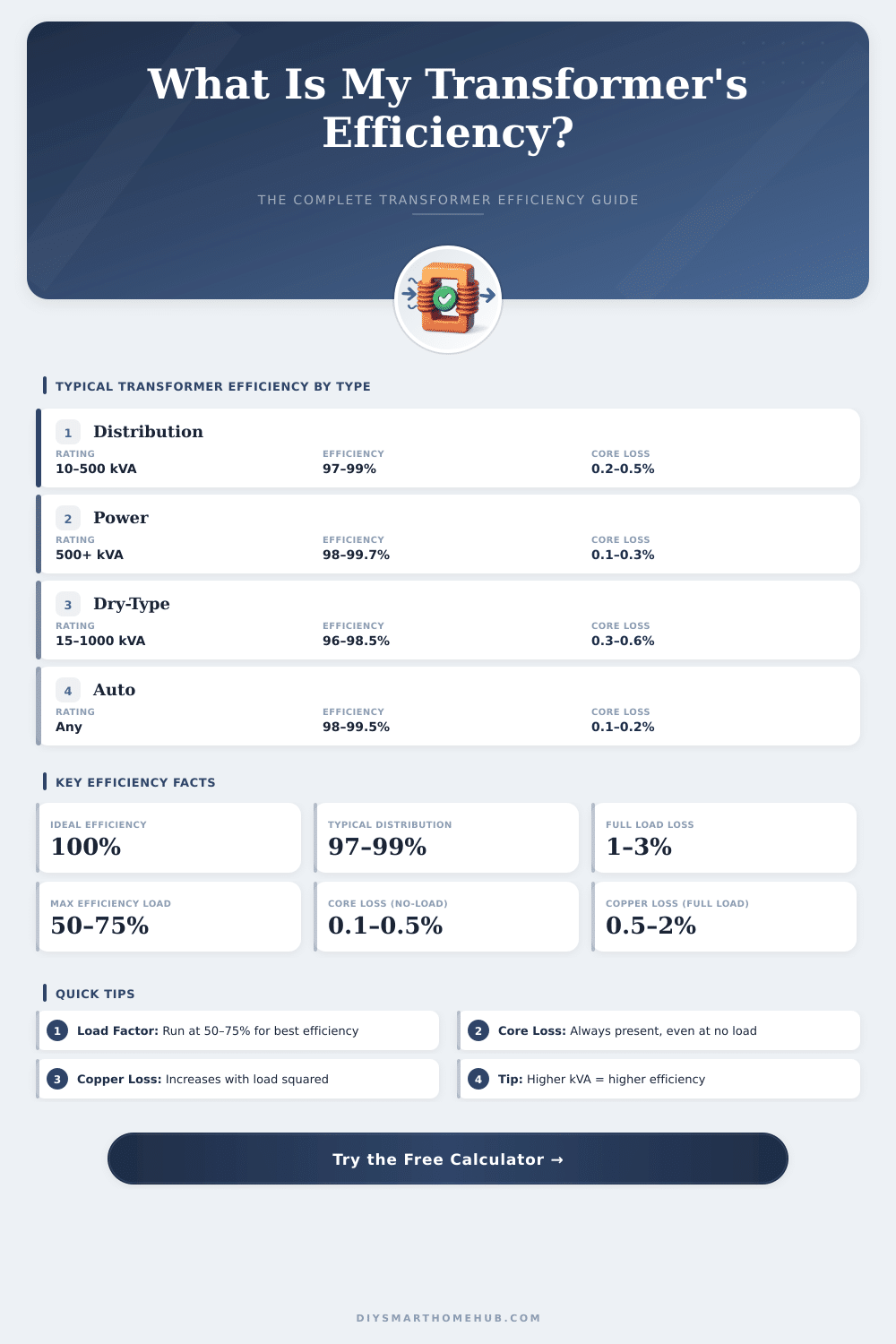
Transformers are made up of electrical parts without moving parts, what makes them reliable and long-lasting. Even so, part of the power is lost during the process, so they do not reach truly 100 percent efficiency. Efficiency of a transformer simply shows the ratio between useful output power and total input power.
One shows it by means of percentages, using the Greek sign eta. The calculation itself is easy: one divides the output power by the input, then multiplies by 100. The more the output gets close to the input the more well the device works.
Why transformers are not fully efficient
So, why are transformers not fully efficient? Two main kinds of losses exist: copper losses and core losses. Copper losses happen because of the resistance in the wire of the winding.
Core losses come from eddy flows and hysteresis in the magnetic material. Input power always matches the output plus everything what is lost along the way.
Here is something notable about the behavior of those losses. Core losses stay fairly steady, when the transformer operates, regardless of the load. Copper losses change with the load.
At light loads, core losses become the main cuase of waste. The device reaches its peak efficiency where copper and core losses match. That forms a typical curve of efficiency, that changes with the load.
With no load, a transformer still uses a bit of power, mainly because of the magnetic flow. If one uses too big a transformer for the task, the core losses could cause bigger energy loss then with proper load. So, the size matters for controlling the heat waste.
A transformer with a high turns ratio, for instance 12V to 380V rather than 12V to 230V with same core, most probably has a bit more lower efficiency due to that high ratio.
Practical transformers usually reach efficiency between 95 and 99 percent. Very big models can go up to 99.7 percent. Modern distribution transformers reach 99.48 percent efficiency in standard tests.
Also the temperature matters. A transformer with 80 degree Celsius rise uses 13 to 21 percent less energy to operate than one with 150 degree rise. A more efficient device makes less useless heat from the start.
To improve the efficiency, one uses better core material with low hysteresis and low eddy losses. Thinner sheets in the iron core also reduce eddy losses. Step-up transformers help in long distance power transfer by means of higher voltage and reduced current, what lowers resistive losses in the cables.
Even so, transformers can not increase the total power. The wattage stays limited by the source. At around 80 percent efficiency, the turns ratios must adjust tocompensate for that unavoidable waste.