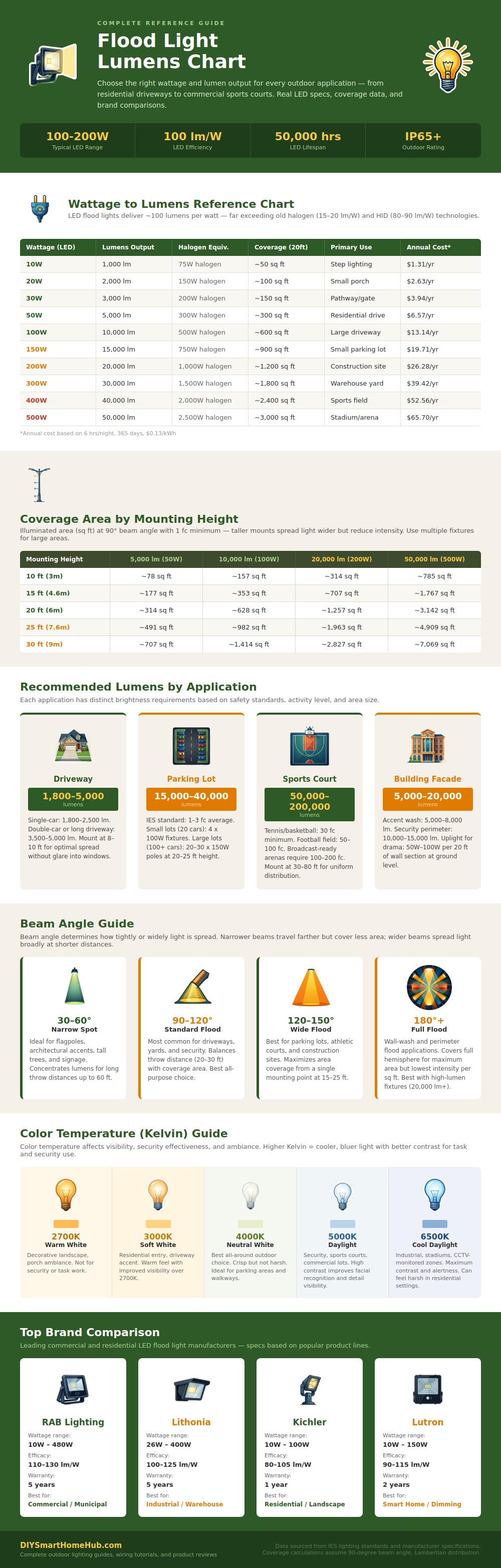
When choosing between flood lights, you must consider the relationship between lumens, distance, and purpose. Lumens measures the visible light of a flood light. The lumen is the most important factor that you should consider when purchasing a flood light.
If there is to few lumens in a flood light, the light will be too dim for the area that you wish to illuminate. If there are too many lumens, the flood light will create glare for your neighbors. Wattage are often used as a measurement of the brightness of flood lights.
How to Choose the Right Flood Light
However, wattage is actualy the measurement of the electricity that the flood light use. LED flood lights use less electricity than halogen lights. However, LED lights can provide the same amount of light output as halogen flood lights.
When purchasing a flood light, focus on lumens instead of the wattage of the flood light. Flood lights that is mounted at higher elevations will illuminate a larger area. If a flood light is mounted at a height of ten feet, the light will be very intense on the ground below the flood light.
However, if you mount the same flood light at a height of twenty-five feet, it will illuminate a much more larger area. The higher that you mount a flood light, the more light that can illuminate an area. However, the intensity of the light on the area will be less.
The purpose of your flood light will determine the amount of light that it should emit. If you have a single car driveway, you will need less light than a commercial parking lot. A commercial parking lot will require more light to allow the people in the parking lot to clear see there surroundings.
Security lighting should use color temperatures that is cooler than the rest of the lights in the area. The use of cooler colors increase the contrast between the dark and light areas in the security lighting. Security cameras will be able to see the dark and light areas with more contrast, and the humans that are viewing the security camera feed will also be able to recognize the faces of people who are at a distance.
Flood lights comes in different beam angles. If the beam angle of the flood light is narrow, the light will illuminate the area to a great distance. However, the sides of the area will remain dark.
If the beam angle is wide, the flood light will illuminate a large area. However, the intensity of the flood light will be reduce. Most residential yards will use a standard flood range for the beam angle.
Parking lots will use a wider beam angle so that the entire parking lot can be illuminated. Color temperatures of flood lights range from warm white to cool daylight. Warm white lights are used for areas like front porches.
However, warm white lights does not allow people to clearly see the details in their designated area. Cool daylight light is better for task areas because it allow people to clearly see the details of their area of task. The color temperature of a flood light will determine the amount of detail that can be seen in that lights beam.
The most common mistake when purchasing flood lights is to purchase the brightest flood light without consider the needs of the area. A bright flood light may be suitable for a small yard, for example, but it may create glare and may not appropriately illuminate the area for your neighbors. First, determine the area that need light.
Then, determine the height at which the flood light should of been mounted. Finally, find the correct lumen and beam angle flood lights for that area. If you properly match these factors with the area that you want to illuminate, the flood light will function correct.