Evaporative Cooler Calculator
Estimate wet-bulb temperature, climate suitability, delivered air temperature, room ACH, required CFM, evaporation water use, and sensible cooling capacity from one consistent evaporative cooling model.
Evaporative Cooling Output
Calculated from dry bulb, wet bulb, saturation efficiency, room volume, airflow, and water evaporation.
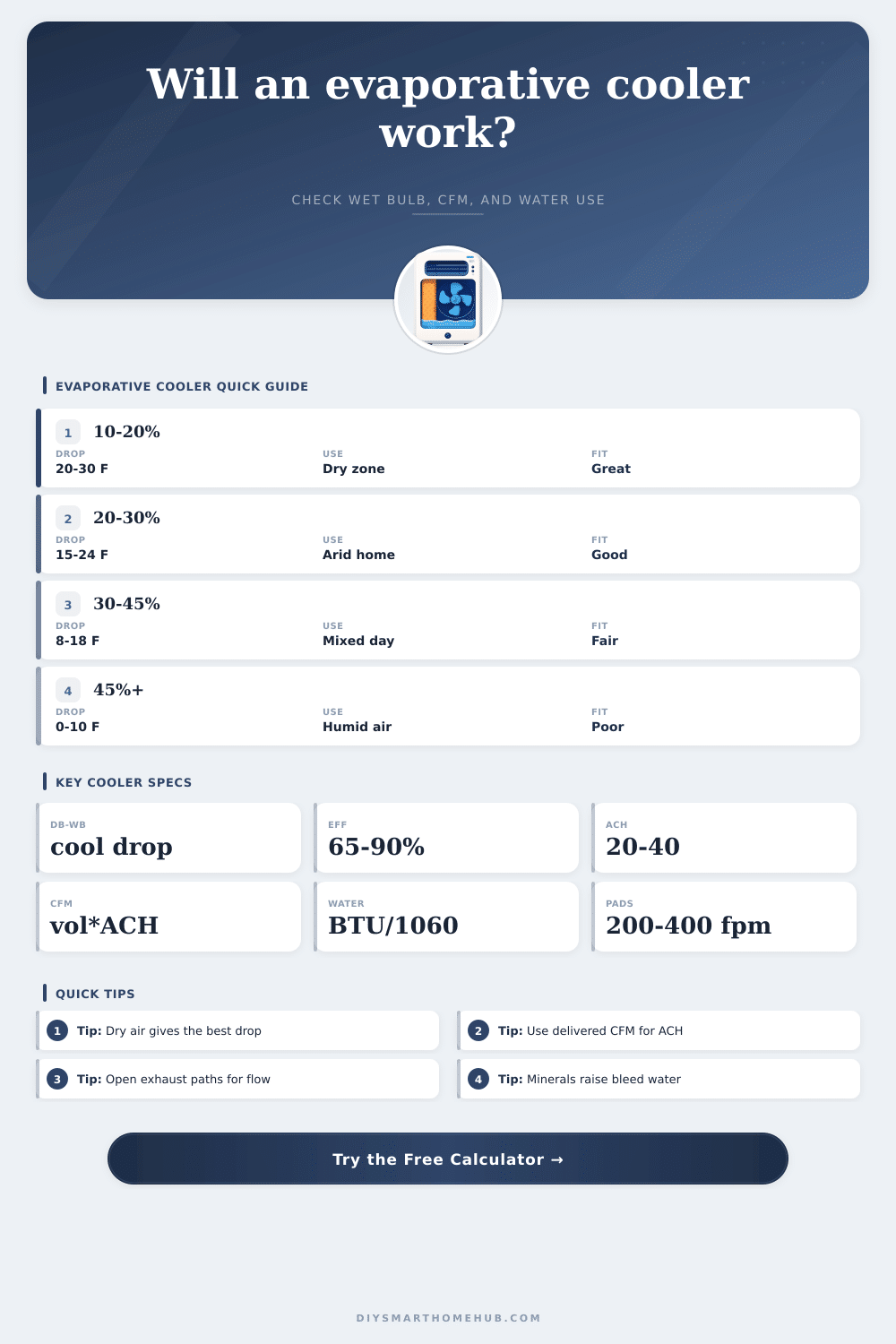
| Climate condition | Typical RH | Wet-bulb depression | Evaporative cooling suitability |
|---|---|---|---|
| Hot arid afternoon | 10% to 20% | 20 F to 35 F | Excellent: large temperature drop is possible. |
| Dry summer house | 20% to 30% | 15 F to 28 F | Good: direct evaporative coolers can be effective. |
| Mixed or monsoon day | 30% to 45% | 8 F to 18 F | Fair: useful airflow, but less temperature drop. |
| Humid coastal day | 45% to 60%+ | 0 F to 10 F | Poor: humidity limits evaporation and cooling. |
| Cooler type | Common airflow | Saturation efficiency | Best use |
|---|---|---|---|
| Personal desktop or tent cooler | 200 to 400 CFM | 55% to 70% | Spot cooling with short throw and low static pressure. |
| Portable tower or rolling unit | 500 to 1200 CFM | 60% to 75% | Bedrooms, offices, small garages, and patio rooms. |
| Window or through-wall cooler | 1500 to 4500 CFM | 65% to 82% | Single large rooms or small apartments with exhaust relief. |
| Side-draft or down-draft whole-house cooler | 4500 to 9000 CFM | 75% to 88% | Whole-house cooling in dry climates with open windows. |
| Greenhouse or commercial evaporative section | 10000 to 25000+ CFM | 80% to 90% | High ventilation loads with large pad face area. |
| Space served | Common volume | ACH target | Approximate CFM |
|---|---|---|---|
| Bedroom or office | 1200 to 1800 cu ft | 20 to 30 ACH | 400 to 900 CFM |
| Garage bay or studio | 3000 to 5000 cu ft | 25 to 35 ACH | 1250 to 2900 CFM |
| Open-plan living zone | 5000 to 9000 cu ft | 25 to 40 ACH | 2100 to 6000 CFM |
| Whole-house dry-climate setup | 12000 to 20000 cu ft | 25 to 40 ACH | 5000 to 13300 CFM |
| Formula item | Calculation | Typical range | What it means |
|---|---|---|---|
| Delivered air temperature | DB - Eff x (DB - WB) | 60% to 90% efficiency | Pad outlet temperature before room heat gain. |
| Recommended airflow | Volume x ACH / 60 | 20 to 40 ACH | CFM needed to exchange the space quickly. |
| Sensible cooling capacity | 1.08 x CFM x temp drop | Varies with dry air | Approximate BTU/h removed from entering air. |
| Evaporation water | BTU/h / 1060 / 8.34 | 0.2 to 10+ gal/h | Gallons per hour evaporated, before bleed allowance. |
Evaporative cooling depends on wet-bulb depression, not just the outdoor temperature. A 95 F day at 15% RH can cool dramatically; a 85 F day at 60% RH may not.
Delivered CFM only works when the space has an exhaust path. Open windows, vents, or relief dampers allow moist air to leave so new cooled air can replace it.
An evaporative cooler is an machine that uses water to lower the temperature of the air in a room. In order to effectively utilize an evaporative cooler, it is important to understand how the humidity in the outside air can impact the ability of the cooler to lower the air temperature in the room. In general, the cooler will be able to effectively lower the temperature of the air in the room if the outside air are dry.
However, if the outside air contains alot of moisture, the cooler will not be able to effectively lower the air temperature within the room. One of the factor that can be used to determine whether an area is dry or humid is the difference between the dry bulb and wet bulb temperatures. The dry bulb temperature are a measurement of the heat within the air.
Things That Affect How Well an Evaporative Cooler Works
It does not, however, help to indicate the amount of moisture present within the air. The wet bulb temperature is one that does provide information regarding the moisture within the air. The wet bulb temperature measure the lowest temperature that the air within a space can be lowered through the evaporation of moisture.
A large wet bulb depression in an area indicates that the air within that area is dry. A large wet bulb depression, therefore, indicates that an evaporative cooler will be able to effectively lower the air temperature within the room. A small wet bulb depression, on the other hand, indicates that the air within that area is humid.
Thus, an evaporative cooler will not be able to effectively lower the temperature of the air within the room. The saturation efficiency of the evaporative cooling pad can also impact the effectiveness of the cooler. Saturation efficiency indicate the proximity of the air within the pad to the wet bulb temperature.
Different types of evaporative cooling pads has different saturation efficiencies. For instance, a rigid media pad may have a high saturation efficiency compared to an aspen pad. The saturation efficiency of the pad will have a direct effect upon the air temperature within the room.
Higher saturation efficiencies will lead to lower temperatures of the air that pass through the evaporative cooler. Thus, higher saturation efficiencies means that the cooler will be more effective at lowering the indoor air temperatures. Other factor that can impact the effectiveness of an evaporative cooler are the size of the room and the number of air changes per hour within that room.
An evaporative cooler work by replacing the warm air within the room with cool air from the cooler. To accomplish this, the room must have an appropriate amount of airflow. Airflow can be calculated by multiplying the area of the room by the height of the ceiling to determine the volume of the room in cubic feet.
The cubic feet of the room can be multiplied by the number of air changes per hour to determine the required number of cubic feet of airflow per minute. If the cooler dont provide enough cubic feet per minute of airflow, it will not be able to effectively cool the room. Another factor to consider with the operation of an evaporative cooler is the amount of water that will be consumed by the cooler.
The amount of water that evaporates from the pad will help to lower the temperature of the air. Therefore, the amount of water that the cooler will use is directly related to the humidity of the air outside of the cooler. In dry regions of the country, where the air contains little moisture, the evaporative cooler will use a low amount of water.
In regions that are humid, however, the cooler will use more water to lower the air temperatures in the room. The amount of water that will be used by the cooler increase as a result of the need for the cooler to run for longer periods of time in an attempt to cool the indoor air. Finally, a bleed factor will need to be added to the amount of water that is calculated as will be used by the cooler.
The bleed factor ensure that the minerals in the water do not accumulate within the cooler. It is also necessary to perform regular maintenance of the evaporative cooler. Over time, the cooling pad can become covered in dust and minerals.
This accumulation of dust and minerals will lead to a decrease in the amount of air that can move through the cooler. As a result, the saturation efficiency of the pad will decrease. Additionally, the decrease in saturation efficiency will lead to an increase in the temperature of the air that exit the evaporative cooler.
To avoid these issues, it is important to perform regular cleanings of the cooling pad. For instance, you can rinse the pad with water every month to ensure that it maintains as high a saturation efficiency as possible. Finally, other factor that will impact the performance of the cooler are the placement of the cooler and the placement of windows in the house.
To assist in circulating the air that is produced by the cooler, it is important to open a window on the opposite wall from the cooler. If the windows is left closed, the cooler will struggle to move the air within the house and the cooler air wont be able to reach the corners of the house. Thus, the movement of the air within the house is just as important as any specification regarding the cooler itself.