Room Air Exchange Calculator
Estimate room volume, adjusted ACH target, required CFM, delivered fan airflow after derating, and purge time for bedrooms, baths, workshops, offices, kitchens, and utility rooms.
Presets
Inputs
Live Notes
Results
Fan And Ventilator Spec Grid
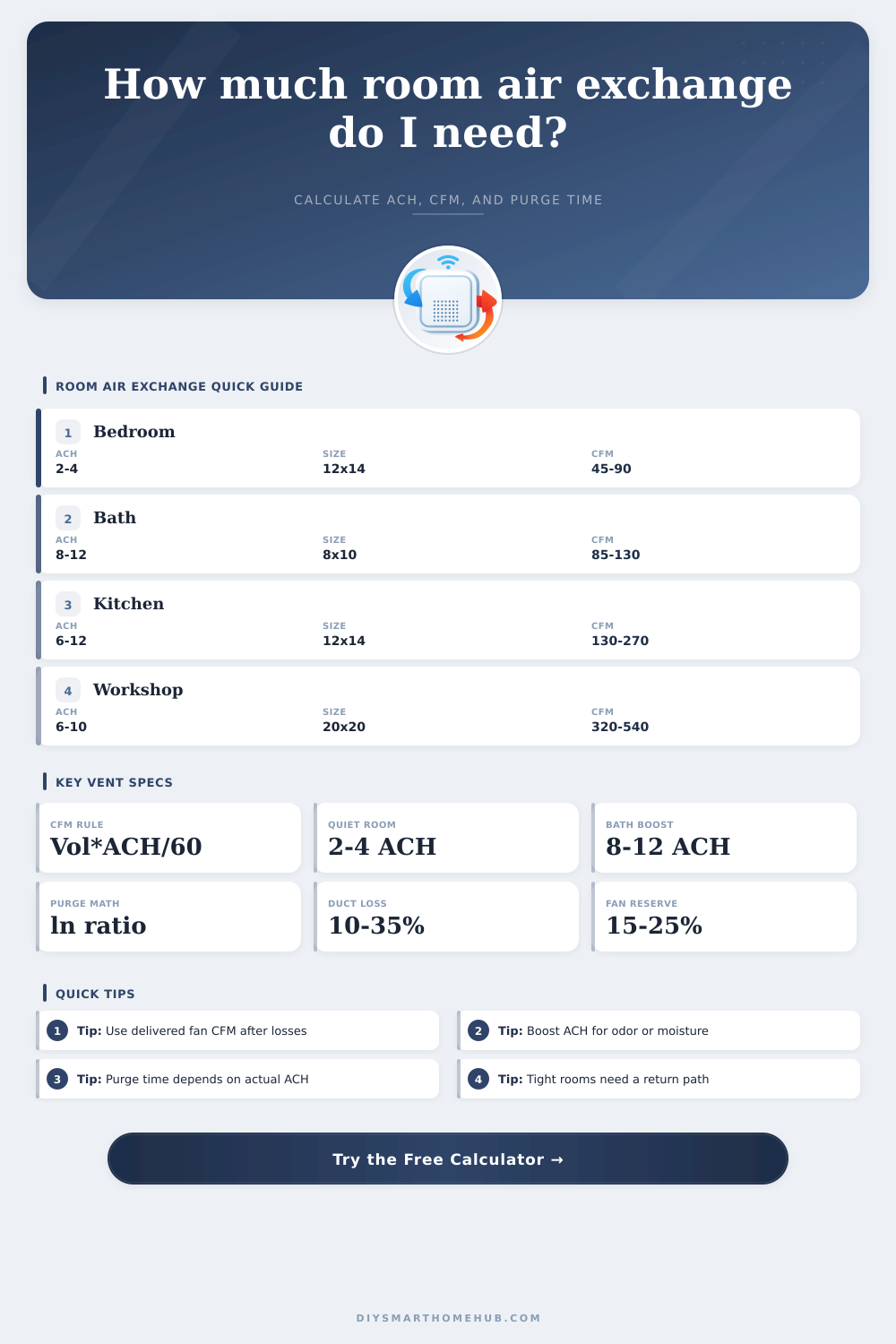
Room ACH Reference Table
| Room type | Common ACH range | Typical driver | Planning note |
|---|
Room Size And CFM Examples
| Example room | Volume | Target ACH | Required CFM |
|---|
Derating Reference Table
| Air path condition | Suggested derate | 110 CFM fan delivers | Use when |
|---|
Purge Time Reference Table
| Delivered ACH | 50% remaining | 25% remaining | 10% remaining |
|---|
Practical Tips
Rated airflow is measured under favorable test conditions. A grille, backdraft damper, elbow, wall cap, or closed door can reduce delivered CFM enough to miss the ACH target.
Purge time assumes well-mixed air. Strong source locations, dead corners, and missing return paths can leave pockets of stale air even when the math looks adequate.
Air turnover are essential to room management. Air turnover ensures that stale, damp, or odor-filled air dont remain in a room. If the air does not turn over in a room, the air within that space will not be refreshed.
To allow air to turn over at a proper rate within a room, one must understand the volume of that room and the performance of a ventilation fan within that space. The volume of a room is the first measurement that must be calculated. The volume of a room determine how much air is within the room.
How to Calculate Air Changes in a Room
To calculate the volume of a room, one measures the length of the room, as is the width of the room. The height of the room is also measured. These three dimension are multiplied to determine the volume of air within the room.
Once you know the volume of the room, the air changes per hour (ACH) can be calculated. Air changes per hour is a measurement of how many times fresh air can replace the total volume of air in a room within one hour. Different rooms may have different air changes per hour because different rooms has different needs.
For instance, a bedroom may require fewer air changes per hour then a bathroom, and a bathroom may require fewer air changes per hour than a workshop room. Several factor affect how many air changes per hour are required within a room. One factor is the number of people within that room.
The more people within a room, the more air changes per hour that is required to allow the air within the room to remain fresh. Another factor is the pollutants within the room. Air changes per hour must be increased if a room contains high level of moisture, dust, or odors.
This is to allow for the dilution of those pollutants within the room. Dilution is the process of replacing the air within a space with fresh air. This process is especially important in a room that does not have a dedicated exhaust hood.
It is also important to distinguish between the rated performance of a fan and its deliver performance. The rated performance is represented as the nameplate CFM of a fan. CFM is a unit of measurement of the amount of cubic feet of air that pass through a fan in the span of one minute.
The fans nameplate provides this unit of measurement. However, the delivered performance of a fan will often be less then the nameplate CFM reading. This is because the delivered CFM of the fan will be less due to obstacle within the room to which the fan is installed.
The obstacles to the movement of air within the room may include the presence of grilles, ducts, elbows, and wall caps. These can create resistance within the system for airflow. As a result, there will be a loss in airflow within the room.
Fifteen to twenty-five percent of the required airflow is typically lost due to these obstacle. However, if the path of the air is forced to travel a longer path due to these obstacles, the airflow may be lost to thirty-five percent or more. In these situations, the delivered CFM is used to calculate the air changes per hour for the room.
Purge time is the amount of time that a fan will have to run in order to remove a specific amount of air from the room. If an odor is to be removed from the room, or if moisture is to be removed from the room, then the purge time will have to be calculated. The purge time will depend upon both the air changes per hour that are delivered to the room and the amount of air that is desire to remain in that room.
The longer that air is to remain in the room, the longer that the room will have to be purged. There are a variety of physical variable in the real world that may prevent the air to behave as mathematically modeled. For instance, air may become stagnant in the corners of a room, or doors may prevent the air from flowing in the desired path.
Additionally, fans may move air within the ceiling of a room, but that air may not move within the lower portion of the room. Furthermore, fans require air to entering the fan in order to function; this air is referred to as “makeup air”. If there is not enough makeup air to enter the fan to replenish the air that the fan removes from the room, the fan will work harder to move that air, but may not successfully move that air from room to exhaust location.
When purging a room of air, it is recommended that some margin is provided for airflow. Enough airflow are required to meet the needs of that room, but there should be some additional margin so that if an air grille is blocked or a door is closed, the airflow will not be entirely eliminate. These calculation can be made in advance of purchasing the required fan.
Additionally, once the fans are installed, youll have to observe the room to ensure that the air is change within the room.