Electric Radiator Size Calculator
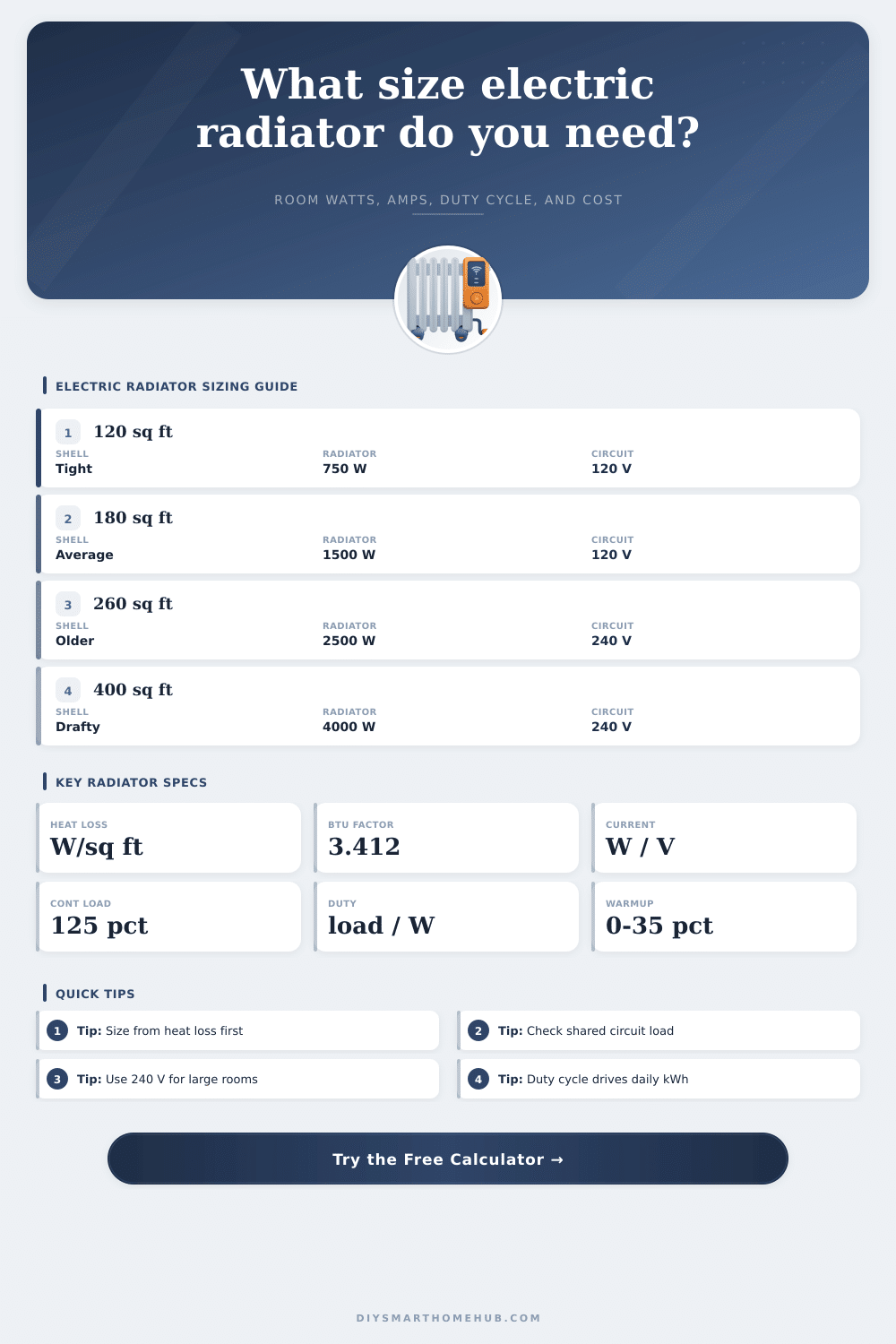
Estimate the electric radiator wattage for one room from heat loss, warmup allowance, thermostat duty cycle, voltage/current, breaker headroom, shared circuit load, and daily operating cost.
🏠Electric radiator presets
Choose a typical room and circuit scenario, then adjust the inputs for your actual space.
📏Radiator sizing inputs
🔎Live sizing check
📊Electric radiator spec grid
Bathroom or small ensuite heat with low air movement.
Good fit for tight bedrooms, offices, and small zones.
Common 120 V portable class with slower, steadier cycling.
Large room output normally needs a dedicated 240 V circuit.
📘Reference tables
| Room profile | Baseline watts | Best use | Adjustment cue |
|---|---|---|---|
| Tight interior room | 5 W/sq ft at 50 F split | Interior bedrooms and halls | Use lower warmup allowance if temperature is stable |
| Modern exterior room | 7 W/sq ft at 50 F split | Updated windows and insulated walls | Often fits a 750 W to 1500 W radiator |
| Average insulated room | 10 W/sq ft at 50 F split | Typical existing rooms | Ceiling height and window area matter |
| Older exterior room | 14 W/sq ft at 50 F split | Older walls or exposed corners | Add margin before selecting a standard size |
| Drafty or glazed room | 18 W/sq ft at 50 F split | Sunrooms and leaky rooms | Expect high duty cycle in cold weather |
| Standard size | BTU/hr equivalent | 120 V amps | 240 V amps |
|---|---|---|---|
| 500 W | 1,706 BTU/hr | 4.2 A | 2.1 A |
| 750 W | 2,559 BTU/hr | 6.3 A | 3.1 A |
| 1000 W | 3,412 BTU/hr | 8.3 A | 4.2 A |
| 1500 W | 5,118 BTU/hr | 12.5 A | 6.3 A |
| 2000 W | 6,824 BTU/hr | 16.7 A | 8.3 A |
| 3000 W | 10,236 BTU/hr | 25.0 A | 12.5 A |
| 4000 W | 13,648 BTU/hr | 33.3 A | 16.7 A |
| Circuit plan | Usable continuous load | Typical radiator ceiling | Shared-load note |
|---|---|---|---|
| 120 V 15 A shared | 1,440 W before existing load | 750 W to 1000 W | Existing receptacle loads can quickly reduce headroom |
| 120 V 20 A dedicated | 1,920 W | 1500 W | Common upper limit for plug-in electric radiators |
| 240 V 15 A dedicated | 2,880 W | 2500 W | Useful for larger fixed panel or baseboard units |
| 240 V 20 A dedicated | 3,840 W | 3000 W to 3500 W | Good match for large living spaces |
| 240 V 30 A dedicated | 5,760 W | 4000 W to 5000 W | Often used for large room or multi-panel circuits |
| Room example | Area | Heat loss input | Likely radiator |
|---|---|---|---|
| Bathroom or ensuite | 45 to 70 sq ft | Tight to modern | 300 W to 750 W towel or panel radiator |
| Small bedroom | 100 to 140 sq ft | Modern to average | 750 W to 1500 W panel or oil-filled radiator |
| Living room | 170 to 250 sq ft | Average exterior room | 1500 W to 2500 W radiator class |
| Sunroom | 120 to 220 sq ft | Drafty or glazed | 2000 W to 4000 W, often 240 V |
| Workshop or garage | 250 to 450 sq ft | Garage profile | 3000 W to 5000 W fixed radiator |
💡Electric radiator sizing tips
Electric radiators convert nearly all input watts into room heat, so the sizing decision is mostly the room loss at design temperature plus any warmup allowance you want.
A 1500 W plug-in radiator can already use most of a 15 A shared circuit after the continuous-load factor, so existing loads and breaker size matter.
Electric radiator work by transforming the electrical input into heat energy. The effectiveness of an electric radiator is dependent upon the rate at which the room with the electric radiator lose heat to the outside environments. The rate at which a room loses heat to the outside environment is due to the walls of the room, the windows in the room, the height of the ceiling of the room, and how exposed the room is to the outside weather.
The calculator will perform the mathematical calculations for the user regarding the rate at which the room will lose heat. The calculator will calculate these values after the user enter the size of the room that is to be heated and the temperature difference between the inside and outside of the room. Thus, the calculator eliminates the user from having to guess the mathematical calculations for the heat loss from the room.
How to Choose the Right Electric Radiator
Many people make the mistake of purchasing an electric radiator based off solely upon the square footage of the room to be heated. Two room may have the same square footage, but one may have three exterior walls and the other may be an interior room. Thus, the calculator allows for the user to account for these different conditions of the rooms by allowing the user to select a heat loss profile for the radiator.
For instance, the interior walls of a house may require fewer watt of heat than a sunroom with drafty exterior walls. Another factor that individuals who are selecting an electric radiator often overlook is the duty cycle of the electric radiator. Electric radiators do not continuously run at full power; instead, the thermostat that control the radiator will cycle the radiator on and off in response to the temperature of the room being heated.
For instance, a thermostat may set the electric radiator to turn on when the temperature of the room reach 68 degrees, and then the thermostat will turn the electric radiator off when the temperature of the room reaches 72 degrees. This cycle will repeat itself each time that the room reaches those temperatures. The electric radiator will calculate the duty cycle based upon the outside temperature and the hours in which the room is to be used.
For instance, an electric radiator that is only to be used in a bedroom for 3 hours per day will cost less to operate than an electric radiator that is to be used in a living room for 12 hours per day. The electrical circuit upon which the electric radiator will be installed is another important consideration. Electric radiators are considered to be continuous load; thus, the circuit breaker that is used to control the electric radiator will have to be sized to handle 125 percent of the draw of the electric radiator.
Additionally, any other device that are installed in that same electrical circuit will reduce the amount of power that can be provided to the electric radiator. Thus, the electric radiator calculator will allow the user to enter the existing load upon the circuit, and will calculate how the electric radiator will fit into that existing circuit. Another consideration is the warmup allowance of the electric radiator.
Most room that are to be heated will sit at temperatures that are below the desired temperature for long periods of time. Thus, the electric radiator may need to have an initial “warmup” period to reach the desired temperature for the room. The calculator will allow the user to set the warmup allowance to 10, 20, or 35 percent above the heat loss calculations for the room.
The voltage at which the electric radiator will be operated will affect both its installation and cost. Electric radiators that are designed to run at 240 volts will be able to provide more watts than those that is 120 volts. Thus, larger rooms will require electric radiators that is installed into 240 volt circuit.
The calculator will provide the number of amps that the electric radiator will draw at both 120 volts and 240 volts. The operating cost of the electric radiator can be calculated by three number: the wattage of the electric radiator, the number of hours that the electric radiator will be operated each day, and the electric rate in the user’s area. These three numbers can be multiplied on the calculator to determine both the daily and monthly operating costs of the electric radiator.
The operating cost will change with the change in the weather; the electric radiator will cycle on and off based upon the outside temperature, and thus the longer that electric radiators are cycled on and off, the more that the electric radiator will cost to operate. For instance, the electric radiator will cost more to operate in the winter than it will in the fall. The reference tables located on the calculator allow the user to verify the calculations of the electric radiator based upon common measurements of common rooms.
Additionally, the reference tables indicate the amount of power that circuits of various size can provide for electric radiators after application of the 125 percent continuous load circuit rule. In order to select the correct size of electric radiator for a room, there must be a balance between comfort in the room, the electrical circuit in the room, and the cost of operating that electric radiator. Should the electric radiator be too large for the area to be heated, money will be wasted upon purchase of the electric radiator, and in the cost of the electricity that is used to heat the area.
Conversely, if the electric radiator is too small for the area to be heated, the room will not reach the desired temperature on cold days.