Steam Radiator Size Calculator
Estimate radiator EDR by type, sections, and height, convert it to steam BTU/hr at 240 BTU per sq ft EDR, then check pickup, venting, boiler connected load, and room balance.
🎛Steam radiator presets
Choose a starting point, then edit the count, section length, radiator height, and room load to match the actual connected radiation.
📏Radiator and room inputs
💡Live sizing notes
📊Steam radiator results
Use the radiator EDR and boiler manufacturer's net steam rating for final connected-load checks. Confirm venting, piping, controls, and pressure settings with a qualified steam professional.
🔧Steam radiator spec grid
📚Reference tables
Approximate cast iron EDR factors
| Radiator style | 20 in high | 25 in high | 30 in high | Use as |
|---|---|---|---|---|
| 2-column cast iron | 2.1 | 2.7 | 3.2 | EDR per section |
| 3-column cast iron | 2.8 | 3.5 | 4.2 | EDR per section |
| 4-column cast iron | 3.5 | 4.4 | 5.2 | EDR per section |
| 4-tube cast iron | 2.2 | 2.8 | 3.3 | EDR per section |
| 5-tube cast iron | 2.8 | 3.55 | 4.2 | EDR per section |
| 6-tube cast iron | 3.45 | 4.35 | 5.2 | EDR per section |
Steam output by connected EDR
| Connected EDR | Net steam BTU/hr | With 1.33 pickup | Approx BHP |
|---|---|---|---|
| 25 sq ft | 6,000 | 7,980 | 0.24 |
| 50 sq ft | 12,000 | 15,960 | 0.48 |
| 100 sq ft | 24,000 | 31,920 | 0.95 |
| 250 sq ft | 60,000 | 79,800 | 2.38 |
| 500 sq ft | 120,000 | 159,600 | 4.77 |
| 750 sq ft | 180,000 | 239,400 | 7.15 |
Room balance interpretation
| Balance ratio | Status | What it suggests | Typical action |
|---|---|---|---|
| Under 80% | Undersized | Room may lag on design days | Check EDR count or load |
| 80-90% | Low side | May work in mild weather | Improve balance or load estimate |
| 90-115% | Balanced | Radiator output tracks load | Good target band |
| 115-135% | High side | Room may heat early | Use venting to tune fill rate |
| Over 135% | Oversized | Large output mismatch | Review load and radiation |
Common steam radiator scenarios
| Scenario | Type | Connected EDR | Steam output |
|---|---|---|---|
| Bedroom column | 3-column | 56 sq ft | 13,440 BTU/hr |
| Dining room | 4-tube | 50 sq ft | 12,000 BTU/hr |
| Cast baseboard | Per ft | 29 sq ft | 6,960 BTU/hr |
| Whole floor | Mixed proxy | 280 sq ft | 67,200 BTU/hr |
✅Calculation tips
Steam radiator sizing is the processes of ensuring that a steam heating system create enough heat energy to warm each rooms within a building. If the steam radiators are too small for each room, then those rooms will remain cold. However, if the steam radiators is too large for each room, those rooms may become too hot for the inhabitant of those rooms.
In order to ensure that a steam heating system operate correctly, you must understand the relationship between the steam radiators and the boiler. The first measurement that must be understood is the equivalent direct radiation (EDR) of the steam radiators. One square foot of EDR is a measurement of the amount of heat that a radiator will produce.
How to Size Steam Radiators for Each Room
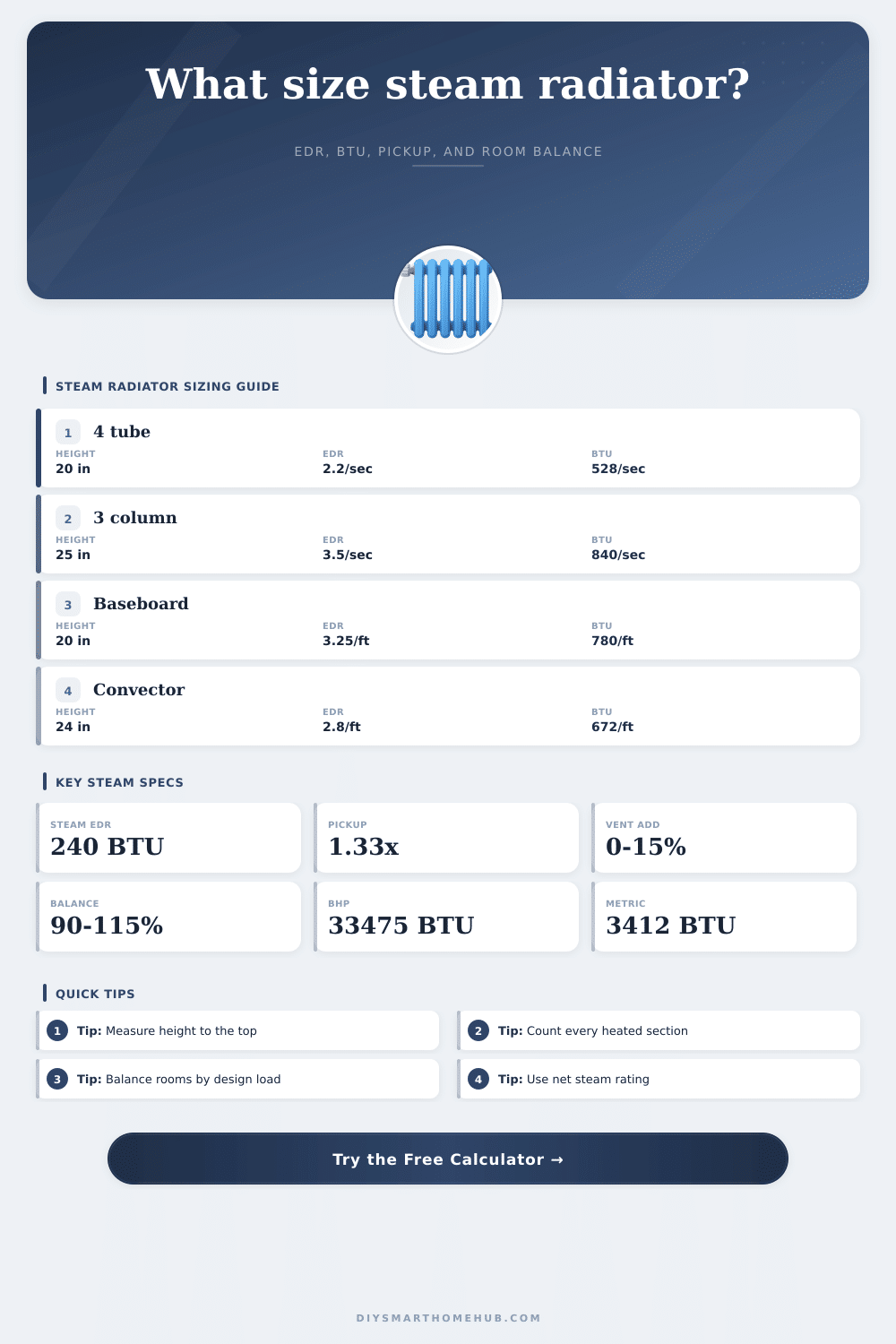
One square foot of EDR will produce 240 BTUs of heat per hour if the radiator is supply with steam at one pound per square inch. Different steam radiators will have different amounts of heat output because of the difference in the shape and size of those steam radiators. For example, a steam radiator that has four columns of steam will release more heat than a steam radiator that only have two columns of steam of the same size.
The height and the number of columns of steam radiators will impact the amount of heat that it release. Therefore, you must make these measurements to calculate the EDR of each steam radiator. The next step is to convert the EDR of the steam radiators into the total load that must be provided by the boiler for the steam heating system.
Steam heating systems often lose heat through the steam pipes that are used to distribute heat from the boiler to the steam radiators. The boiler must also supply heat to the water within the boiler to warm it to the temperatures required by the steam radiators. These losses is accounted for through the addition of a pickup allowance to the total radiation output of the steam radiators.
A common pickup allowance is 1.33 times the amount of radiation that the steam radiators give off. The connected load is found by adding this pickup allowance to the radiation output of the steam radiators. This connected load is the total amount of heat that the boiler will have to provide.
If the connected load of the steam heating system is too great for the boiler to provide, the steam heater will not be able to heat the house. However, if the connected load is much less than the amount of heat that the boiler can provide, the boiler will continuously turn on and off to attempt to heat the rooms. You must also check the balance of each room to make sure that each room recieve the correct amount of heat.
Each room should be balanced if the amount of heat that the steam radiators produce is equal to the amount of heat that is lost by the room. If the amount of heat that the steam radiators produce is between 90% and 115% of the heat loss of the room, the temperature within that room should remain at a comfortable level. However, if the amount of heat that the steam radiators produce is less than 80% of the heat loss of that room, the room will be too cold.
Additionally, if the amount of heat that the steam radiators produce is more than 135% of the heat loss of that room, the temperature within the room will be too hot. Thus, by checking to see if each room is balanced, you can ensure that the steam radiators in each room are the correct size to provide heat to that specific room. Many different factor can play a role in the amount of heat that is radiated from the steam radiators within a building.
Each radiator is initially manufactured to lose a specific amount of heat. However, if an individual paints a radiator multiple times, the thick layer of paint can play a major role in reducing the amount of heat that is radiate from that steam radiator. Additionally, if an individual places furniture within the room in front of a radiator, that furniture may reduce the amount of heat that radiates from the steam radiator.
It is important to ensure that no such obstruction exist in the room. Another important component to steam radiators are the air vents. Steam radiators must release the air that is within the radiator so that the steam can enter the radiator.
If the air vents within the radiator are clogged or are slowly releasing the air, the steam will not be able to reach the different portion of the radiator. Thus, the radiator will not reach its EDR. If a room is too cold with appropriately sized steam radiators, the air vent may be the problem.
In this case, replacing the air vent may fix the problem in the radiator more quicker than purchasing a new steam radiator for that specific room. To size a steam radiator system appropriately for a building, you must measure each steam radiator. Based off the EDR ratings for each steam radiator, you can calculate the load that can be connect to each steam radiator.
Additionally, the heat loss of each room can be compared to the heat output of the steam radiators of that same building. By measuring the steam radiators and checking the air vents in the radiators, the steam heating system will provide even heat to the entire building.