Electric Furnace Size Calculator
Estimate electric furnace kW from design heat loss, then convert to BTU/hr, blower CFM, staged strip heat banks, continuous-load amps, and breaker planning values.
🏠Electric Furnace Presets
Start with a real building profile, then adjust the area, ceiling height, design temperatures, voltage, and furnace air temperature rise.
📏Heat Loss And Furnace Inputs
💡Live Furnace Notes
⚙Electric Furnace Spec Cards
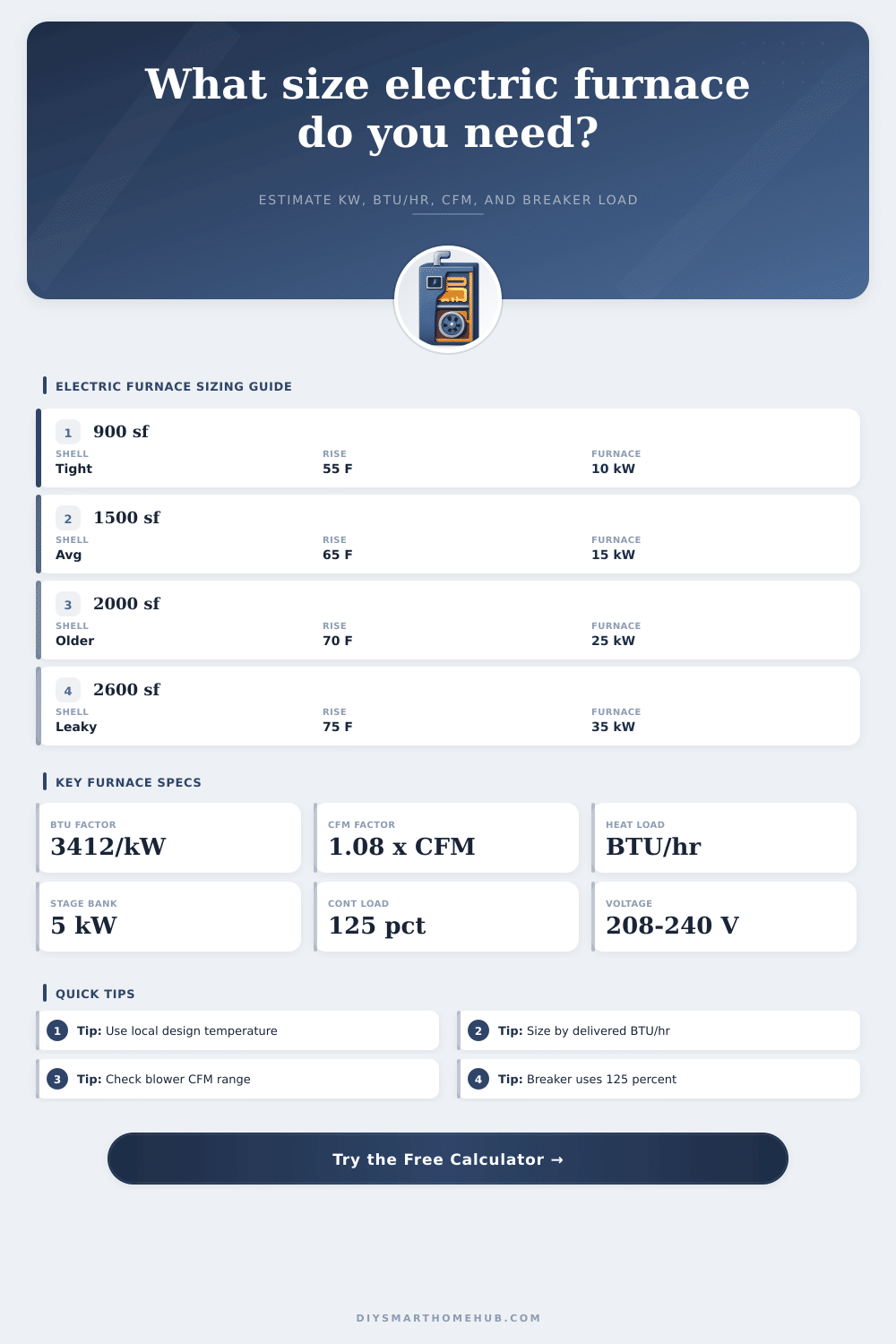
Electric resistance heat converts kW to delivered heat with kW x 3412.142.
BTU/hr = 1.08 x CFM x furnace air temperature rise for standard air.
Electric space heat is treated as continuous for ampacity and breaker math.
Many electric furnaces sequence strip heat in 5 kW banks or close variants.
📊Electric Furnace And Strip Heat Comparison Grid
Dedicated electric furnace
- Common size10 to 30 kW
- Air moverBuilt in
- Stage styleSequenced banks
- Compare bykW and CFM
Air handler strip heat
- Common size5 to 20 kW
- Air moverAir handler
- Stage styleAux heat kit
- Compare bykit rating
Heat pump auxiliary heat
- Common size5 to 15 kW
- Air moverIndoor unit
- Stage styleBackup stages
- Compare bybalance point
Duct heater bank
- Common size3 to 50 kW
- Air moverExternal blower
- Stage styleContactors
- Compare byairflow limit
📘Envelope Heat Loss Assumptions
| Envelope profile | BTU/hr per sq ft at 70 F split | ACH used | Calculator margin |
|---|---|---|---|
| Super insulated / passive shell | 15 | 0.20 air changes per hour | 8% margin after heat loss |
| Modern tight construction | 22 | 0.35 air changes per hour | 10% margin after heat loss |
| Average insulated home | 32 | 0.55 air changes per hour | 12% margin after heat loss |
| Older mixed insulation | 45 | 0.85 air changes per hour | 15% margin after heat loss |
| Leaky or high-loss shell | 60 | 1.20 air changes per hour | 18% margin after heat loss |
| Basement or below-grade zone | 25 | 0.40 air changes per hour | 10% margin after heat loss |
🔢Electric Furnace kW, BTU, CFM, And Amps
| Strip heat size | Delivered BTU/hr | Approx CFM at 45 F rise | 240 V continuous amps |
|---|---|---|---|
| 5 kW | 17,061 BTU/hr | 351 CFM | 26.0 A after 125% |
| 10 kW | 34,121 BTU/hr | 702 CFM | 52.1 A after 125% |
| 15 kW | 51,182 BTU/hr | 1,053 CFM | 78.1 A after 125% |
| 20 kW | 68,243 BTU/hr | 1,404 CFM | 104.2 A after 125% |
| 25 kW | 85,304 BTU/hr | 1,755 CFM | 130.2 A after 125% |
| 30 kW | 102,364 BTU/hr | 2,106 CFM | 156.3 A after 125% |
🧮Breaker And Load Formula Table
| Sizing step | Formula | Example | Output |
|---|---|---|---|
| kW to BTU/hr | kW x 3412.142 | 15 kW x 3412 | 51,182 BTU/hr |
| Design heat loss | Area x BTU/sq ft x delta ratio + infiltration | 1,500 sq ft average shell | Load in BTU/hr |
| Blower CFM | BTU/hr / (1.08 x air rise) | 51,182 / (1.08 x 45) | 1,053 CFM |
| Heater amps | kW x 1000 / volts | 15,000 W / 240 V | 62.5 A load |
| Continuous load amps | Heater amps x 125% | 62.5 A x 1.25 | 78.1 A |
| Breaker planning | Round up to next standard size | 78.1 A continuous | 80 A class |
📝Common Home Size Reference
| Building case | Design heat load pattern | Common furnace class | Stage and airflow cue |
|---|---|---|---|
| Tight apartment or small cottage | 15,000 to 30,000 BTU/hr | 5 to 10 kW | One or two heater banks with modest CFM |
| Average insulated 1,200 to 1,700 sq ft home | 35,000 to 55,000 BTU/hr | 10 to 20 kW | Two to four banks, check duct static and blower speed |
| Older 1,800 to 2,400 sq ft home | 55,000 to 85,000 BTU/hr | 20 to 30 kW | Multiple stages and larger feeder demand |
| Large leaky all-electric retrofit | 85,000 to 130,000 BTU/hr | 30 to 40 kW plus | Often split into multiple heater circuits |
💡Electric Furnace Sizing Tips
The electrical load is based on the selected strip heat kW, but the correct kW starts with the building heat loss at the indoor and outdoor design temperatures.
A large electric furnace needs enough blower CFM to keep the air temperature rise inside the equipment range. Low airflow can make a correctly sized heater behave poorly.
When choosing an electric furnace, you need to understands the total heat loss of a house. To understands the total heat loss of a house, you must consider many different factor. People often assume that the size of the electric furnace is dependent upon the square footage of the house.
However, other factors must also be consider. For example, if the electric furnace are too small for the house, it wont be able to reach the desired temperature within the house on cold winter nights. On the other hand, if the electric furnace is too large for the house, it will cycle excessive on and off too frequent.
How to Choose the Right Size Electric Furnace
These cycles will lead to higher bills and wear on the electric furnace. The calculator consider several different factors to determine the heat loss of a house. For example, the size of the floor area of the house, the height of the ceilings in the house, the indoor design temperature, the outdoor design temperature, and the envelope profile of the house.
Because heat loss are related to the volume of the house, the height of the ceilings is required as an input in the calculator. In addition, heat loss is related to how often the air in the house move in and out of the house. The envelope profile is related to the degree of leakage in the house envelope, and the calculator also requires this input.
After determining the design heat loss of the house, the calculator determine the electric furnace size by rounding the heat loss up to the nearest available size in standard strips of electric heat. Electric furnaces is sized in kilowatts. The number of heat stages in the electric furnace is determined at this same time.
Using staged electric heat control, the electric furnace doesnt have to use all of its heating power on cold winter day. This staged heat ensure the comfort of the house and protects the contactors of the electric furnace. The calculator will also provide a blower CFM value for the electric furnace.
This value is important for determining how many BTUs of heat the electric furnace will add to the air in the house in comparison to the amount of air that the blower in the electric furnace can move. If these two value do not match, it is possible that the electric furnace will either overheat the electric heating elements or will not get to the desired temperature in the house. In addition to determining the size of the electric furnace, the calculator will determine the electrical sizing of the furnace.
Electric heat will be running the majority of the winter month. According to electrical code requirements, because electric heat will be continuously running, a 125 percent factor is applied to the electric heat load. The calculator will provide this final electrical number so that you can decide on the size of the electrical feeder for the electric furnace.
In addition, you can also use this number to determine if one electrical circuit is going to be sufficient for the electric furnace or if the load will have to be split between multiple circuits. Finally, the calculator will show the delivered BTU output of the electric furnace. This value will allow you to compare the electric furnace to the total heat loss of the house.
Although the calculator take into account numerous factors, there are a few additional complication in real houses that cannot always be accounted for in the calculator. For example, the house may have duct leakage, it may have poor insulation on only one wall, or it may have multiple large window. All of these factors will impact the total heat loss of the house.
A sizing margin is built into the calculator so that these factors can be accounted for. The margin increase if the envelope profile is changed to one that represents a leakier envelope. A sizing margin is included in the calculator because the design temperatures are statistical average of the winter months, and the infiltration of outside air into the house will change with the change in wind and the frequency with which the doors to the house are open.
Because electric furnaces are often compared to heat pump systems, which use electric strip heater as a backup heating source when outdoor temperatures drop below a certain level, it is also useful for heat pump systems. The kilowatt (kW) requirement, the BTU output, and the breaker load for the electric strip heater will be the same. However, the amount of time that the strip heaters will be running will change.
The best way to start determining the size of the electric furnace for a house is to first find the design heat loss of the house. Once you know the heat loss of the house, all of the other choice regarding the electric furnace will be simple choices. This calculator help to eliminate the need to manually calculate the number for each of these variable.
Instead, you can focus on making sure that the electric furnace match the characteristics of the house itself.