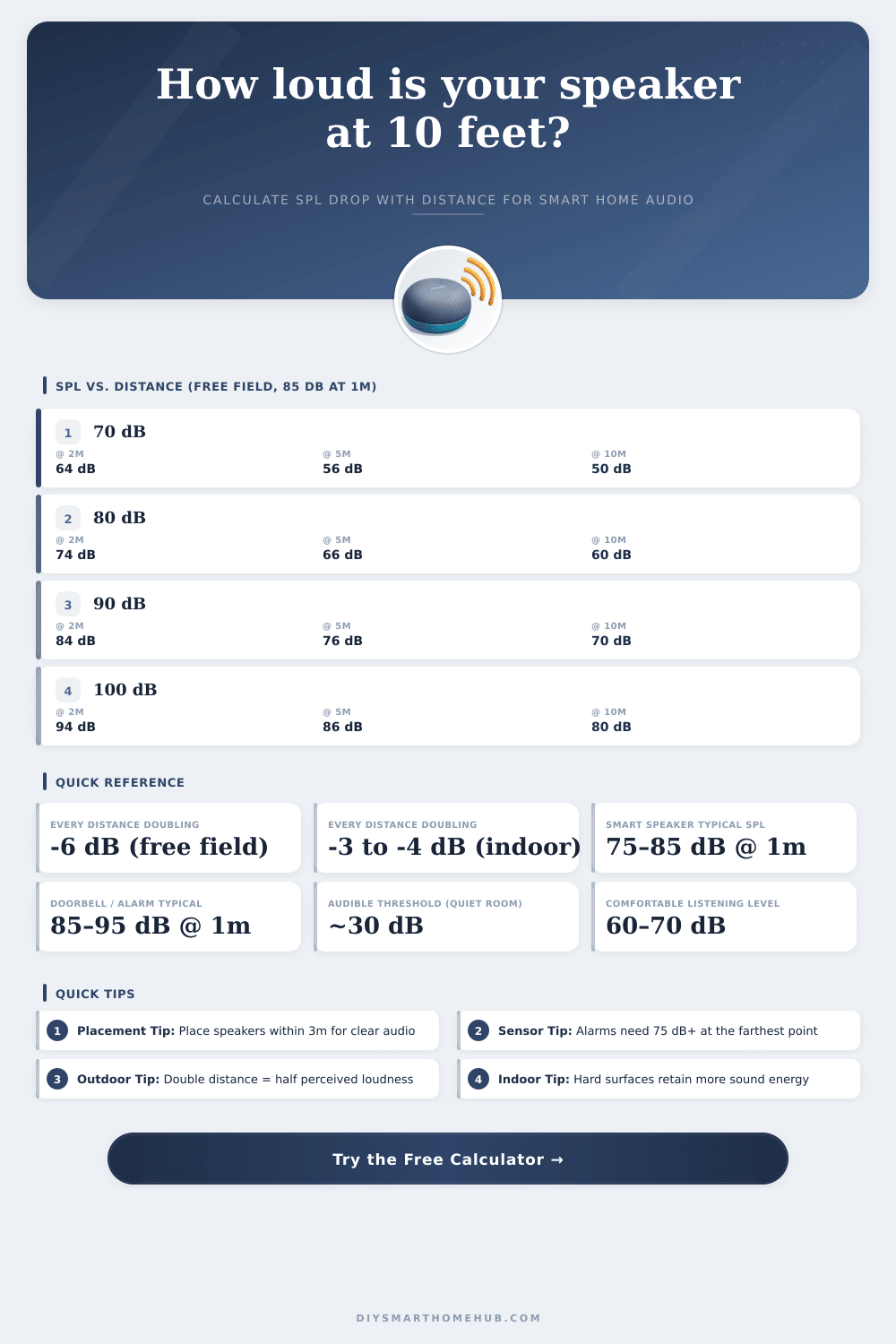
🔊 Decibel Distance Calculator
Calculate how sound level changes with distance for smart home speaker and sensor placement using the inverse square law.
| Source dB @ 1m | @ 2m | @ 3m | @ 5m | @ 10m |
|---|---|---|---|---|
| 70 dB | 64.0 dB | 60.5 dB | 56.0 dB | 50.0 dB |
| 75 dB | 69.0 dB | 65.5 dB | 61.0 dB | 55.0 dB |
| 80 dB | 74.0 dB | 70.5 dB | 66.0 dB | 60.0 dB |
| 85 dB | 79.0 dB | 75.5 dB | 71.0 dB | 65.0 dB |
| 90 dB | 84.0 dB | 80.5 dB | 76.0 dB | 70.0 dB |
| 95 dB | 89.0 dB | 85.5 dB | 81.0 dB | 75.0 dB |
| 100 dB | 94.0 dB | 90.5 dB | 86.0 dB | 80.0 dB |
| Source dB @ 1m | @ 2m | @ 3m | @ 5m | @ 10m |
|---|---|---|---|---|
| 70 dB | 66.0 dB | 63.7 dB | 60.6 dB | 56.6 dB |
| 75 dB | 71.0 dB | 68.7 dB | 65.6 dB | 61.6 dB |
| 80 dB | 76.0 dB | 73.7 dB | 70.6 dB | 66.6 dB |
| 85 dB | 81.0 dB | 78.7 dB | 75.6 dB | 71.6 dB |
| 90 dB | 86.0 dB | 83.7 dB | 80.6 dB | 76.6 dB |
| 95 dB | 91.0 dB | 88.7 dB | 85.6 dB | 81.6 dB |
| 100 dB | 96.0 dB | 93.7 dB | 90.6 dB | 86.6 dB |
| Device | Rated SPL @ 1m | Audible Range (Free Field) | Audible Range (Indoor) |
|---|---|---|---|
| Smart Speaker | 75–85 dB | ~5–12 m | ~8–18 m |
| Smart Doorbell | 85–95 dB | ~15–30 m | ~20–40 m |
| Smoke Alarm | 85 dB | ~10–15 m | ~15–22 m |
| Security Siren | 100–110 dB | ~60–120 m | — |
| HVAC Unit | 55–70 dB | ~3–8 m | ~5–12 m |
| White Noise Machine | 65–75 dB | ~3–6 m | ~5–10 m |
| Intercom / Panel | 80–90 dB | ~8–18 m | ~12–25 m |
The decibel distance points the distance, in which you expect sound level in dB, known the sound intensity in other distance Usually you assume spherical expansion of sound in free field. The decibel itself does not have distance part, it simply describes the sound level where you measure it. So, number of dB itself does not say much, if you do not mention also the distance.
Here counts the basic 6 dB rule. When the distance to the sound source doubles, the sound intensity declines by around 6 dB. For instance, if you go from 100 to 200 feet of the source, the sound diminishes by 6 dB.
How Decibels Change with Distance
That comes from the reverse square law: every doubling of distance cause 6 dB decrease. So, 160 dB in 1 meter should become 154 dB in 2 meters. The loudness adjust according to distance, because the sound intensity proporitias vice versa to the square of distance.
Twice more far, the sound is four times weak.
You can count that by means of formula. The decibel distance formula is L2 = L1. 20 × log10(d2 / d1). Choose the wanted final distance, later put the values. Alternatively, dB = 20 × log10(d1 / d2), where d1 are the start distance and d2 the intended of the sound source.
In actual life however the reverse square law stays only ideal. It assumes equal spreading sound everywhere. Reflective surfaces in the sound field add reflected sounds to the direct sound, so you receive more sound than the formula projected.
For sound pressure you usually measure in 1 meter, unless another distance is shown. In Australia the industrial standard requires measure in 7 meters of the sound generator using the dB(A) scale. The dB(A) scale is weighted to match with the hearing threshold of human ear.
For campgrounds in national parks commonly limit generator noise to 60 decibels on A-weighted scale in 50 feet. Most of RV generators reach 48 until 65 decibels in 50 feet.
The decibel scale is logarithmic, so even little differences matter. Plus of 10 dB seem doubly louder. For find the most silent generator do not suffice to compare decibels from pamphlets, because they no always equal.
Genuinely decisive role play the measure distance of the source for fair comparison.