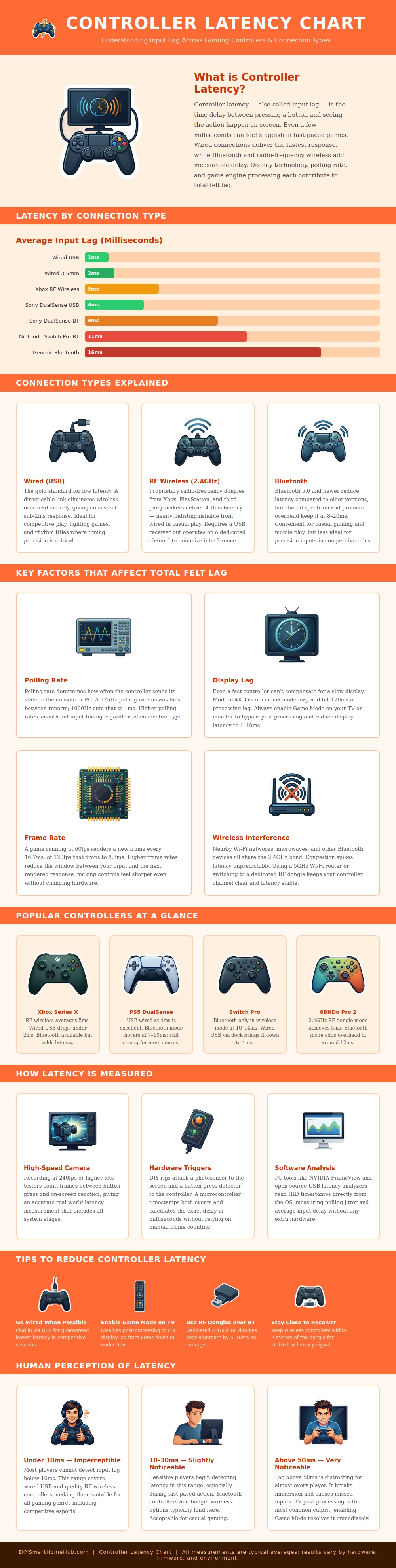
Controller latency is an amount of time between a player pressing a button on a controller and the game responding to that button press on the screen. Controller latency is a measurement of time, and controller latency is usualy measured in milliseconds. If the latency of a controller is high, the controller will feel slow to the player.
If the latency of a controller is low, the controller will feel responsive to the player. The method of connection a controller use will impact the latency of that controller. Controllers that a user wires to the gaming system will have the lowest latency for that connection.
What is controller latency and why it matters
Wireless controllers will experience more higher latency than wired controllers, since the signal from the controller has to travel through air to reach the system. However, some wireless controllers use proprietary radio frequency (RF) systems that have lower latency than Bluetooth connections between the controller and system. Bluetooth connections have higher latency than proprietary RF systems because other electronic devices also use that same frequency band.
Another factor that may impact the latency of wireless controllers is interference. Interference occur when another electronic device also uses the same frequency as the wireless controller. Devices that can cause interference include Wi-Fi networks and microwave oven.
When another device is using the same frequency as the wireless controller, the latency for that controller becomes variable. Keeping the controller close to its receiver and reducing the number of electronic device that are competing for the same frequency band on the wireless network can help to reduce this interference. The polling rate of a controller can also impact the latency of that controller.
The polling rate is the frequency at which the controller report its status to the gaming system. If the polling rate is high, the controller will report its status more often to the gaming system, and the higher the polling rate, the more smoother the experience when playing the game. Conversely, if the polling rate is low, the controller will report its status to the gaming system less often.
High polling rates will improve the experience for a player with high latency wireless connections. Another factor that contribute to the latency between a player pressing a button and the screen responding is display lag. Display lag is the amount of time between a gaming console sending the image to the television screen and that image appearing on the screen.
Many television perform image processing to improve the quality of the screen images. The image processing introduce latency between the console and the screen. Using the game mode on the television screen reduce the amount of image processing that the television performs.
If game mode is not used, the display lag introduced by the image processing on the screen will affect the latency between player input and screen responses. This lag will make fast wired controller seem slow. The latency of a controller can also impact the player differently, depending on the type of game that they are playing.
Games that require players to perform action at precise moments, such as fighting game, rhythm game, or games that require fast aiming, will require low controller latency. High latency will make it more difficult for the player to compete in these types of games. Casual games, such as platformers or adventure games, will not require the same level of precision from the player, so high latency will not lead to as great a frustration for the player.
To measure the latency between a controller button press and the screen response, high speed cameras can be used to measure the time between the press of the button and the reaction on the screen. Additional hardware sensor and software tool can also measure the latency between button press and screen response on an operating system. Each of these measuring tool can reveal which hardware combinations have high latencies and which have low latencies.
Based off the type of games that a player intend to play, that player can choose a controller and connection method. For games that require high level of precision from the controller, a player should of selected a connection method that introduces the lowest possible latency. For games that dont require high precision from a controller, however, a player can use a connection method that does not need to have such low latency.