Combi Boiler Size Calculator
Estimate the larger of space-heating demand and domestic hot-water demand, then check modulation ratio, simultaneous load, and practical combi boiler output class.
🏠Combi Boiler Presets
Load a realistic home and hot-water profile, then adjust the area, heat-loss level, mains temperature, target water temperature, flow rate, and modulation ratio.
📏Heat And Hot-Water Inputs
⚙Combi Boiler Spec Cards
📊Combi Boiler And Spec Comparison Grid
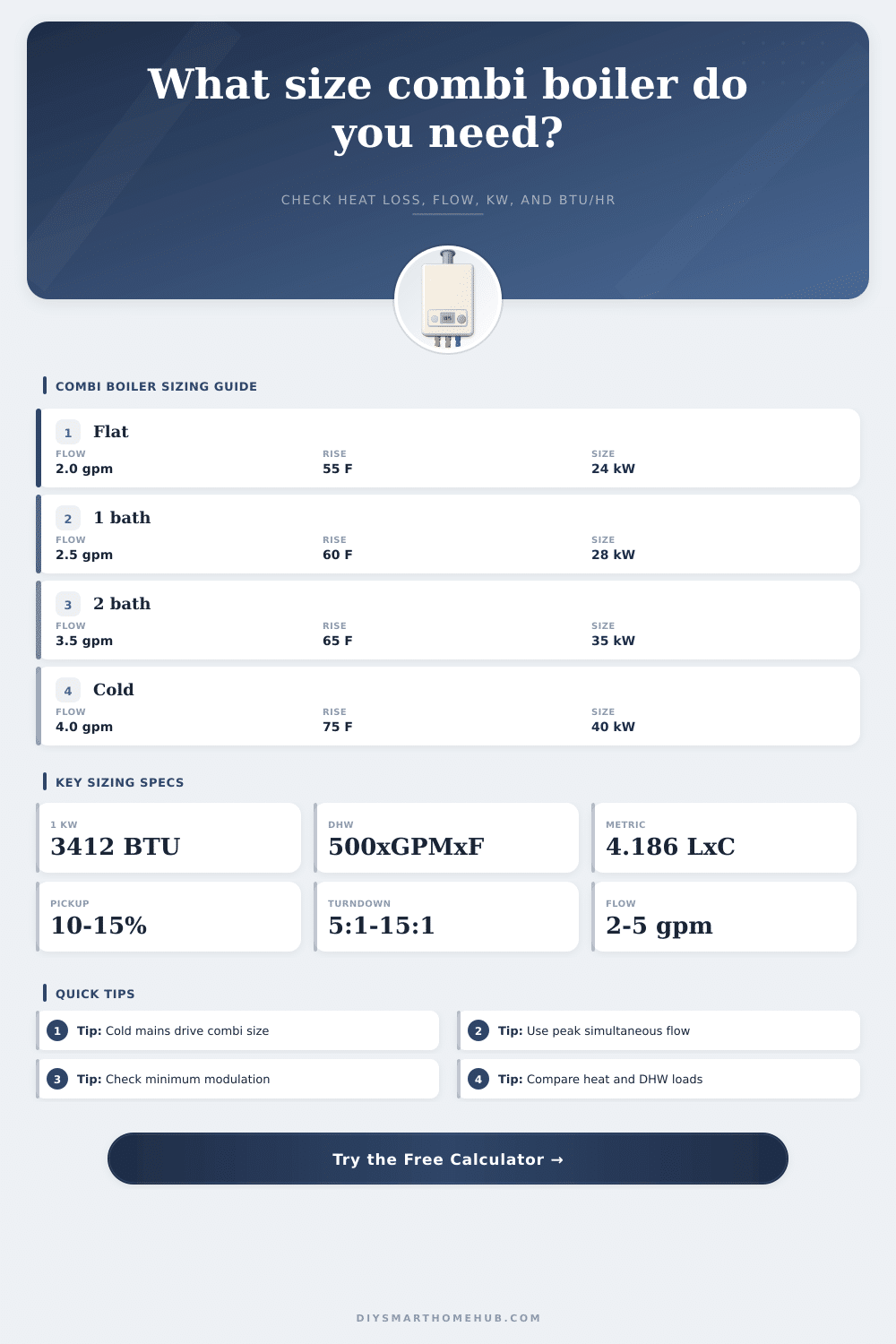
24 kW compact combi
- DHW output82k BTU/hr
- Best fitFlat or 1 bath
- Flow at 60 F rise2.7 GPM
- Watch pointCold mains
30 kW common combi
- DHW output102k BTU/hr
- Best fitSmall house
- Flow at 60 F rise3.4 GPM
- Watch pointTurndown
35 kW high-flow combi
- DHW output119k BTU/hr
- Best fitTwo fixtures
- Flow at 65 F rise3.7 GPM
- Watch pointGas line
40 kW cold-climate combi
- DHW output136k BTU/hr
- Best fitCold inlet
- Flow at 75 F rise3.6 GPM
- Watch pointMin fire
📘Reference Tables
These tables show the heat-loss factors, hot-water flow assumptions, modulation ranges, and formulas used by the calculator.
| Heat-loss profile | BTU/hr per sq ft at 70 F split | W per m2 at 39 C split | Typical building |
|---|---|---|---|
| Super insulated shell | 12 | 38 | Very airtight, thick insulation, low infiltration |
| Modern tight home | 18 | 57 | Recent envelope with good windows and air sealing |
| Average insulated retrofit | 28 | 88 | Updated attic and windows with mixed wall insulation |
| Older mixed insulation | 40 | 126 | Partial insulation, older windows, higher infiltration |
| Leaky solid-wall home | 55 | 174 | High loss shell where room-by-room load is important |
| DHW use case | Typical flow | Rise to 120 F from inlet | Approx output required |
|---|---|---|---|
| Low-flow shower | 1.6 to 2.0 GPM | 55 to 65 F | 44,000 to 65,000 BTU/hr |
| Standard shower | 2.0 to 2.5 GPM | 60 to 70 F | 60,000 to 87,500 BTU/hr |
| Shower plus faucet | 2.8 to 3.5 GPM | 60 to 70 F | 84,000 to 122,500 BTU/hr |
| Two moderate fixtures | 3.5 to 4.2 GPM | 65 to 75 F | 113,750 to 157,500 BTU/hr |
| Fast tub fill | 4.0 to 5.0 GPM | 60 to 75 F | 120,000 to 187,500 BTU/hr |
| Modulation ratio | Minimum fire on 30 kW unit | Minimum fire on 40 kW unit | Best sizing use |
|---|---|---|---|
| 3:1 | 10.0 kW / 34,121 BTU/hr | 13.3 kW / 45,495 BTU/hr | High heat-loss homes with steady demand |
| 5:1 | 6.0 kW / 20,473 BTU/hr | 8.0 kW / 27,297 BTU/hr | Typical combi replacement range |
| 7:1 | 4.3 kW / 14,623 BTU/hr | 5.7 kW / 19,498 BTU/hr | Better match when DHW drives size |
| 10:1 | 3.0 kW / 10,236 BTU/hr | 4.0 kW / 13,649 BTU/hr | Low-load houses with large DHW demand |
| 15:1 | 2.0 kW / 6,824 BTU/hr | 2.7 kW / 9,099 BTU/hr | Best mild-weather cycling control |
| Sizing step | Formula | Example | Result |
|---|---|---|---|
| Space heat loss | Area x profile x design split / 70 | 1,700 x 28 x 65 / 70 | 44,200 BTU/hr |
| DHW load | 500 x GPM x F rise | 500 x 2.8 x 65 | 91,000 BTU/hr |
| Metric DHW | 4.186 x L/min x C rise / 60 | 10.6 L/min x 36.1 C | 26.7 kW |
| Final combi output | Max heat, DHW, simultaneous load | Max 48.6, 91.0, 103.2k | 103,200 BTU/hr |
| Minimum modulation | Selected output / turndown | 30.2 kW / 5 | 6.0 kW min |
💡Combi Boiler Sizing Tips
A small home can still need a large combi when cold incoming water and simultaneous fixtures create a high temperature-rise load.
If DHW forces a large boiler, choose enough modulation depth so the minimum firing rate is not far above mild-weather heat loss.
Choosing a combi boiler require you to understand that a combi boiler will perform two function at once. A combi boiler will provide heating to a home when the temperature within the home is low, and a combi boiler will also provide domestic hot water to the home when a person utilize a domestic hot water fixture within that home. Each of these function requires a combi boiler to have enough capacity to meet each of those demands.
Additionally, because a person may utilize both heating and domestic hot water at the same time, the combi boiler also must have enough capacity to meet these two demand simultaneously. Beyond the size of the home, the incoming water temperature to the home, as well as the numbers of domestic hot water fixtures that is utilized within the home, will determine the size of a combi boiler. Each of these home feature will impact the amount of heat that the home loses, which will impact the size of the combi boiler that is required to heat the home.
How to Choose the Right Combi Boiler
For instance, if the water that enters the home is very cold, the combi boiler will have to work harder to heat that water to the desired temperature. Additionally, if many people in the home utilize hot water from multiple domestic hot water fixture at the same time, the combi boiler will have to work harder to heat the water to the desired temperature. The heat loss calculation that are performed for a home will include a margin to account for the length of time that it take for the home to warm up after being exposed to cold temperature.
However, there is no warm up margin for domestic hot water; hot water demand begin upon the opening of any domestic hot water fixture. Thus, it is necessary to separately calculate the heating load for the home, the domestic hot water load for the home, and the simultaneous load for the home. The simultaneous load is the amount of heat that is required by the home if both the space heating and the domestic hot water system are being simultaneous utilized within the home.
If you calculate the largest single load for a home, but the simultaneous load is not accounted for, it is possible that the combi boiler will not have the necessary capacity to meet the demand of the home. The modulation depth of a combi boiler is another feature of a combi boiler that will impact its operation. Modulation refer to the ability of the combi boiler to adjust the amount of heat that the unit releases.
Combining the concept of modulation with modulation depth allow the combi boiler to adjust the firing rate of the combi boiler to a minimum rate. By being able to reduce the firing rate to a low level, the combi boiler will be able to run for longer period of time on mild days when little or no heat is needed. If, however, the firing rate of the combi boiler cannot be reduced to a low rate, the combi boiler will turn on and off very frequent within short periods of time.
These short periods of time when the combi boiler is continuously turning on and off are referred to as short cycling. Short cycling of a combi boiler waste both fuel and the component of the combi boiler over time. In addition to the factor discussed above, the physical factor of the home in which the combi boiler will be installed will also impact the performance of a combi boiler.
For instance, the length and diameter of the domestic hot water pipe will reduce the flow of domestic hot water that is delivered to the hot water fixture. Additionally, if the water that enters the home is very hard, the combi boiler will have to contend with the scale that will form within the heat exchanger of the combi boiler. This scale will reduce the efficiency of the combi boiler.
Finally, the location of the combi boiler will impact the way in which it can be accessed for service, as well as how the installer can install the venting for the combi boiler. The reference table located on the page will provide information regarding the heat loss rate for different type of homes, as well as the flow rate of domestic hot water that may leave the home based on the type of domestic hot water fixture in the home. By entering the specification of the home into the calculator that is located on the page, the calculator will provide the size of the combi boiler that is recommended for the home.
Furthermore, the output of the calculator will also indicate whether the size of the combi boiler was determined based off the heating load of the home, the domestic hot water load of the home, or if the size of the combi boiler was determined based upon the simultaneous load that is required of the home. Based upon the size of the combi boiler that is recommended for the home, a person can begin to create a shortlist of the different type of combi boilers that may be available for purchase. Each of these combi boiler will have a recommended size listed in the manufacturers rating table.
Thus, the recommended size that is calculated for the home can be compared to the size that are offered by the different combi boilers. Additionally, it is also necessary to ensure that the gas line and venting system for the home are compatible with the combi boilers that are listed on the shortlist. Finally, the person should also ensure the combi boilers that is considered for purchase meet any local building code for the area in which the combi boilers are to be install.
The goal of the step that are described above will be to ensure that a combi boiler is purchased that meet the largest demand that is placed upon the home. By purchasing a combi boiler that is too large for the home, however, the combi boiler will waste energy within the mild day of the year. By understanding the heating load for the home, the domestic hot water load for the home, and the importance of feature like modulation, a person will be able to logicaly select the correct combi boiler for that home.