Color Temperature Calculator
Convert a target Kelvin value into mired shift and RGB approximation, then compare it with smart bulb limits, brightness level, room use, and circadian timing.
1 Real Lighting Presets
Choose a preset or enter your own values. The calculator uses mired conversion, a common Kelvin-to-RGB approximation, use-specific Kelvin targets, and a brightness-weighted circadian alertness index.
2 Color Temperature Inputs
Full Calculation Breakdown
3 Smart Bulb Spec Comparison
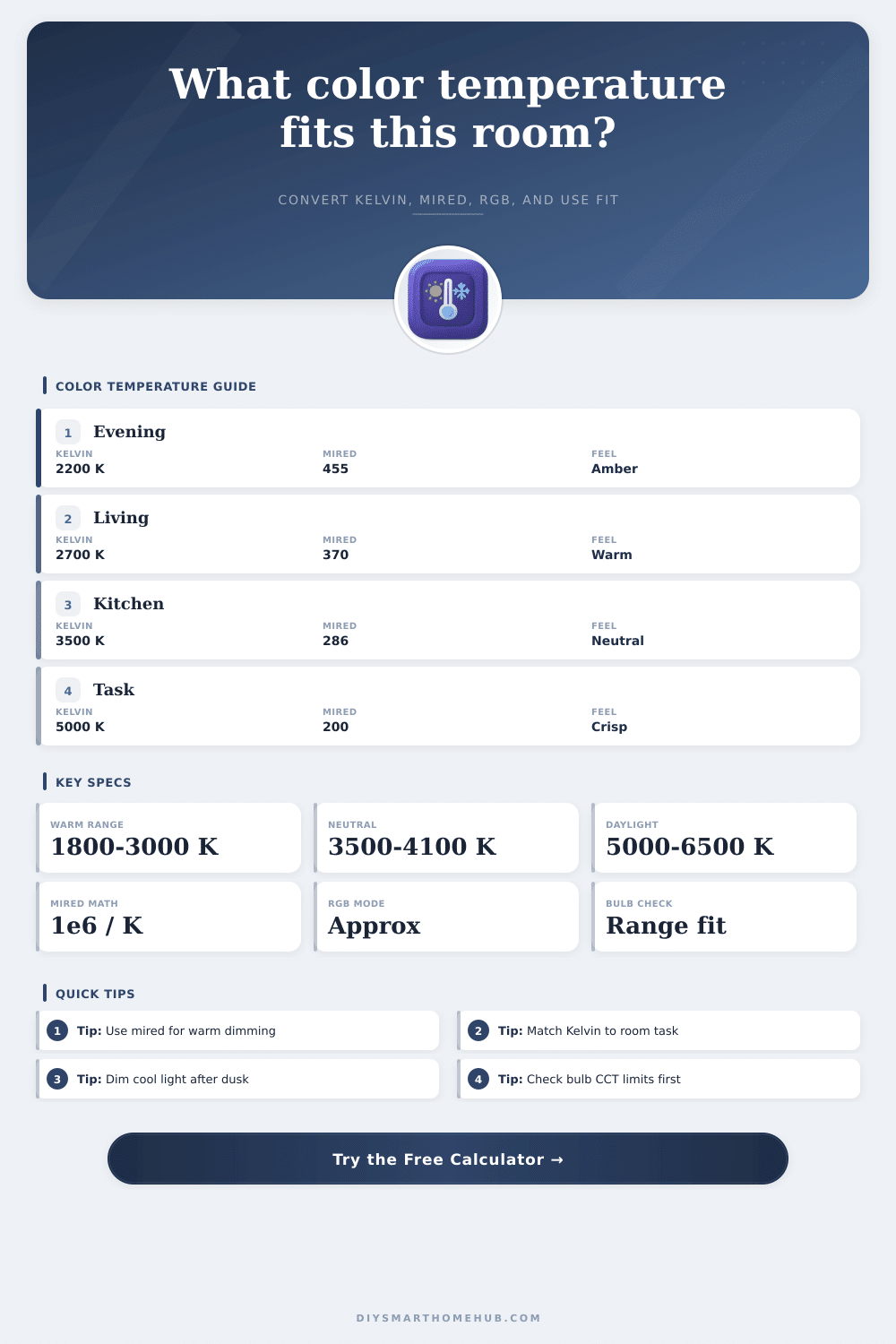
Kelvin, Mired, and Lighting Use Reference
Mired values are useful because equal changes in mired often feel more visually even than equal Kelvin jumps, especially in the warm-white range.
| Reference white point | Kelvin | Mired | Typical smart home use |
|---|---|---|---|
| Candle-like amber | 1800 K | 556 mired | Night scenes, fireplaces, very low brightness |
| Ultra warm white | 2200 K | 455 mired | Bedrooms, late evening, nursery path lighting |
| Warm white | 2700 K | 370 mired | Living rooms, table lamps, relaxed household scenes |
| Soft neutral white | 3000 K | 333 mired | Dining, entry, mixed decorative and useful light |
| Neutral white | 3500 K | 286 mired | Kitchens, laundry, closets, balanced activity zones |
| Cool white | 4100 K | 244 mired | Bathrooms, garages, utility rooms, clean task visibility |
| Daylight white | 5000 K | 200 mired | Desk focus, craft tables, daylight-matched work |
| D65 daylight reference | 6500 K | 154 mired | Screen matching, color checks, high-alert daytime scenes |
Circadian and Time-of-Day Reference
The alertness guidance below combines CCT, scene brightness, and timing. It is a planning cue for home lighting scenes, not a medical sleep recommendation.
| Time profile | Preferred CCT band | Brightness cue | Lighting intent |
|---|---|---|---|
| Pre-dawn low light | 1800-2400 K | Very low output | Navigate without forcing a high-alert scene |
| Morning ramp | 3000-5000 K | Moderate to high output | Shift from warm wake-up to productive white |
| Midday active | 4000-6500 K | Higher task output | Support alertness and visual acuity during work |
| Afternoon steady | 3500-5000 K | Moderate output | Maintain clarity without a harsh blue-white feel |
| Evening wind-down | 1800-3000 K | Low to moderate output | Keep color warm as household activity slows |
| Night path light | 1600-2200 K | Lowest usable output | Favor orientation over task brightness |
Smart Bulb and Fixture Comparison Grid
Compare common smart lighting categories by controllable white range, color support, CRI expectations, and where each profile is most useful.
| Fixture profile | CCT range | Color / CRI notes | Best fit |
|---|---|---|---|
| Fixed warm-white LED | 2700 K only | No white tuning, often 80+ CRI | Simple lamps that never need daytime task white |
| Warm-dim filament LED | 1800-2700 K | Warms as it dims, decorative focus | Bedside lamps, sconces, dining pendants |
| Tunable white bulb | 2200-6500 K | White only, commonly 80-90 CRI | Rooms that move between relaxation and work |
| RGBW smart bulb | 2200-6500 K | White channel plus color effects | Living areas needing both scenes and useful white |
| Full-range color bulb | 1800-6500 K | Wider warm range plus RGB modes | Adaptive whole-room scenes and automation |
| High-CRI tunable lamp | 2700-5000 K | Often 90-95+ CRI, less extreme blue-white | Reading, art, food prep, fabric and finish checks |
| Tunable LED panel | 3000-6500 K | High output, wide ceiling coverage | Offices, garages, studios, utility spaces |
| White ambiance LED strip | 2000-5000 K | Linear accent or under-cabinet white | Cabinets, coves, stairs, worktop edges |
Mired Shift and RGB Approximation Reference
The RGB values are an sRGB approximation of black-body color temperature for interface previews. They are not a substitute for measured lamp spectrum.
| Kelvin change | Mired change | Approx RGB direction | Automation meaning |
|---|---|---|---|
| 1800 K to 2200 K | 556 to 455 | Less red, more usable amber | Good for candle scene to evening reading |
| 2200 K to 2700 K | 455 to 370 | Amber becomes warm white | Useful wake-up or dinner-to-living transition |
| 2700 K to 3500 K | 370 to 286 | Warm white moves toward neutral | Strong change for kitchens and chores |
| 3500 K to 5000 K | 286 to 200 | Neutral becomes crisp daylight | Daytime task scene with higher alertness |
| 5000 K to 6500 K | 200 to 154 | Cooler, bluer daylight impression | Use when color matching or high clarity matters |
A 200 K jump near 2000 K can look much larger than a 200 K jump near 6000 K. When an automation ramps from warm evening to daytime white, compare the mired change to keep the transition visually smooth.
Cool white at very low output often feels thin, while cool white at high output can feel too alert at night. The calculator weights Kelvin by scene lumens and time profile so the result reflects actual use.
Color temperature are a way to describe the color of white light. Color temperature is measured in Kelvin. Lower Kelvin values represents light that appears orange or yellow.
Higher Kelvin values represent light that appears blue. Many peoples use different Kelvin values in there homes to change the way they feel in there homes. A person can use mired values to understand color temperature.
How to Pick the Right Light Color for Each Room
Mired values is a better representation of color temperature than Kelvin values. This is because each step in mired values represents a more consistent change in color than each step in Kelvin values, especially in Kelvin values that express warm color. To determine if a specific Kelvin value will work in a specific room, a calculator use several different inputs.
The first is the use profile for the room. For instance, a kitchen require a different type of light than that in a bedroom. The time-of-day profile takes into account when the room will be used.
A room used during the morning will have a more different score than a room used during the evening. The bulb profile is also important to consider because not all bulb can provide each color temperature. Some bulbs are limited to one color temperature, while other bulbs provides a range of color temperatures.
Brightness is another input. A cool white light at a low brightness level will feel differently than a cool white light at a high brightness level. Another input is daylight contribution.
Bulbs may be exposed to natural light from the windows in their room. The last input is the step size of the bulb. Some bulbs can provide a fine range of adjustment in Kelvin values.
Other bulbs have a large step size between Kelvin setting. This prevents the person using the bulb from choosing a Kelvin value that the bulb cannot reach. The calculator will provide several different result.
The first result will be the mired value. This relates to the Kelvin settings. The next value is the RGB approximation of the light that will result from each Kelvin setting.
The rounded bulb setting will provide the actual value of the bulb. Many bulbs will round to the nearest setting that the bulb can produce. The use fit score will provide a percentage that indicate whether the choice of bulb and color temperature is appropriate for the room.
The last value provided by the calculator is the circadian alertness index. This indicate how stimulating the light will be. High circadian alertness means that the light will be stimulating for the occupants in the space.
Many people believe that cool white light is for when someone is performing tasks in a room, and that warm light is for when someone is relaxing. This is not always true, however. High Kelvin settings can be both gentle and stimulating depending on brightness levels.
High Kelvin levels can be stimulating at high brightness, but gentle if the brightness levels are low. Warm colors can appear flat if brightness values are high. This is because the eye adapt to bright lights.
These interaction are included in the calculator so that each room will have a different recommendation for the same Kelvin value. If the target Kelvin value is outside the range of the bulb’s color temperatures, the bulb will hit one edge of its color temperature range. Its use fit score will be lower than if the color temperature requirement were within the capabilities of the bulb.
A drop in the use fit score to a lower number indicate the bulb profile should be changed. Many households may encounter this problem when automations for lights does not match the plan. Color temperatures can also be affected by the natural light that enter a room through the windows in the room.
This natural light is taken into account in the calculator. This natural daylight adjustment will allow the calculator to provide an indication of how natural daylight will dilute the effect of the color of the bulb in that room. Bulbs in large rooms with many window will have different color temperatures than bulbs in rooms with few windows.
A calculator is accompanied by several reference tables. One table indicate Kelvin values in relation to mired values. Another table include human preference for the color temperatures of lights during the different times of the day.
A third table indicates the color temperature capability of different types of bulbs. These tables can help individuals to determine where to start with choosing a color temperature for the bulbs in the rooms of a home. Each of these tools have a purpose beyond just the calculator.
The goal is to find understanding of the relationship between color temperature, the purpose of the space, and the bulbs in that space.