CFM to SCFM Calculator
Convert between actual CFM and Standard CFM (SCFM) for HVAC, air compressors, and pneumatic systems. Accounts for altitude, temperature, and humidity corrections.
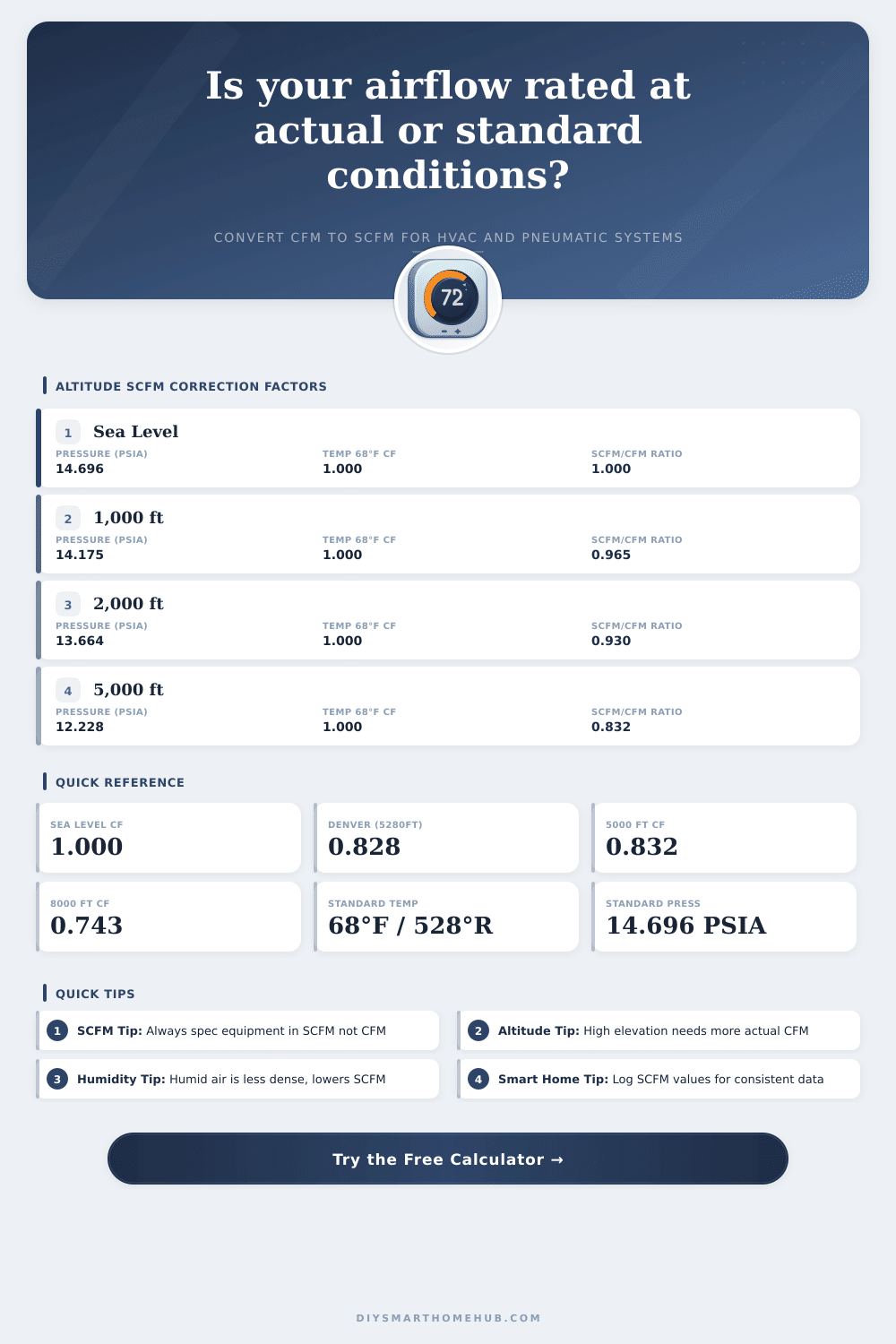
| Altitude (ft) | Pressure (PSIA) | 32°F Ratio | 68°F Ratio | 100°F Ratio |
|---|
| System Type | Typical Conditions | Why SCFM Matters | Standard Used |
|---|---|---|---|
| HVAC System | 65–80°F, ~14.5 PSIA | Ensures consistent airflow spec regardless of season or altitude | ASHRAE 68°F/14.696 PSIA |
| Air Compressor | 70–100°F, 90–150 PSIG | Compressor ratings are in SCFM; actual output varies with conditions | ISO 1217 / PNEUROP |
| Pneumatic Tool | Ambient temp, line pressure | Tool demand in SCFM; supply must exceed demand at altitude | SCFM at 90 PSIG |
| Flow Meter | Process temperature/pressure | Standardizes readings for comparison across sites | API/AGA standard base |
| Gas System | Varies widely | Billing and regulatory compliance require standard conditions | 60°F/14.696 PSIA (gas) |
If you buy air compressors or tools, you must understand the difference between CFM and SCFM. CFM means “Cubic Feet per Minute” and it measures the actual flow of air at the present conditions. On the other hand, SCFM means “Standard Cubic Feet per Minute” which measures the flow normalized to standard conditions.
Those standard conditions include atmospheric pressure of 14.7 psi, temperature of 68°F and 36% relative humidity
What CFM and SCFM Mean and Why It Matters
Because air is compressible, the amount of air changes according to the local conditions. When you use CFM, that means the flow was measured at the actual pressure and temperature. Because those conditions often change, CFM is not standardized, which can cause big differences depending on the surroundings during the measurement.
SCFM however considers the varietions of temperature and pressure, so it is a standard measure.
Here is the spot that most commonly confuses folks. Air compressors usually are described by CFM, but air tools most commonly use SCFM. Because of that, comparing them directly can be hard.
SCFM measures the weight of the air, not only the volume, and it adjusts according to pressure, temperature and humidity, different than CFM. Although standard conditions are not always there, this measure is more practical for comparing various compressors.
The CFM rating of a compressor will always be lower than its SCFM rating, because most makers measure CFM at pressure that is 90 PSI or less. Some say that the actual CFM is about 15% bigger than SCFM, but that is not exact. To do a corect conversion, you should know the accurate temperature and barometric pressure.
Makers of systems for heating and cooling also show the air exchange capacity by CFM, but that figure changes according to the temperature and pressure of the air. For easy comparison of products, some makers use SCFM. For instance, a typical 1-ton air conditioner produces 400 CFM, but the SCFM match could be 350, 390 or 450 depending on the conditions.
Only in very particular situations SCFM can be equal to CFM.
Changes in the standard temperature can cause big volume difference for the same mass flow. For instance, mass flow of 1,000 kg/h of air at 1 atmosphere is 455 SCFM at 32°F, but 481 SCFM at 60°F. Knowing about SCFM is very useful when you work with compressors, especially for scientific or precise gear, where those details affect howmuch air the system indeed receives.