🚿 Bathroom Fan CFM Calculator
Find the right exhaust fan CFM rating using HVI/ASHRAE standards for smart home ventilation
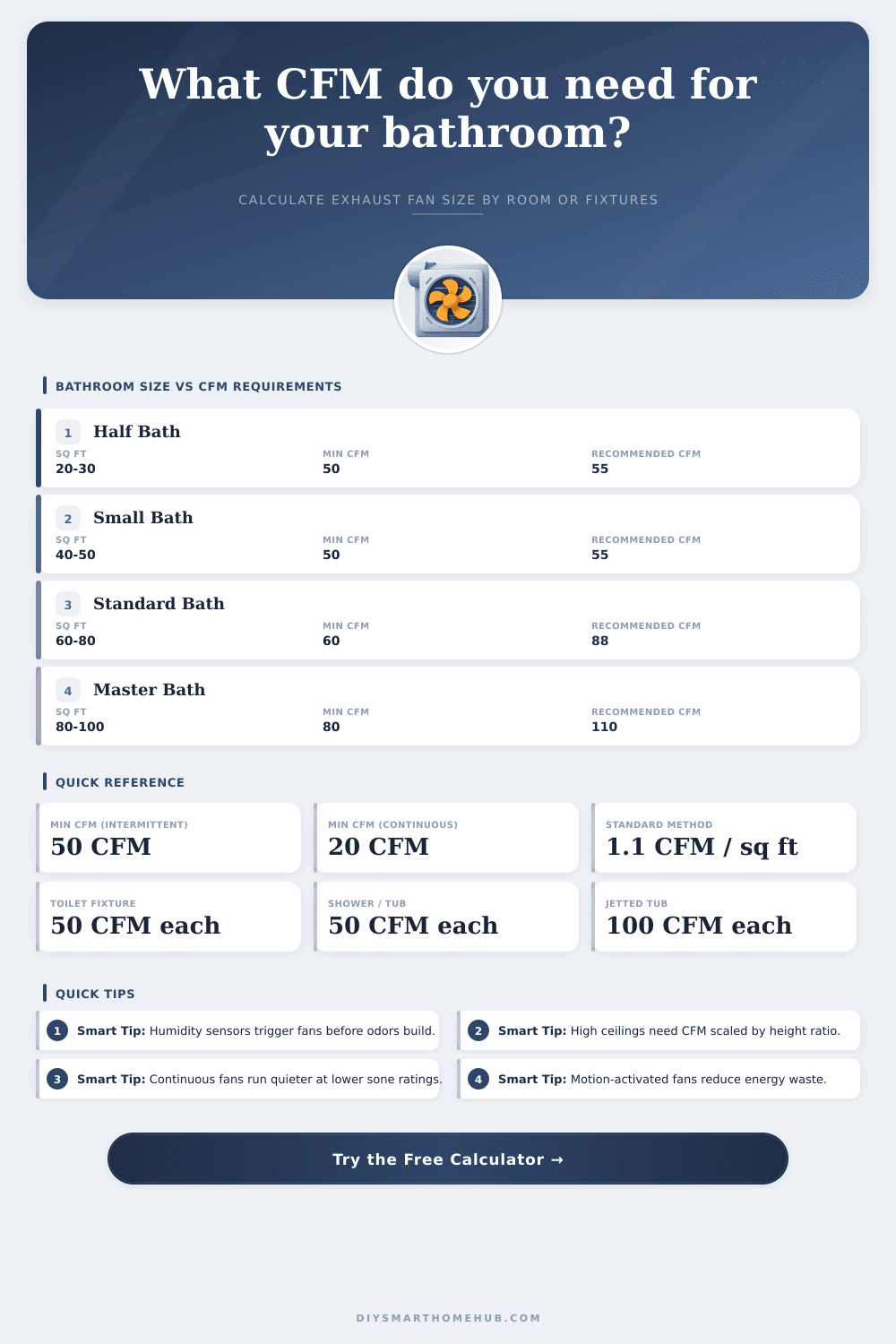
| Room Sq Ft | Min CFM (Code) | Recommended CFM | Fixture-Based CFM | Sone Target |
|---|---|---|---|---|
| Up to 30 | 50 | 50 | 50+ | ≤ 1.5 |
| 31 - 50 | 50 | 55 | 100+ | ≤ 2.0 |
| 51 - 70 | 50 | 77 | 100-150 | ≤ 2.0 |
| 71 - 80 | 50 | 88 | 150+ | ≤ 3.0 |
| 81 - 100 | 80 | 110 | 150-200 | ≤ 3.0 |
| 101 - 120 | 100 | 132 | 200+ | ≤ 4.0 |
| 121 - 144 | 120 | 158 | 200-250 | ≤ 4.0 |
| 145 - 168+ | 140 | 185 | 250+ | ≤ 4.0 |
| Feature Type | Trigger Condition | CFM Requirement | Run Time |
|---|---|---|---|
| Humidity Sensor | RH > 70% | Rated CFM | Until RH < 60% |
| Motion-Activated | Occupancy detected | Rated CFM | Occupancy + 15 min |
| Timer Control | Manual on | Rated CFM | 15 - 60 min preset |
| Continuous Mode | Always running | 20 CFM min | 24/7 |
| Light-Linked | Light switch on | Rated CFM | Light off + 15 min |
| Smart Home (Auto) | Schedule / scene | Rated CFM | Programmed duration |
When you choose the right bathroom fan, only one number really matters: CFM. That means cubic feet per minute, which tells you how much air the fan can move from your room. The size of your bathroom is what leads this decision.
Here is the simple rule most people use; you need at least 1 CFM for every square foot So if your bathroom has 60 square feet, look for 60 CFM. If it is 100 square feet, you need at least 100 CFM.
Choose the Right Bathroom Fan by CFM
Most building rules suggest ventilation based on eight air changes each hour, and that math usually leads you to one CFM per square foot of area. For instance, a bathroom of 7×10 feet with an 8-foot ceiling would need around 70 CFM. Even so, higher ceilings alter the calculation and create problems in the reslutls.
Finding the volume of your room is quite simple. Take a measure and get the height, width and length. Multiply those three and you will have the cubic feet.
A space of 5x10x7, for instance, gives 350 cubic feet. A typical little bath of 5×8 measures around 40 square feet, so 40 CFM technically works, although most folks choose something between 50 and 80. A bigger room…
For instance 10×12, needs at least 120 CFM, and maybe even 150 or 200 if you like long warm showers or have high ceilings.
For little spaces, anything between 50 and 80 CFM works well. Bigger bathrooms usually need 100 CFM or more. A bathroom of 50 square feet needs at least 50 CFM, but higher power only means that the fan will remove the moisture more quickly.
If you are the type who loves long, steamy showers, a good 100 CFM fan will serve you without being too noisy.
Here is the problem, mirrors and walls will fog if you do not have enough power. Want to stop that? A 150 CFM fan or more helps a lot.
The hard part is the pipes. Most fans need 18 inches of straight tube before you can bend it. Moreover, a 4-inch tube limits the capacity to 80 CFM.
If you put a 300 CFM fan on a 5-inch pipe, you only stress the engine and get only half of the promised air through those tubes.
Also, do not forget about the timer. Leave the fan on around 10 minutes or more after you are done. Little home models commonly have two speeds, the lowest works around 50 to 60 CFM for bringing in fresh air almost silently.
Actually, well made, high capacity fans can be quieter than the cheapest choices. Going from 50 to 80 CFM will not make a big difference in noise, so ensure that your bathroom has permanent airflow in.