CFM to m³/hr Calculator
Convert airflow between CFM, m³/hr, L/s, L/min and more for HVAC and smart home equipment.
💨 Airflow Unit Converter
⚡ Common Presets
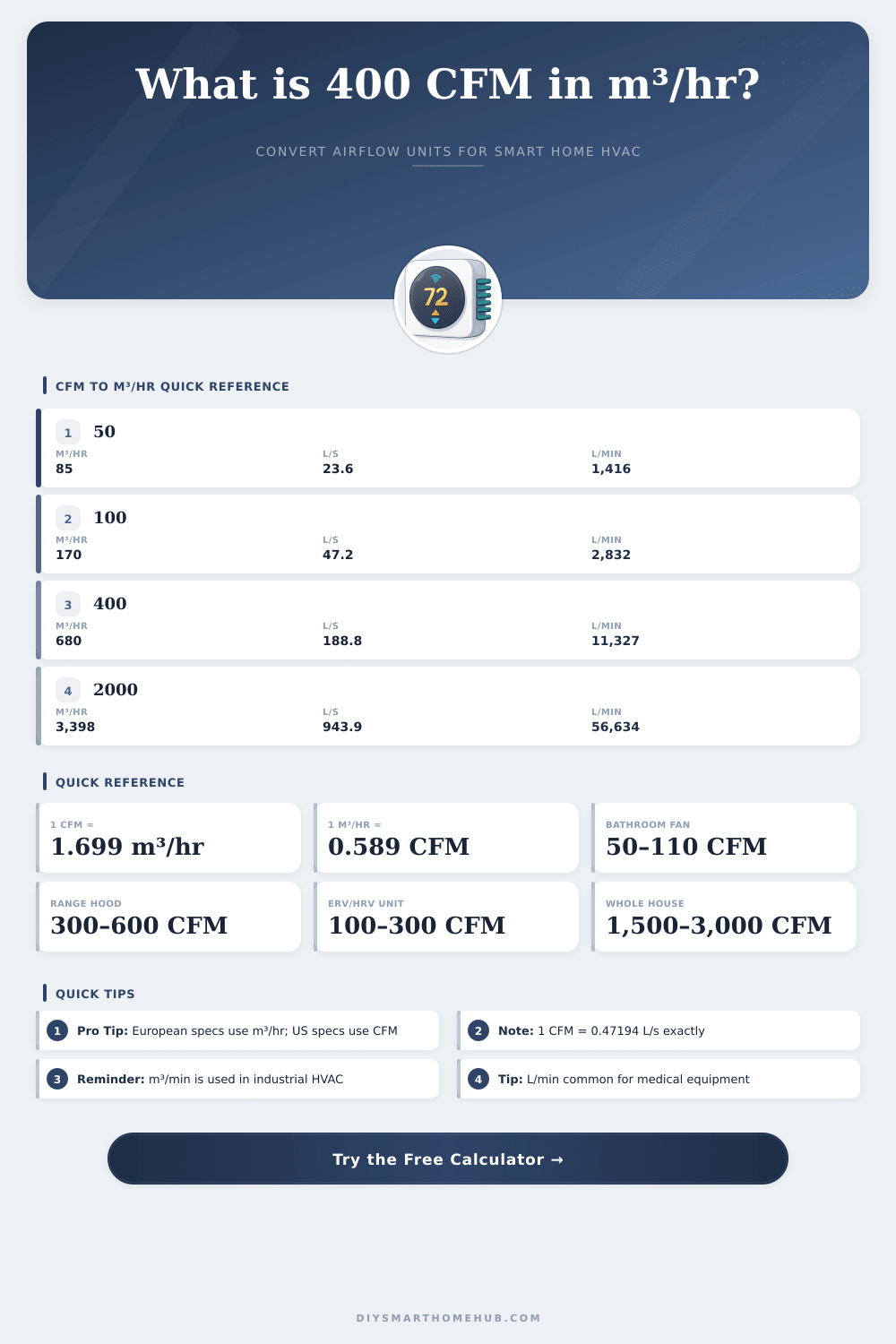
North American HVAC systems, range hoods, and bathroom fans are rated in CFM (cubic feet per minute). European and international products use m³/hr. When importing a European range hood or ERV unit, multiply the m³/hr rating by 0.589 to get CFM and compare it to your ductwork capacity.
Use CFM when specifying US ductwork, fans, and filters. Use m³/hr for European appliances and international equipment spec sheets. Use L/s when working with Australian or UK building codes. L/min is common for medical devices and small air purifiers. All four units measure the same thing — volume of air per unit of time.
📋 Common Airflow Values — Spec Grid
🏠 Equipment Airflow Ratings
| Device Type | Typical US (CFM) | Typical EU (m³/hr) | L/s Equiv. | Notes |
|---|
📄 Full Conversion Table — CFM 10 to 2000
| CFM | m³/hr | m³/min | L/s | L/min |
|---|
When you work with air compressors, HVAC setups, industrial ventilation or pneumatic gear, you commonly must convert between CFM and m3/h. These two units… Cubic feet per minute (CFM) and cubic meters per hour (m3/h), measure the volume of air that moves through a system during time.
The main difference is that CFM bases on the imperial system while m3/h are metric. If you work in a land where you use the metric system you most likely will meet m3/h.
How to convert CFM and m3/h
The math conversion is entirely simple when you understand it. One CFM matches to about 1.699 m3/h. If you want to count vice versa, one cubic meter per hour is around 0.5886 CFM.
Although the official SI unit for flow rate is cubic meters per second, in the actual world you rarely will see that; m3/h and CFM is much more populra.
Here is how the calculation works, if you wonder. First, we look at the volume: one cubic foot is around 0.0283168 cubic meters. Later, we add the time, because an hour has 60 minutes.
So the full conversion of CFM to m3/h happens like this: you multiply 0.02832 cubic meters by 60, thus we receive 1.699 m3/h. Here is where that factor comes from.
What relates to air compressors, CFM points out how many air moves each minute. For instance, if an air compressor is estimated at 30 CFM, that means that 30 cubic feet of air flow every minute.
Convert of m3/h to CFM are entirely just as easily. Because one m3/h match to 0.5886 CFM, you can easily count. If you want to know how much are 8 cubic meters each hour, multiply 8 by 0.588578 and you will receive about 4.71 CFM.
Or for instance, 100 m3/h is almost 58.86 CFM.
You maybe will see m3/h written as CMH, which is only shorthand for the same unit. Even so, recall, that convert m3/h to m3/min is another calculation. For that, you share 1 m3/h by 60, which gives 0.01667 m3/min.
If you do not want to count everything yourself, there are many free online calculators that do that quickly. HVAC specialists, pneumatic specialists and technicians of ventilation use them all the time for jump between imperial and metric units. You only type “2 cfm to m3/h” and the tool settles it.
Most of those programs also address other units, as liters per minute, mbar, hPa, Torr and psi, together with the flowrates.