CCTV Camera Coverage Distance Calculator
Estimate horizontal field of view, scene width at distance, pixel density in PPF and PPM, DORI distance bands, and useful coverage after mounting angle loss.
📌CCTV scene presets
⚙Coverage inputs
🔍Live camera readout
📷Lens and camera spec comparison grid
📐DORI pixel density reference
| DORI level | PPM threshold | PPF equivalent | Common CCTV meaning |
|---|---|---|---|
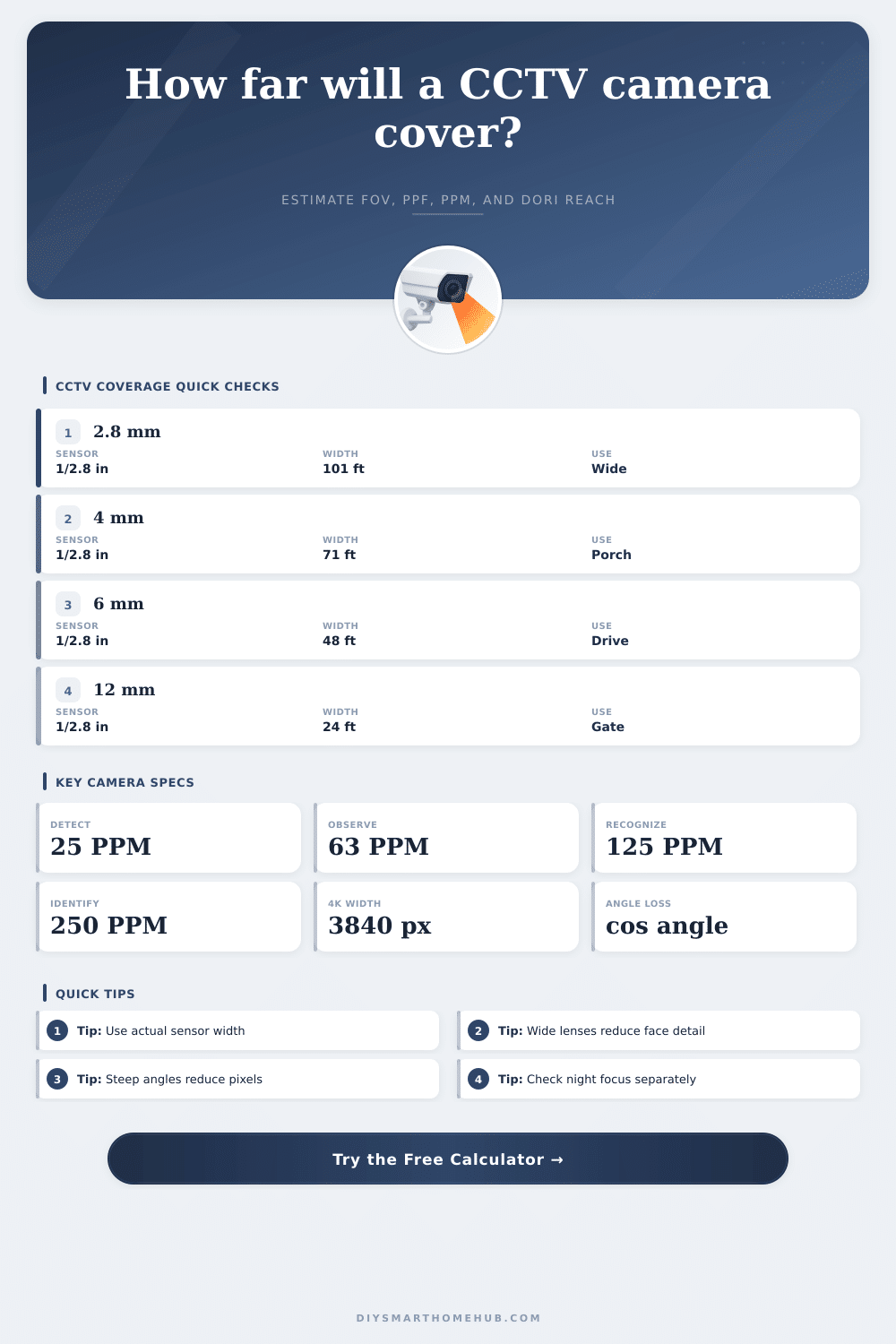
| Detect | 25 PPM | 7.6 PPF | Enough pixels to detect a person-sized target moving in the scene. |
| Observe | 63 PPM | 19.2 PPF | Enough pixels for broad clothing, body, and direction cues. |
| Recognize | 125 PPM | 38.1 PPF | Enough pixels to recognize a known person or familiar object. |
| Identify | 250 PPM | 76.2 PPF | Higher-detail planning level for faces under favorable conditions. |
📊Resolution and sensor reference
| Camera class | Horizontal pixels | Typical sensor width | Coverage note |
|---|---|---|---|
| 2MP / 1080p | 1920 px | 4.8 to 5.37 mm | Good for close entries when the scene width is kept modest. |
| 4MP / QHD | 2560 px | 5.37 to 6.4 mm | Common smart-home balance between detail and storage load. |
| 5MP | 2688 px | 5.37 to 7.18 mm | Slightly denser than 4MP when lens and sensor size are similar. |
| 8MP / 4K | 3840 px | 5.37 to 10.67 mm | Wider scenes can still hold useful PPF if optics and focus are good. |
| 12MP style | 4096 px | 7.18 to 10.67 mm | More horizontal pixels help, but lens quality and low-light noise still matter. |
📏Lens coverage examples at 30 ft
| Lens on 1/2.8 in sensor | Horizontal FOV | Scene width at 30 ft | 4MP density |
|---|---|---|---|
| 2.8 mm wide lens | 87.6 degrees | 57.5 ft / 17.5 m | 44.5 PPF / 146 PPM |
| 4 mm entry lens | 67.8 degrees | 40.3 ft / 12.3 m | 63.5 PPF / 208 PPM |
| 6 mm driveway lens | 48.3 degrees | 26.9 ft / 8.2 m | 95.3 PPF / 313 PPM |
| 8 mm side-yard lens | 37.1 degrees | 20.1 ft / 6.1 m | 127.1 PPF / 417 PPM |
| 12 mm gate lens | 25.2 degrees | 13.4 ft / 4.1 m | 190.7 PPF / 626 PPM |
🏠Common CCTV scene planning table
| Scene | Typical target distance | Lens starting point | Pixel-density planning note |
|---|---|---|---|
| Front door face view | 8 to 14 ft / 2.4 to 4.3 m | 4 mm on 1/2.8 in sensor | Keep face width large in frame for recognize or identify goals. |
| Porch package zone | 6 to 12 ft / 1.8 to 3.7 m | 2.8 mm wide lens | Wide coverage is useful, but small labels need a closer detail camera. |
| Single driveway | 25 to 45 ft / 7.6 to 13.7 m | 6 mm lens | Longer lens preserves PPF across a vehicle-width scene. |
| Back gate or side path | 30 to 70 ft / 9.1 to 21.3 m | 8 to 12 mm lens | Narrow view and lower mount angle help maintain recognition distance. |
| Garage or workshop interior | 10 to 25 ft / 3.0 to 7.6 m | 2.8 to 4 mm lens | Use the target width field for tools, doors, or people instead of room size. |
💡Practical calculation tips
When you choose an CCTV setup, you must consider the level of detail that such a CCTV setup will provide to you at a specific distance from the surveillance camera’s subject. Many individuals considers megapixels and lens size when choosing a CCTV security camera, but the level of detail that the CCTV setup will provide is based upon the interaction between those two variables after the CCTV setup has been mounted. For instance, if you use a CCTV security camera with a 4K sensor and a wide lens, you may have trouble obtaining a clear image of a subject that is located at a distance from the surveillance camera.
The mathematical relationship between the megapixel counts, the lens size, the distance between the CCTV security camera and its subject, and the angle of the subject from the CCTV security camera will determine whether the CCTV setup will provide you with a recording of the area’s motion only, or whether the CCTV setup will capture the level of detail of the objects in its field of view. The distance between the CCTV security camera and the subject that you are interested in viewing will have the greatest impact upon the level of detail of the CCTV security camera’s image. At ten feet between the CCTV security camera and its subject, a modest lens may provide enough pixels to recognize the individual that is in the subject.
What Affects CCTV Image Detail
At forty feet, however, the same number of pixels may not provide enough pixels to recognize the same subject. Additionally, the height at which you mount the CCTV security camera will also have an impact upon the level of detail of the surveillance camera’s image. By mounting the CCTV security camera high above the subject that you wish to observe, the subject will appear compressed within the surveillance camera’s image.
This compression vertical will reduce the level of detail in the image, regardless of the field of view of the CCTV security camera; a slight downward tilt to the CCTV security camera will reveal more of the subject than a dramatic downward angle will reveal. Pixel density are a factor in the level of detail of a CCTV security camera. For instance, to perform certain tasks with a CCTV security camera, such as detecting, observing, recognizing, or identifying a subject, the CCTV security camera must have a certain number of pixels per meter within its field of view of the subject.
Therefore, the CCTV security camera may be able to meet the threshold for observation of a subject, but may not have enough pixels to identify the subject. This CCTV security camera calculator consider these various factors; by entering the sensor width of the security camera, its focal length, its resolution, and the distance between the CCTV security camera and its subject, the CCTV security calculator will provide you with an understanding of how many pixels will be within the subject’s field of view. Furthermore, the CCTV security calculator will factor in the angle of the surveillance camera; the subject of a CCTV security camera will lose pixels if viewed at an angle from the surveillance camera.
Most CCTV security cameras is not aimed at a perfect square angle to the subjects that the CCTV security camera observes. Another factor that will impact the level of detail provided to an individual by a CCTV security camera is the size of the sensor within the CCTV security camera. For instance, two CCTV security cameras may have the same lens, but the one with the larger sensor will have a wider view of its field of view.
Such a wider view will distribute the same number of pixels across a wider area, which will reduce the pixel density of the surveillance camera. Therefore, instead of considering the format in which the CCTV security camera’s image is recorded, the factor that should be considered is the image width that the CCTV security camera provides. The reference table located within this article can help to individuals to understand the sensors sizes of common CCTV security cameras.
The angle of the subject that the CCTV security camera observes will reduce the number of pixels that is contained within the subject of the CCTV security camera. For instance, if an individual’s face is viewed at a thirty-degree angle, the number of pixels that are contained within that face is less than if the CCTV security camera viewed the same individual straightly-on. Additionally, as the angle increases beyond forty-five degrees, the number of pixels within the subject rapidly decreases.
Due to the loss of pixels of angled subjects, a CCTV security camera that is aimed across a driveway will need to have a longer focal length than the distance between the CCTV security camera and the subject suggests for the subject in that driveway. The same is true of the interiors of establishments; a CCTV security camera that is mounted at one end of a hallway will reveal more pixels of subjects located at the end of that hallway than a CCTV security camera that is mounted at a corner of that establishment. The performance of a CCTV security camera during the night may be another factor that must be considered.
For instance, some lenses are not as focused in low light as they are during the daytime. Additionally, the wider apertures of some CCTV security cameras are more prominent during the daytime. The CCTV security camera calculator does not consider these variables, but does provide individuals with information as to how much margin that their CCTV security camera has before the pixel density of the surveillance camera’s image drops to the level required of the CCTV security camera.
If the calculated pixel density of the CCTV security camera is near that threshold, you could of changed the CCTV security camera to one with a different lens or mounting height. Before purchasing a CCTV security camera, an individual should decide what level of detail they need from the CCTV security camera. For instance, a CCTV security camera that is placed at the porch light to observe package deliverers may have a wider lens than one that is installed at the front gate to recognize the individuals that pass by the gate.
Once you have decided what level of detail you need from your CCTV security camera, you must provide information about the sensor width of the CCTV security camera, the focal length of the lens, the distance between the CCTV security camera and its target, and the angle of that target. These four variables will determine the settings for the CCTV security camera.