Smart Carbon Monoxide Alarm Placement Calculator
Estimate CO alarm count and placement zones from occupiable floors, sleeping areas, fuel-burning appliance zones, attached garage risk, distance limits, and smart interconnect planning.
📌Real home presets
📐Placement inputs
Live placement map
Preset results will update after calculation.
Placement results
Full breakdown
📟CO alarm spec snapshot
📊Reference tables
Placement rule reference
Use these planning rules before checking manufacturer instructions and local code.
| Placement zone | Calculator rule | Count effect | Distance check | Planning note |
|---|---|---|---|---|
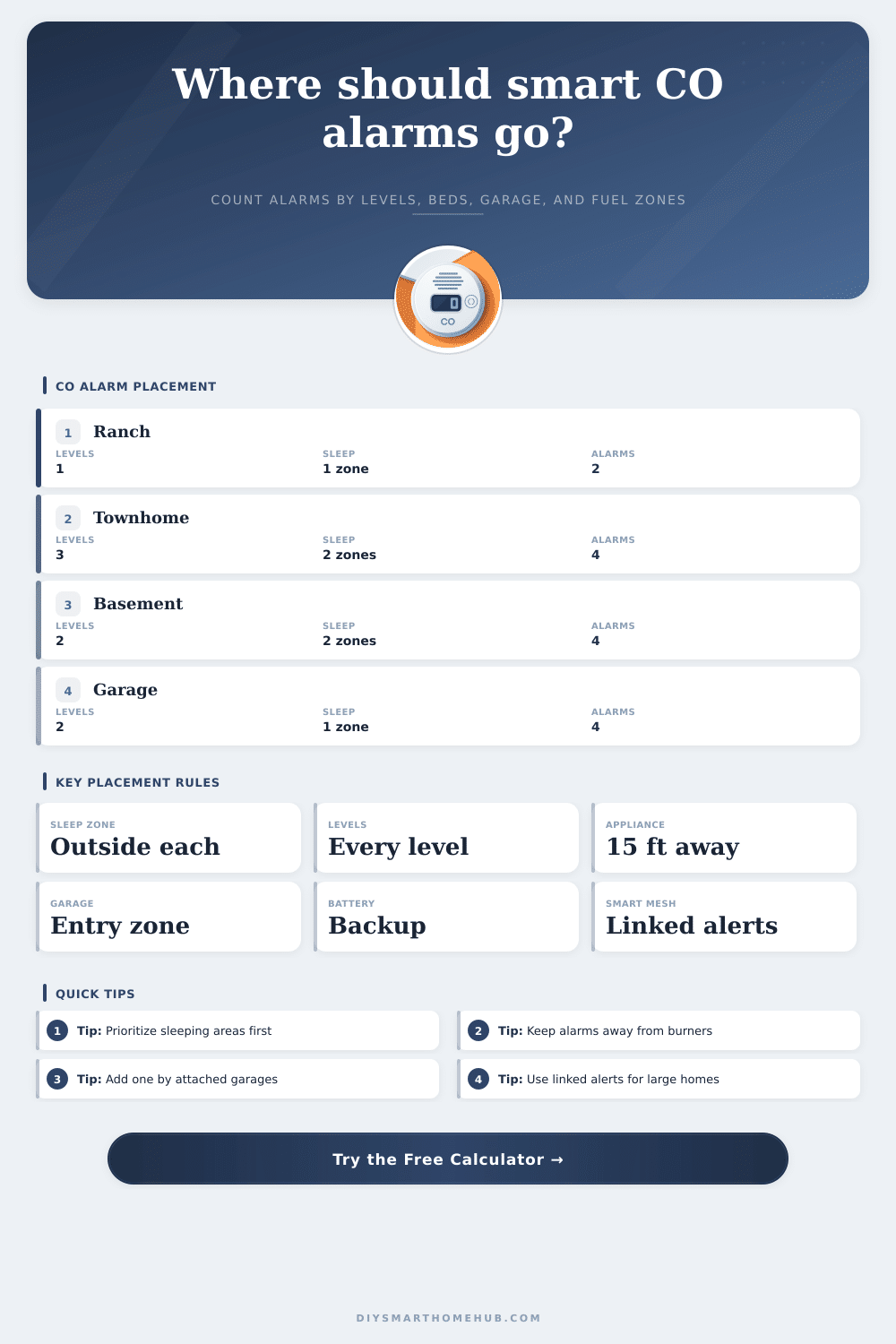
| Separate sleeping area | One alarm outside each distinct sleeping zone | Raises sleeping-zone count | Keep path short and audible | Highest priority because occupants are asleep. |
| Every occupiable level | At least one alarm on each finished level | Raises level count | Central hall or open area | Finished basements and sleeping lofts count as levels. |
| Fuel-burning appliance zone | Check remote zones and appliance buffer | Adds review points when zones exceed levels | Keep alarm at least 15 ft away | Do not place directly beside a burner or vent. |
| Attached garage | Add a living-space buffer near interior connection | Adds 1 or 2 alarms by condition | Inside living space, not in garage | Living space above a garage gets a stronger buffer. |
| Closed bedroom | Optional in-room linked alarm | Adds smart total only | Audibility and notification layer | Useful where doors stay closed overnight. |
CO alarm and smart spec comparison grid
Compare common CO alarm profiles without using brand recommendations.
| Alarm profile | Power and backup | Alert behavior | Best placement role | Calculator use |
|---|---|---|---|---|
| Battery CO alarm | Battery only | Local sounder | Simple level or sleep-zone coverage | Counts as one placement position. |
| Hardwired CO alarm | Line power with battery backup | Often interconnected | Newer homes and repeated level alerts | Good core alarm type for every level. |
| Smart CO alarm | Battery or line power with app alerts | Local, mobile, and sometimes voice | Separated floors, travel, and remote notifications | Use smart total for linked-device planning. |
| Combination smoke/CO | Varies by model | Smoke and CO sound patterns | Shared ceiling locations where instructions allow | Do not erase the CO sleeping-area rule. |
| Listener or bridge | Plug-in or battery accessory | Relays existing alarms | Notification layer near existing listed alarms | Not counted as the sensing alarm itself. |
Preset outcome table
These examples use the same formulas as the calculator above.
| Preset | Floors and area | Sleep and fuel zones | Garage condition | Recommended count |
|---|
Distance and count formulas
The count is not a square-foot coverage shortcut; it is built from life-safety placement zones.
| Calculation piece | Formula used | Pass target | Why it matters |
|---|---|---|---|
| Core base | max(occupiable levels, sleeping areas) | One per level and sleep zone | A hall alarm can often satisfy both on the same level. |
| Garage buffer | 0, 1, or 2 added alarms | Living-space side of connection | Attached garages increase CO entry risk. |
| Remote appliance add | ceil(max(fuel zones - levels, 0) / 2) | Review distant appliance zones | Remote mechanical or stove zones may need a separate central alarm. |
| Sleeping distance | score from 10 ft target to 15 ft max | 10 ft target, 15 ft review limit | Shorter path helps the alarm protect sleeping occupants. |
| Appliance buffer | closest distance / 15 ft | 15 ft or more | Too close can create nuisance alarms from startup exhaust. |
💡Planning tips
Carbon monoxide are a gas that does not have a scent or a color, and it also does not make a sound as it move through the home. Because humans cannot detect carbon monoxide using there five sense, a person must use a carbon monoxide alarm to detect its presence in the home. The placement of the carbon monoxide alarm is also important to ensure that an individual will be awakened if carbon monoxide is detect in the home.
If the carbon monoxide alarm is too far from the sleeping area of the home, the sound of the alarm will not be able to reach the sleeping individual. The carbon monoxide alarm calculator require the person to enter a number of factors regarding the home in which the calculator will perform its calculations. Factors such as the number of finished level in the home, the number of sleeping areas in the home, whether the home has an attached garage, and the distance between the nearest carbon monoxide alarm to the nearest fuel-burning appliance in the home will be required from the individual using the calculator.
Where to Put Carbon Monoxide Alarms
Each of these factors will contribute to the number of carbon monoxide alarms that is required for that specific home. Sleeping areas in a home are the most important area to place a carbon monoxide alarm. If an individual is sleeping and exposed to carbon monoxide, the individual can quickly lose consciousness.
If the bedroom in which an individual sleeps has its door closed, that individual may not be able to hear the carbon monoxide alarm. If the distance between the bed and the carbon monoxide alarm in that bedroom is more than fifteen feet, the individual may not be able to hear the alarm. The carbon monoxide alarm calculator will calculate the distance between the bed and each alarm in sleeping areas, and will use that distance to determine if the sleeping areas are protected by alarms.
The number of sleeping levels within a home is also an important factor in the placement of carbon monoxide alarms. Carbon monoxide is a gas that readily mix with the air within the home. Therefore, if a carbon monoxide alarm is placed within the main level of the home, it may not be able to notify individuals who are sleeping within another level of the home.
As such, each level of the home that is finished and contains individuals who may sleep within that level requires its own carbon monoxide alarm. The carbon monoxide alarm calculator will take into account each finished level within the home, including basements and lofts, to determine the total number of carbon monoxide alarms that is required for that home. Another factor that contributes to the total number of carbon monoxide alarms that is required within a home is if the home have an attached garage.
Homes that contain an attached garage may contain carbon monoxide from the car engine that is driving within the garage. If the bedrooms are located above the attached garage, the risks of exposure to carbon monoxide increases for the individuals who may sleep in those bedrooms. In this case, the carbon monoxide alarm calculator will add a carbon monoxide alarm that is located on the living space side of the attached garage.
This alarm is not counted in the attached garage, as the goal of the alarm is to protect the living space of the home. Similar to attached garages, fuel-burning appliances within the home, such as furnaces, water heaters, fireplaces, and stoves can emit carbon monoxide into the home. As such, an alarm may be placed too close to these appliances, which could result in nuisance alarms.
Nuisance alarms are those that sound due to the operation of the fuel-burning appliances within the home. As such, the distance between each fuel-burning appliance and each carbon monoxide alarm needs to be at least fifteen feet. Additionally, the calculator also determines if the remote area of the home that contain fuel-burning appliances are at a safe distance from the sleeping areas of the home.
If those remote areas are too close to the sleeping areas, then it will also suggest that a dedicated carbon monoxide alarm is place in that remote area of the home. When running the calculator, the alarm will provide several different output. One output will be the number of core carbon monoxide alarms that are required to ensure that each sleeping area is covered and that each level of the home is covered by at least one alarm.
In addition to these core alarms, there will also be an output of the number of additional carbon monoxide alarms that are required due to the presence of either attached garages or remote fuel-burning appliances. In addition to these alarms, the calculator will also produce a “smart total” of the total number of carbon monoxide alarms that is required in the home. This smart total will include the number of optional linked carbon monoxide alarms for sleeping areas that has their doors closed.
These linked carbon monoxide alarms have the added benefit of being able to send a notification to a phone if the sounder of the alarm is not hear. Finally, the calculator also creates a placement score for the home, represented as a percentage. Many individuals may make mistakes in the placement of their carbon monoxide alarms.
One of the most common is to treat the placement of a carbon monoxide alarm similar to smoke alarms. Smoke rises in the air to the ceiling in a home, which is when smoke detectors should be placed. However, carbon monoxide gas readily mix with the air in the home, so the alarms can be placed on lower walls in the home as recommended by the manufacturer of the alarms.
Another common mistake is to place the only carbon monoxide alarm within a home near one of the fuel-burning appliances in that home. Such placement may allow for the carbon monoxide alarm to satisfy the requirement of distance from fuel-burning appliances, but it may not ensure that sleeping area are protected by the alarm. To avoid such a mistake, the alarm calculator separates the requirement of distance from fuel-burning appliances from the requirement of placing alarms in sleeping areas of the home.
Power failures may prevent the proper function of the carbon monoxide alarm. If the individual places the carbon monoxide alarm in such a way that it relies solely upon the house current to function, then the alarm will no longer function if there is a power failure within the home. By contrast, linked smart carbon monoxide alarms have battery backups that will continue to function in the event of a power failure in the home.
To use the calculator, the individual will need to enter the number of sleeping levels, sleeping areas, whether the home has an attached garage, and the distance between the fuel-burning appliances and the nearest carbon monoxide alarm. After entering these parameters, the carbon monoxide alarm calculator will automatically calculate the number of carbon monoxide alarms that is required for each sleeping area, each sleeping level, any attached garages, and any remote fuel-burning appliances. By testing various configuration within the calculator, the individual can determine a placement of the alarms that will best provide for each sleeping area, sleeping level, and attached garage.
If an individual moves the sleeping areas closer to the carbon monoxide alarms, or if the individual places a linked carbon monoxide alarm next to each sleeping area whose bedroom door is closed, the placement score for the home will increase. Once the number of carbon monoxide alarms that is required for the individual’s home is determined, they will have to follow the instructions that are provided with each alarm to mount the alarms into the home.