Boiler Flue Size Calculator
Estimate a boiler flue diameter from input BTU, fuel type, appliance category, vertical height, lateral run, elbows, equivalent length, draft margin, and condensation risk.
📌Boiler Venting Presets
Choose a realistic starting point, then adjust the nameplate input and measured flue route. Final sizing must follow the boiler manual and local fuel-gas or mechanical code tables.
⚙Flue Sizing Inputs
Formula Breakdown
This is a sizing screen for planning. Approved vent sizing depends on the boiler listing, vent manufacturer tables, connector type, altitude, combustion air, and local code.
📊Flue Sizing Reference Specs
Common screening allowance for each full elbow in a boiler vent run.
Equivalent length used for each offset fitting in this calculator.
Capacity margin target after height, lateral, category, and fuel factors.
Category I lateral runs near flue height receive a draft caution.
📘Reference Tables
| Diameter | Category I Gas | Oil Chimney | Cat IV Direct Vent |
|---|---|---|---|
| 2 in / 51 mm | Not typical | Not typical | Up to 80k BTU/h short run |
| 3 in / 76 mm | Up to 45k BTU/h | Not typical | Up to 160k BTU/h common |
| 4 in / 102 mm | Up to 95k BTU/h | Small oil only by listing | Up to 300k BTU/h common |
| 5 in / 127 mm | Up to 150k BTU/h | Low to mid oil input | Large listed systems |
| 6 in / 152 mm | Up to 240k BTU/h | Common 100k to 160k oil | Commercial listed systems |
| Fitting or Condition | Allowance | Used For | Draft Effect |
|---|---|---|---|
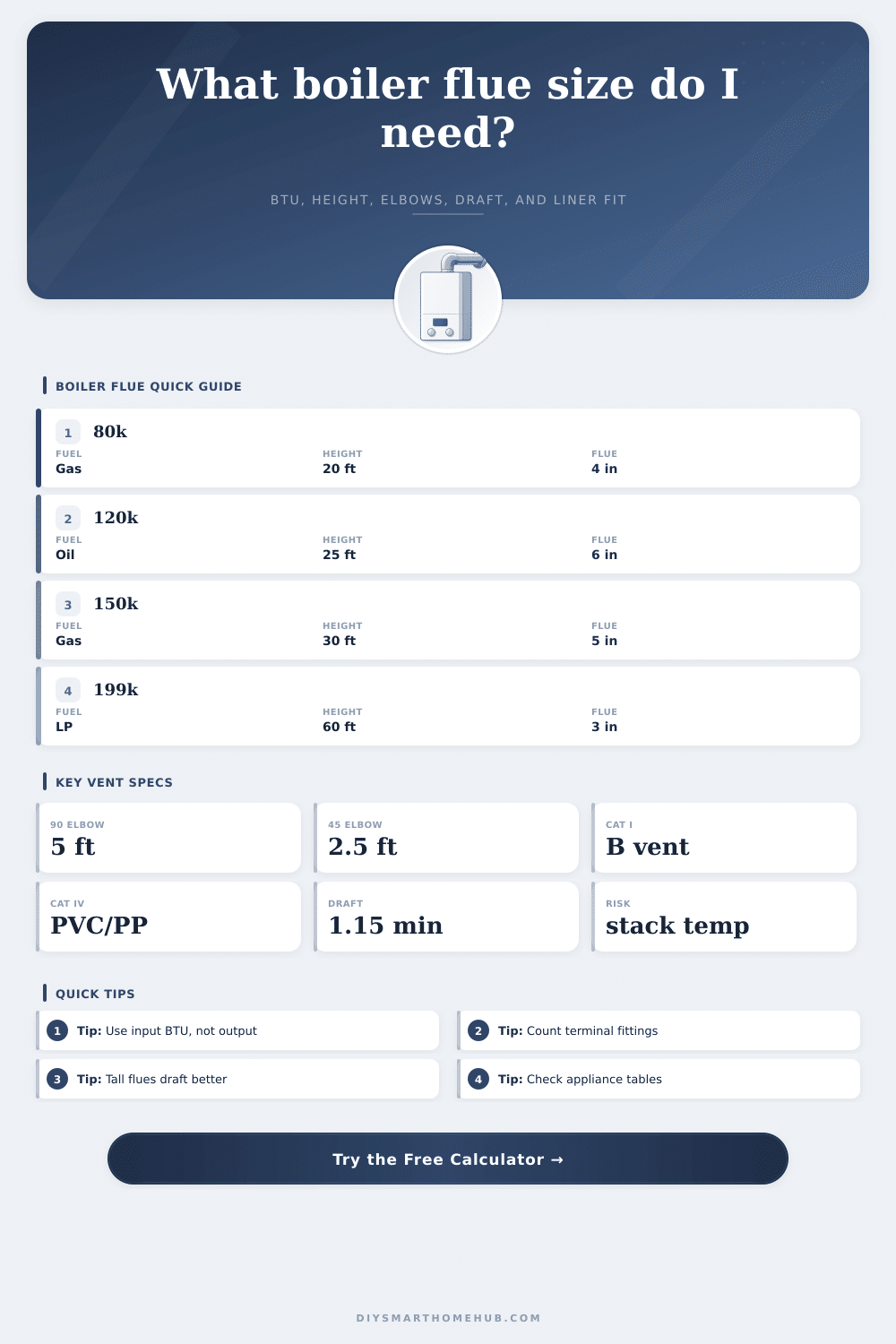
| 90 degree elbow | 5 ft / 1.5 m | Connector and vent route | Reduces available margin |
| 45 degree elbow | 2.5 ft / 0.8 m | Offset bends | Moderate pressure loss |
| Sidewall hood | 5 ft / 1.5 m | Power and direct vents | Counts against max run |
| Concentric terminal | 10 ft / 3.0 m | Condensing boilers | Often listed by maker |
| Snorkel termination | 15 ft / 4.6 m | Snow clearance risers | High equivalent penalty |
| Setup | Pressure | Wet Or Dry | Typical Vent |
|---|---|---|---|
| Natural gas Category I | Negative | Dry if warm enough | B vent or listed liner |
| LP gas Category I | Negative | Dry if warm enough | B vent or listed liner |
| Oil boiler chimney | Negative | Hot flue, soot tolerant | Stainless liner or chimney |
| Category III boiler | Positive | Usually dry | Stainless special gas vent |
| Category IV boiler | Positive | Wet condensing | PVC, CPVC, PP, or stainless |
| Scenario | Input | Height | Likely Screen |
|---|---|---|---|
| Small cast-iron gas boiler | 80k BTU/h | 20 ft / 6.1 m | 4 in liner or B vent |
| Residential steam boiler | 150k BTU/h | 30 ft / 9.1 m | 5 in to 6 in liner |
| Oil hydronic boiler | 120k BTU/h | 25 ft / 7.6 m | 6 in stainless liner |
| Wall-hung mod-con boiler | 80k BTU/h | 40 ft / 12.2 m equivalent | 2 in or 3 in direct vent |
| High-input combi boiler | 199k BTU/h | 70 ft / 21.3 m equivalent | 3 in or 4 in direct vent |
🧱Vent And Flue Liner Comparison Grid
Double-wall metal vent for listed gas appliances. Not for oil or condensing positive-pressure exhaust.
Works well for masonry relines, oil boilers, and many Category III or IV systems when listed for the appliance.
Used on many Category IV boilers. Strong choice for acidic condensate when the boiler listing allows it.
Common on direct-vent boilers where local code and the boiler manufacturer permit plastic vent material.
💡Flue Sizing Tips
Selecting the correct sizes for the flue on a boiler system is a process that goes beyond finding a pipe that will pass through the wall. The size of the flue must account for the way that the boiler create heat, the way that the flue must exit the building, and the temperature of that flue. If you dont account for these factors when choosing the size of the flue, you may experience issue with the performance of the burner or the chimney system altogether.
The flue size calculator included with this website account for several factors. First, it is possible to use the input rating of the boiler instead of the output number of a manufacturer. The input rating of the manufacturer is important in that this number will indicate how much fuel are being burned by the boiler.
How to Choose the Right Flue Size for a Boiler
The more fuel that the boiler burns, the more flue gas will exit the building. For instance, a boiler that has an input of 120,000 BTU/h will produce more flue gas than a boiler with an input of 80,000 BTU/h. However, the fuel type will also impact this number, so a factor for that is included in the calculator.
Oil burns at a higher temperature than natural gas, for instance. Propane burns at a temperature that is between that of oil and natural gas. Each fuel type will exit the chimney at a different temperature, and that impacts the draft within the chimney.
Therefore, the installer adjusts the capacity of the flue according to the differences in those fuel temperatures. Additionally, if you are replacing an older oil-fired boiler with a gas-fired boiler, you must consider that the gas-fired boiler will release less heat. As a result, the flue inside of the masonry chimney may condense within the walls.
The category of the boiler will also impact the sizing requirements of the flue. Category I boilers utilize a natural draft to remove the gases created by the burning of fuel within the boiler. As a result, there are minimum requirement for the height and the temperature of the flue created by a Category I boiler.
Category IV boilers are condensing boilers, meaning that they use a fan to push the flue gases out of the boiler. Additionally, these types of boilers emit acidic condensate, as a result of the condensation of water vapor within the flue gases. Therefore, the material for the flue must be able to handle these acidic fumes.
The flue size calculator will alert the installer if certain type of vent material are not suitable for the category of the installed boiler. Additionally, the flue often includes elbows or other form of termination of the flue. Each of these elements adds length to the flue that is not visible to the installer.
For instance, each 90-degree elbow adds 5 feet of length to the flue, and if there are two 90-degree elbows, plus a rain cap, the flue will be 15 feet in length. This length must be accounted for when determining the size of the flue. This factor is useful if other types of offset elbows are to be installed, for instance, or if a sidewall hood is to be installed.
Another issue that can impact the efficiency of the chimney system is lateral runs. These are horizontal lengths of the flue that may exist in some installations. If the lateral run is too long relative to the height of the chimney, the draft will be difficult to establish.
Therefore, an adjustment to the flue capacity must be made based on the length of the lateral run. This factor will adjust the capacity accordingly so that taller chimneys with shorter lateral runs will have smaller diameters then long lateral runs. Condensation within the masonry chimney is another issue that can develop, especially after the first heating season of the year.
If an oversized masonry chimney is connected to a high-efficiency boiler, the masonry chimney may remain cool. If the temperature within the chimney remains low, the moisture within the flue gases will condense within the mortar that build the chimney. This can lead to the deterioration of the mortar and the flue liner.
Therefore, a scoring routine will alert the installer to these issues. While the flue size calculator is not a replacement for a site inspection, it may alert the installer to the need for a liner or insulation upgrade to the chimney. The tables included in this article will help to ensure that the size of the flue is correct for the chimney.
These tables include factors like the diameter, the category, and the fuel type of the boiler. While these tables are not intended to be a replacement for the specifications within the manufacturer manual for the boiler, these tables will help to ensure that the flue size selected for the installation is within the requirements for the system. The flue size calculator includes a target for the draft of 1.15.
This margin is established as a safety measure; leaving a margin above of 1.15 will allow for factors like altitude within the installation site, dirty heat exchangers for the boiler, or cold days within the area in which the installation is made. The tables will not account for variables that may exist at the installation site. Other variables may include the elevation of the chimney, other buildings within the area, or the type of liner that is already within the masonry chimney.
Therefore, the final step in installing the chimney is to compare the numbers from the calculator and the tables to the specifications of the manufacturer for the vent and the boiler manufacturer. This will allow for a quick discussion between the installer and the homeowner about the variables of the installation site.