Cast Iron Radiator Size Calculator
Estimate cast-iron radiator EDR from sections, columns, height, and radiator style, then compare steam or hot-water output with the room heat loss while checking length, weight, and water volume.
🏠Room and Radiator Presets
⚙Radiator and Room Inputs
📊Cast-Iron Radiator Results
🔧Cast-Iron Radiator Spec Grid
📑Reference Tables
| Radiator Type | Height | EDR/Section | Typical Use |
|---|
| System | Rating Basis | BTU/h per EDR | Notes |
|---|---|---|---|
| Steam | Low pressure | 240 | Direct EDR rating for connected load. |
| Hot water | 170°F AWT, 70°F room | 170 | Classic high-temperature hydronic rating. |
| Hot water | 150°F AWT, 70°F room | 128 | Moderate water temperature retrofit. |
| Hot water | 130°F AWT, 70°F room | 88 | Lower-temperature condensing operation. |
| Hot water | 120°F AWT, 70°F room | 70 | Very low-temperature radiator output. |
| Room Heat Loss | Steam EDR | 180°F Water EDR | 140°F Water EDR |
|---|---|---|---|
| 3,000 BTU/h | 12.5 | 20.0 | 50.8 |
| 5,000 BTU/h | 20.8 | 33.3 | 84.7 |
| 8,000 BTU/h | 33.3 | 53.3 | 135.5 |
| 12,000 BTU/h | 50.0 | 80.0 | 203.3 |
| 18,000 BTU/h | 75.0 | 120.0 | 305.0 |
| Scenario | Sections | System | Output Range |
|---|
💡Calculation Notes
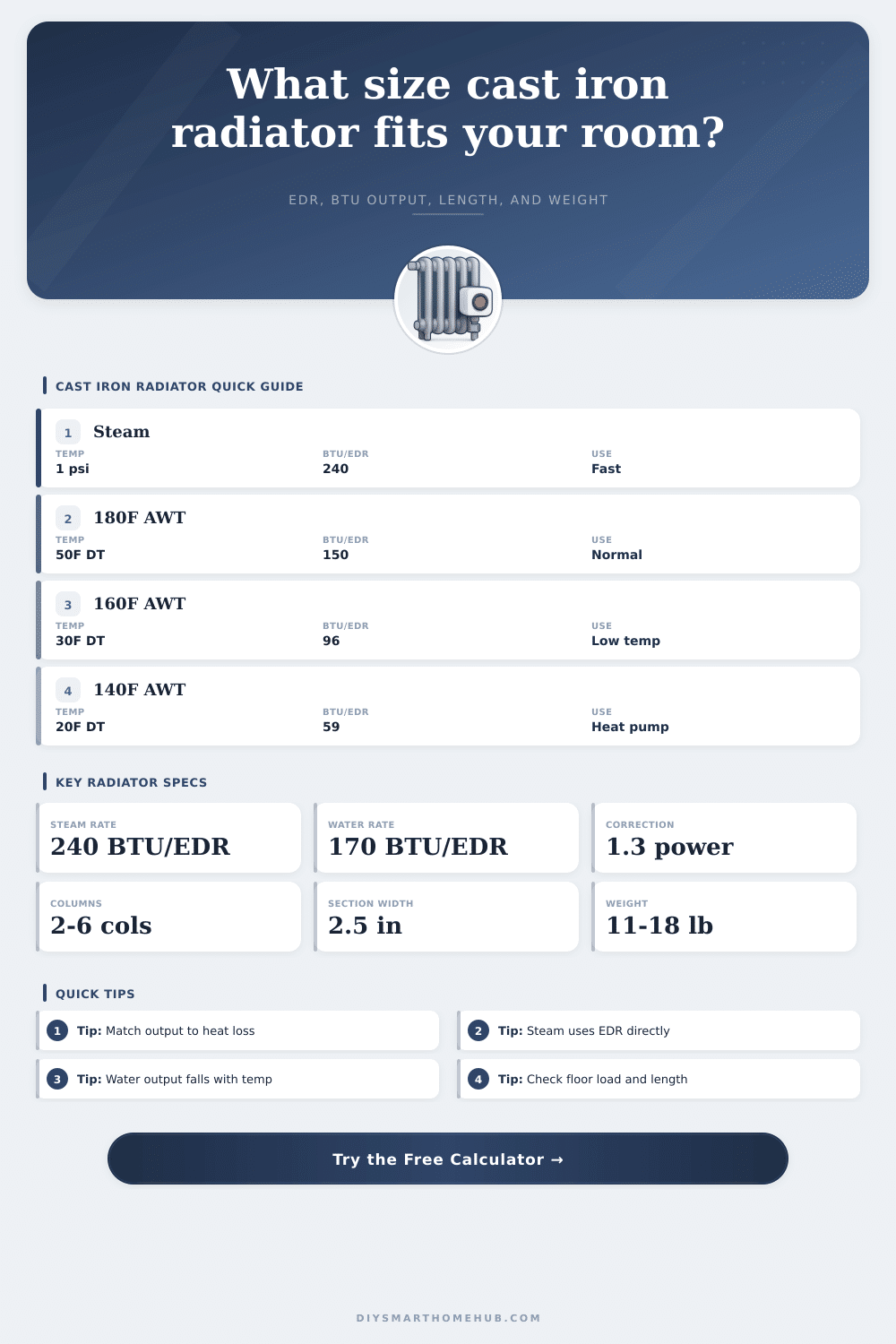
Cast-iron radiator sizing is easiest when every radiator is converted to square feet EDR first. Steam compares EDR directly; hot water then applies a temperature correction.
Section count affects heat, but it also changes length, filled weight, and floor loading. Confirm valve spacing, wall clearance, and support before moving heavy cast iron.
Cast iron radiator is heating units that are often found in older buildings. Cast iron radiator can be used in many different type of heating systems. When you are selecting a cast iron radiator for you’re home or office building, you must consider the heat output of the radiator.
The physical size of the radiator does not provide the heat output, but rather by the surface areas of the radiator. The surface area of the radiator is measured in square feet of equivalent direct radiation (EDR). The EDR of a radiator is a measurement of the surface area of the unit.
How to Choose a Cast Iron Radiator
However, the effect of EDR on the heat output of the radiator also depend upon the type of heating system that is use. In steam heating systems, the heat output of the radiator is the same regardless of the temperature of the steam and the EDR of the radiator. In hot water heating systems, however, the heat output of the radiator change based off the temperature of the water that circulates through the system.
At low temperatures in the heating water system, the heat output of the radiator will be low. At high temperatures in the heating water system, the heat output of the radiator will be high. Because the heat output of the radiator and the temperature of the water are not linear relationship with one another, a drop in the temperature of the water may require an increase in the EDR of the radiator to provide sufficient heat to the room.
Another factor to consider when you are choosing a radiator is the number of section that the radiator has. The number of sections will affect the total EDR, the length, and the weight of the radiator. Each section is provided with a specific volume of water that will allow it to heat the rooms efficient.
Additionally, the height and the column style of the radiator will also affect the heat output of each section of the radiator. Thus, a tall radiator may have a more different heat output for each section of the radiator then a short radiator that has the same number of sections as the tall radiator. You must also calculate the heat loss of the room that the radiator will heat.
The heat loss of a room include any heat that is lost through the windows of the room, through the walls of the room, and due to air changes in the room. If you find that the heat loss of the room is high, it may be necesary to increase the amount of heat that the radiator provides to warm the room as quick as possible. If the heat output of the radiator is less than the heat loss of the room, the room will not reach the desired temperature.
Beyond the characteristics of the radiator, there is also some physical factors that can affect its installation. One factor is the weight of the radiator and the strength of the structures upon which it will rest. Radiators is heavy and the structures beneath them must be able to support their weight when they are filled with water.
Additionally, the placement of the radiator also affect its installation. The placement of the radiator will affect the spacing of the valve of the radiator. If you use the reference tables for the temperatures of the heating systems, you can determine the EDR requirement of your rooms.
By comparing the EDR of your current radiator with the EDR requirements of the rooms, you can determine if you should add more sections to the radiator. Similarly, you can use the reference tables to determine if you should purchase a taller radiator rather than a radiator that have the same number of sections but is of a different height. Finally, it is important to remember that EDR is a measurement of the surface area of the radiator.
However, the amount of heat that the radiator provides is not related to the EDR but to the temperature of the water within the system. You should of checked the EDR requirements more carefully. It is a lot of work, but it makes the installation more comfortabley.
The radiator’s size is important. Its easy to forget how heavy they are. Dont forget to check the floor too.
Youll need a moddern system if you want the heat to be consistent. The radiator’s weight can be an issue for some floors. A radiator should be installed on a solid surface.