Heat Pump Radiator Size Calculator
Estimate room heat loss, low-temperature radiator derating, required radiator output, radiator length, and hydronic flow for heat pump radiator upgrades.
⚙Heat Pump Radiator Presets
🌡Room, Water, and Radiator Inputs
Calculation Breakdown
📊Low-Temperature Radiator Spec Grid
📋EN442 Derating Reference
| Flow / return | Room temp | Mean Delta T | Approx output from T50 |
|---|---|---|---|
| 55 / 45°C | 20°C | 30 K | About 52% at exponent 1.30 |
| 50 / 45°C | 20°C | 27.5 K | About 46% at exponent 1.30 |
| 45 / 40°C | 20°C | 22.5 K | About 36% at exponent 1.30 |
| 40 / 35°C | 20°C | 17.5 K | About 26% at exponent 1.30 |
🔧Radiator Type Comparison
| Emitter type | EN442 T50 output | Low-temp fit | Use when |
|---|---|---|---|
| Type 11 panel | 900 W/m | Limited at 45°C flow | Small rooms or long walls |
| Type 22 panel | 1800 W/m | Common heat pump retrofit | Bedrooms, kitchens, living rooms |
| Type 33 panel | 2600 W/m | High output per wall length | Short walls or high heat loss |
| Fan-assisted emitter | 3000 W/m equivalent | Strong low-temperature output | Very low flow temperatures |
🏠Common Room Sizing Examples
| Room profile | Heat loss input | Water design | Typical radiator direction |
|---|---|---|---|
| Small bedroom | 10 m² x 45 W/m² | 45 / 40°C | Type 22 around 0.8 m |
| Living room | 24 m² x 60 W/m² | 45 / 40°C | Long Type 22 or Type 33 |
| Open plan zone | 42 m² x 55 W/m² | 50 / 45°C | Split across two emitters |
| Garage conversion | 20 m² x 75 W/m² | 50 / 40°C | Type 33 or fan-assisted |
💧Hydronic Flow Reference
| Radiator load | 5 K water drop | 7 K water drop | Design note |
|---|---|---|---|
| 500 W | 86 L/h | 61 L/h | Small bedrooms and halls |
| 1000 W | 172 L/h | 123 L/h | Typical bedroom circuit |
| 2000 W | 344 L/h | 246 L/h | Large living zone |
| 3000 W | 516 L/h | 369 L/h | Split flow may balance better |
💡Radiator Sizing Tip Boxes
Also: when replacing a boiler with a heat pump, you have to rethink radiator sizing. Water temperatures goes way down, and that changes everything. People install huge new systems and still live in a cold house, because they didn’t take into account the fact that their new water temperature won’t be anywhere near as hot than it was with an 80-degree boiler flow. Emitters that can’t get job done at only 45-degrees of heat pump water aren’t going to make much difference…you want emitters that move heat even when they’re cool. That’s why most retrofits don’t work: undersizing of radiators by homeowners who assumed they could use the same ones that worked with 80-degree boiler flow but were only getting 40-ish from the heat pump.
First, take note of how much your room actualy loses heat (this isn’t about square footage; it’s about what kind of walls you have). You’ll enter the length and width of those walls into the calculator, along with insulation level. It may turn out an insulated bedroom require just eight-hundred watts, while a drafty garage conversion with single-glazed window requires double that. Underestimating the loss means underheating your space, so your radiator can never catch up. Overestimating the loss mean buying more expensive equipment than necessary, and wasting precious wall space in the process, since most of it will run idle. Ideally, you want to find sweet spot between efficiency and comfort.
Why You Need Bigger Radiators for Heat Pumps
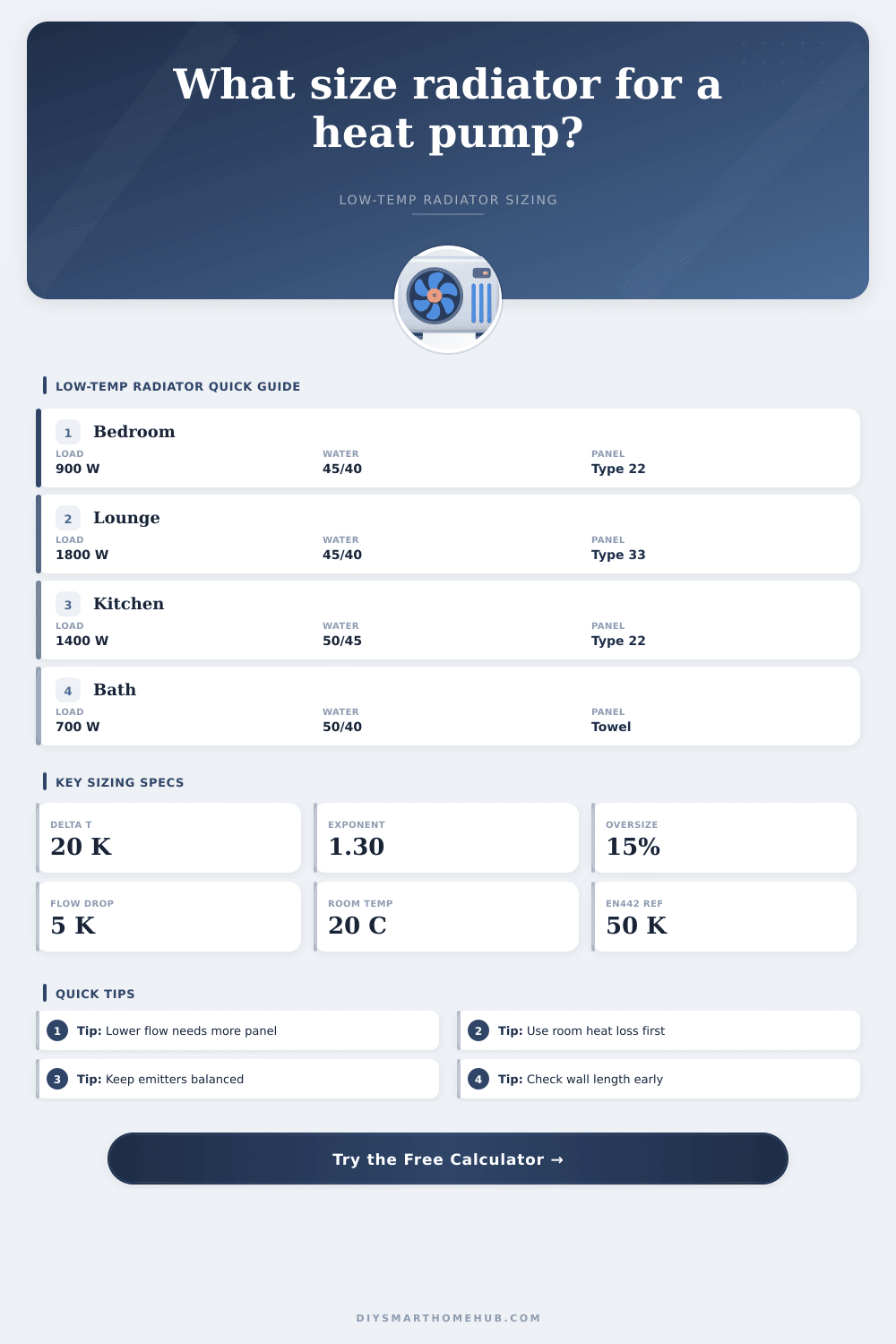
Derating: Now you know your heat loss. How do you allow for derating? Manufacturers rates radiators on an assumed room temperature of zero degrees C (32F) and very hot water of fifty degrees C (122F), which is a standard temp diff of fifty Kelvin. Because a heat pump works across a far smaller difference in temperature between water and air, it will use far fewer calories per meter of radiator. That is, each meter of radiator will produce much less heat than indicated on the manufacturer’s datasheet when the water is cooler. As flow temp drops to forty-five degrees C, output reduce dramatically, as illustrated in the reference table. If a Type 22 panel radiator were used, it would give only thirty-six percent of its rated output under these conditions. In other words, you’ll need to oversize your emitters by roughly fifteen to twenty percent to achieve the same performance as what you previously enjoyed.
Don’t counteract undersized radiators with an extra-hot supply temperature from your heat pump. The sweet spot for a heat pump is low water temperatures. Where its coefficient of performance remains high and its electricity bill stays affordable. By forcing water too hot, you force compressor to do extra work and negate the energy savings you are seeking. Larger radiators help prevent higher utility bills. Consider adding Type 33 panels or fan-assisted emitters if you have limited wall space, they can deliver more output while taking up less space, even when fed cooler water.
Another component many ignore until you’re in the middle of heating season is hydronic balance. The calculator determine roughly what flow rate should go through each radiator based on how much temperature drops throughout the system. Basically smaller temp drops necessitate higher flows for the same volume of energy delivered. An under-powered pump and/or too small pipes means water goes wherever it can get out. This leaves certain room cold while overheating others. Each room has its own length of piping and different demand which require enough volume passing through each zone to deliver that heat where it’s needed. Balancing valves comes into play here
Early on, take stock of how much space you have on any given wall. If you calculate and find out that you need a 2-meter-long radiator, but your window bay only measures one meter, well then you’ve got yourself a problem. Your options are: 1) Upgrade to something with better insulation so that you can get away with a smaller emitter. 2) Get a higher-output panel type that fits in your space. 3) If your building allows, split the load into two smaller emitters. There are trade-offs with each solution, but making no allowance for space means you’re looking at either a clunky install job or a cold-ass winter. You should of planned ahead.
Radiator sizing in heat pump systems isn’t nearly as much about muscle as it is about thermal endurance, meaning you desire emitters that are warm (but not too warm) so they don’t get drafty or even worse create places where condensation could form. If you’re mindful of how well the tech works, then it’s simple math: use the tool, allow for it to lead you into an appropriate-sized radiator for your goals and your wall structure. Balance is what makes comfort comfortable; brute force does not. You should’ve known that comfortaly living requires care.