Smart Radiator Valve Runtime Calculator
Estimate active valve runtime, delivered heat, room heat loss, and thermal response from room volume, radiator output, water temperature, valve opening, and duty cycle.
Live radiator balance
Smart Radiator Valve Runtime Results
Full calculation breakdown
These tables are calculation references for runtime estimates. Use measured room performance and radiator data sheets when they are available.
| Preset room | Room volume | Radiator and valve | Active runtime | Runtime result |
|---|
| Heat loss profile | Design loss density | Design delta basis | Thermal response | Best fit |
|---|---|---|---|---|
| Very low loss, internal room | 18 W per m3 | 20 C indoor-outdoor spread | 4.8 h time constant | Internal apartment room or well buffered zone |
| Modern insulated room | 25 W per m3 | 22 C indoor-outdoor spread | 4.2 h time constant | Modern walls, decent windows, normal ceiling |
| Standard insulated room | 34 W per m3 | 24 C indoor-outdoor spread | 3.6 h time constant | Typical existing home room with one outside wall |
| Corner room with outside walls | 42 W per m3 | 25 C indoor-outdoor spread | 3.0 h time constant | Two outside walls or more glass exposure |
| Loft or roof exposure | 50 W per m3 | 26 C indoor-outdoor spread | 2.6 h time constant | Top-floor room with roof and wind exposure |
| Older draft-prone room | 60 W per m3 | 28 C indoor-outdoor spread | 2.2 h time constant | Older room with infiltration or weak glazing |
| Valve opening | Linear reading | Calculator valve factor | Runtime meaning | Use in formula |
|---|---|---|---|---|
| 20% open | Low command | 35% output factor | Still passes enough flow for small trims | Rated W x DT factor x 0.35 |
| 40% open | Partial command | 55% output factor | Common modulating position after warm-up | Rated W x DT factor x 0.55 |
| 60% open | Mid-high command | 72% output factor | Useful for recovery without full overshoot | Rated W x DT factor x 0.72 |
| 80% open | High command | 86% output factor | Close to full emitter output | Rated W x DT factor x 0.86 |
| 100% open | Full call | 100% output factor | Maximum available radiator output | Rated W x DT factor x 1.00 |
| Radiator or emitter type | Common DT50 output range | Response behavior | Valve pairing note | Calculator setting |
|---|---|---|---|---|
| Single panel radiator | 450 to 1100 W | Fast surface warm-up but lower total output | Good for bedrooms and smaller offices | Use actual DT50 watts from size chart |
| Double panel convector | 900 to 2400 W | Higher output with moderate response speed | Common in living rooms and open zones | Higher rating with 40 to 70% valve opening |
| Towel radiator | 250 to 900 W | Lower water volume and smaller heat surface | Often needs longer runtime in cold bathrooms | Check heat loss headroom carefully |
| Cast iron radiator | 800 to 3000 W | Slow warm-up and long heat tail | Smart valve duty may look low after warm-up | Use longer tau profile when room feels slow |
| Multiple emitters in one zone | 1800 to 6000 W | Fast recovery if flow is balanced | Enter combined output controlled by the valve plan | Use whole-zone area and combined DT50 W |
| Formula step | Expression used | Why it matters | Result behavior |
|---|---|---|---|
| Room volume | Floor area x height | Heat loss and air mass scale with volume | Larger rooms need more radiator runtime |
| Heat output correction | Rated W x (DT / 50)^1.3 | Radiator output falls when water temperature is lower | Low-temperature systems need more active time |
| Valve output factor | (Open% / 100)^0.65 | Valve flow response is curved rather than linear | Part-open valves retain useful heat output |
| Active runtime | Window hours x duty cycle | Duty cycle turns an available window into heat-on hours | Higher duty raises heat energy directly |
| Thermal response | Equilibrium lift x (1 - exp(-h / tau)) | Rooms do not instantly receive all calculated heat | Slow rooms show smaller short-runtime gains |
Smart radiator valve offer homeowners numerous benefit. However, many people are confused as to how long a smart radiator valve should remain open during each day. Several factor simultaneously influence the amount of heat that a radiator can produce, including the size of the room, the water temperature within the radiator, the opening of the smart radiator valve, and the amount of time that the heating system is continuous on.
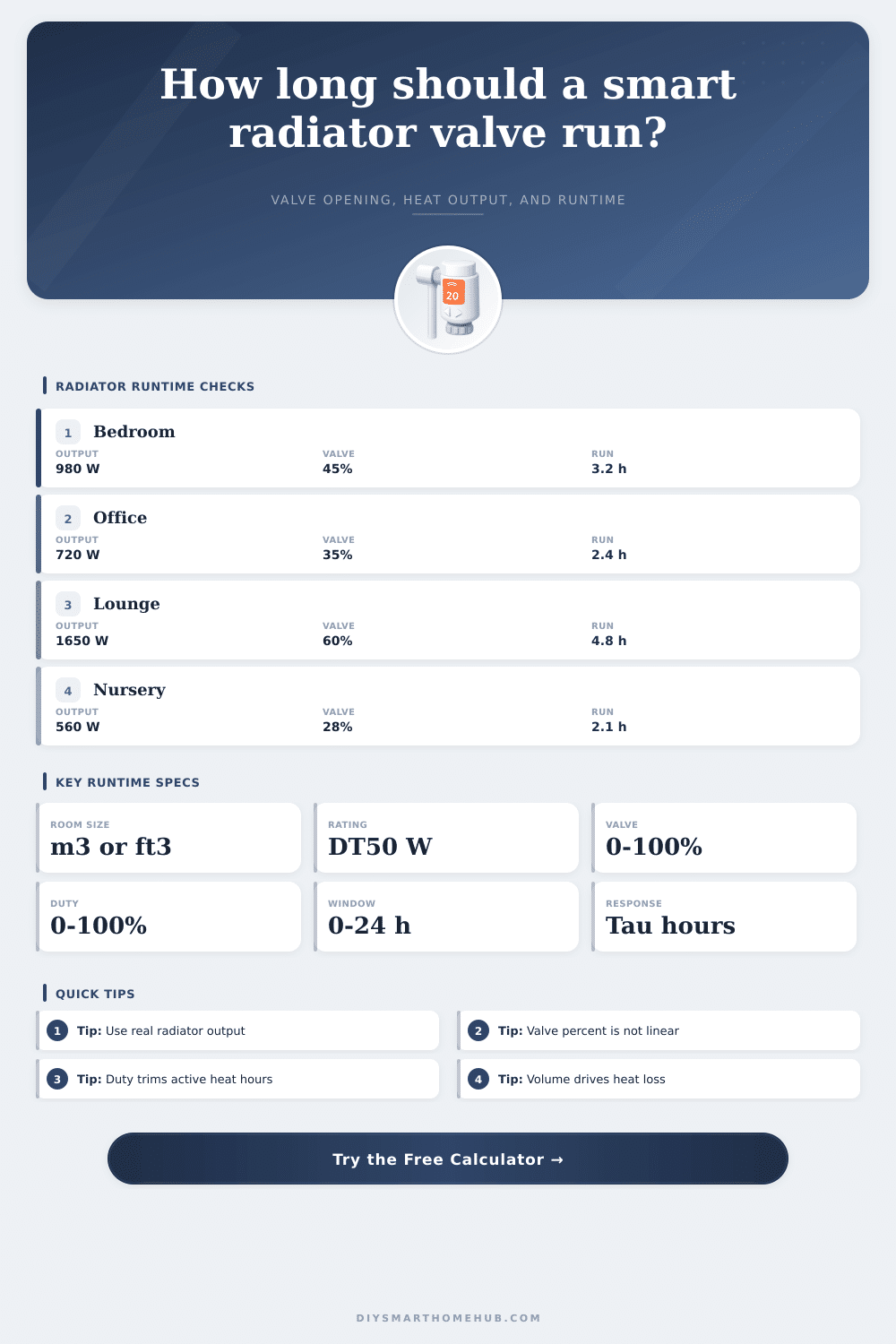
A person must gain an understanding of the difference between the position of a smart radiator valve versus the duty cycle of the valve. The position of the valve determine the amount of water that can exit the valve, and the increased movement of water increase the amount of heat that the radiator system emits. However, the duty cycle is the amount of time that the valve is active within a specific time window.
How Long to Leave a Smart Radiator Valve Open
For example, a smart radiator valve in a bedroom may be forty percent open for a period of six hour within an eight-hour time window. The active runtime of the valve determine the level of comfort within the room and the cost of heating the room. Therefore, a person should not confuse the two term.
Another factor that a person should consider is the heat loss profile of the room. The heat loss of a room that is an internal room that has shared wall to the other rooms in the house will lose heat at a slower rate. As such, a radiator is all that is required to maintain the temperature of the room.
In contrast, the heat loss of a room that is located in the loft of the house and has exposure to the roof and glass window will experience a higher rate of heat loss. Consequently, the smart radiator valve in the room will require a higher opening or a longer duty cycle. The mass of the room is another important factor to consider.
High-mass rooms will warm up to the desired temperature slow but will stay at that temperature for a longer period. In contrast, lightweight rooms will warm up quickly but will not stay at a certain temperature for long. The water temperature within the smart radiator valve will impact the amount of heat that is provided to the room.
If the boiler of the heating system maintain a lower water temperature within the valve, the radiator will emit less heat into the room. The relationship between water temperature and heat output is not linear. Consequently, when employing heat pump to heat the rooms in the home, the lower the water temperature, the more the smart radiator valve will need to remain open in order to reach the desired heat output for the room.
The amount of water that passes through the smart radiator valve does not increase in a linear fashion based off the percentage of the valve that is open. For example, if a smart radiator valve is forty percent open, it might emit more than half of the total heat that the valve could emit if it were fully open. However, if the user increases the valve from eighty percent open to one hundred percent open, the amount of heat emitted will increase by a small percentage.
Consequently, small changes to the percentage of the valve that is open in the middle portion of the valve range will have a greater impact on the amount of heat that is emitted than large changes to the percentage near the fully open portion of the valve. Another factor that a person using smart radiator valves should consider is the thermal response time of the room. The thermal response time of the room is the time that it takes for the temperature within the room to establish a steady state within the room.
In rooms with a long thermal response time, the temperature will take longer to rise to the steady state. For example, the room may only gain a few degree in the first hour of applying heat to the room. In these instances, short duty cycles may not provide adequate heat for the room.
A longer time window for the heating system to warm the room may be required. However, the numerous variable in the house can impact the rate at which each room within the house can lose heat. For example, the placement of furniture in the room can impact the rate of heat loss.
The number of doors that are open in the room may impact the amount of heat that is lost within the space. These variable to the heat loss rate of each room mean that a person should use a calculated amount of time for the smart radiator valve to remain open as a starting point. Subsequently, a person should make small adjustments to that calculated time according to the actual heat loss rate of each rooms.
The calculations for the active runtime of the smart radiator valve should be used only as a starting point for the percentage of the valve that should be open. These calculations should be performed, the percentage for the smart radiator valve should be noted, and the temperature of each room should be observed over time. If the room reaches the desired temperature too quickly, the percentage that the valve is open or the duty cycle for the valve may need to be reduced.
If the percentage of the valve that is open is too low for the room to reach the desired temperature, that percentage should be increased slightly rather than made drastic to the percentage of the valve that is open. By using this system of noting the calculated percentage of the valve that should be open and making small change as necessary, a person can better control the amount of heat that the smart radiator valve system provides to each room. Youll find that using this method works better then just guessing.
It’s better to be accuratly calibrated with the furnitures placement. You should of checked your settings before starting.