Lighting Energy Consumption Calculator
Estimate monthly and annual lighting kWh, active load, smart-control reduction, and lighting power density for LED, CFL, halogen, incandescent, strip, and tube lighting zones.
Full Formula Breakdown
Equivalent wattages vary by product, optics, dimming level, and color temperature; use the exact fixture label when known.
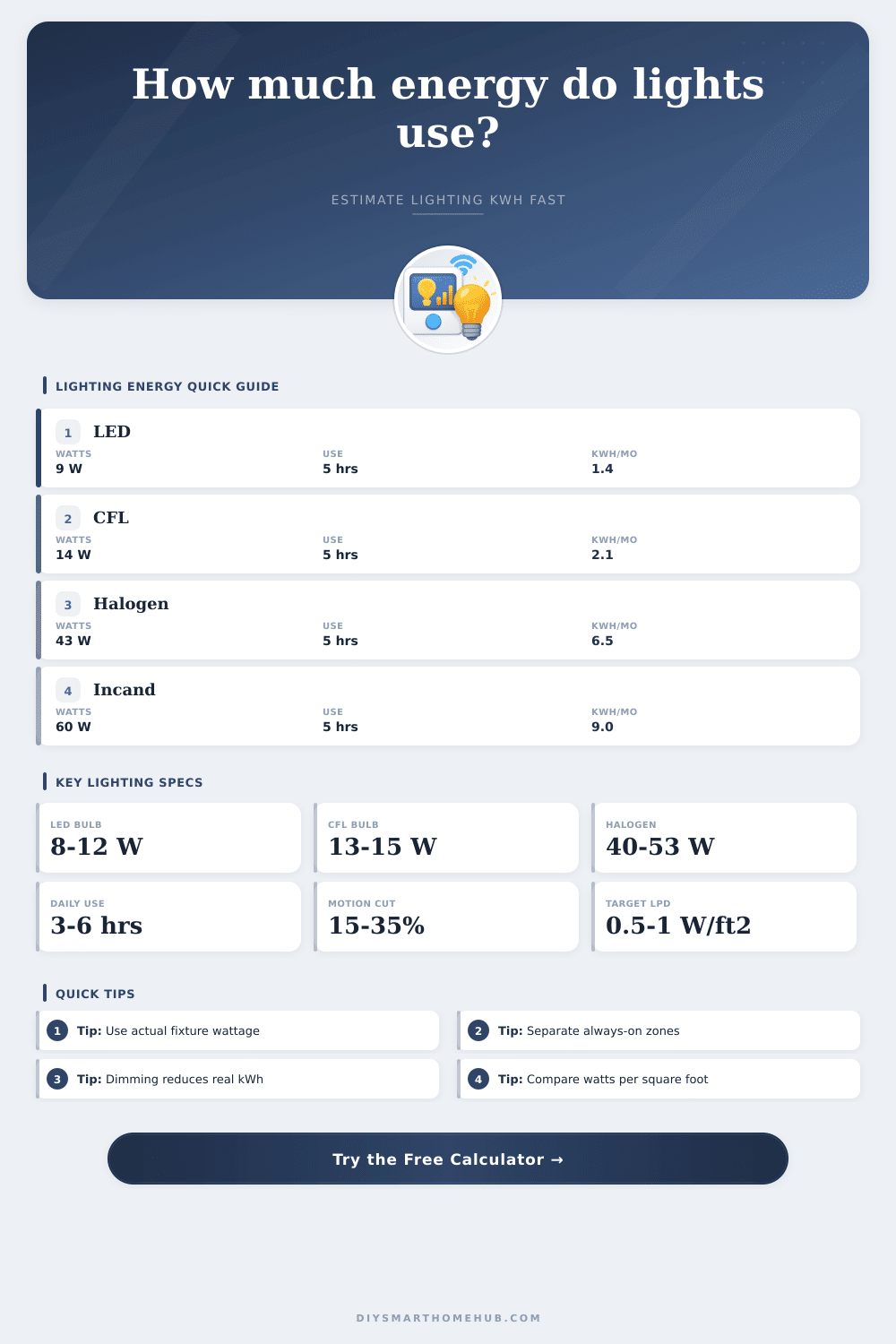
| Lamp type | Typical watts for about 800 lm | Typical efficacy | 30-day energy at 5 hr/day |
|---|---|---|---|
| Incandescent bulb | 60 W | 10 to 17 lm/W | 9.0 kWh per lamp |
| Halogen bulb | 43 W | 16 to 24 lm/W | 6.45 kWh per lamp |
| Compact fluorescent | 13 to 15 W | 50 to 70 lm/W | 2.1 kWh per lamp at 14 W |
| Standard LED bulb | 8 to 12 W | 80 to 120 lm/W | 1.35 kWh per lamp at 9 W |
| Smart RGB LED bulb | 9 to 11 W at full white | 60 to 90 lm/W in white mode | 1.5 kWh per lamp at 10 W |
| LED tube or shop light | 15 to 25 W per tube | 90 to 130 lm/W | 3.0 kWh per tube at 20 W |
| Zone type | Common area | Typical connected load | Density range |
|---|---|---|---|
| Kitchen with LED downlights | 120 to 220 sq ft | 60 to 120 W | 0.35 to 0.8 W/sq ft |
| Living room LED lamps | 180 to 320 sq ft | 35 to 90 W | 0.15 to 0.5 W/sq ft |
| Garage or workshop LED tubes | 300 to 600 sq ft | 80 to 220 W | 0.25 to 0.7 W/sq ft |
| Hallway or stair sensor zone | 60 to 180 sq ft | 15 to 60 W | 0.2 to 0.8 W/sq ft |
| Accent strip lighting | Linear cove or shelf area | 2 to 6 W per ft typical | Varies by strip length |
| Technology | Energy behavior | Smart-home fit | Best calculation use |
|---|---|---|---|
| Standard LED | Low watts, stable output, good dimming models | Good with smart switches or smart dimmers | Use actual rated watts for each lamp |
| Smart LED bulb | Low active watts; color mode can reduce output | Excellent for scenes, schedules, and occupancy logic | Use full-white wattage for conservative estimates |
| LED strip | Power depends on strip watts per foot or meter | Good for accent scenes and low-level night lighting | Enter total strip wattage as one fixture or run |
| CFL | Moderate watts; less ideal for frequent cycling | Limited dimming and automation compatibility | Use label watts and realistic hours only |
| Halogen | High watts and high heat for equivalent light | Works with many dimmers but uses more energy | Compare to LED for retrofit energy delta |
| Incandescent | Highest watts for common household output | Simple dimming but inefficient for long runtime | Useful as a baseline comparison |
| Lighting project | Example load | Use pattern | Typical monthly energy |
|---|---|---|---|
| Single bedroom LED lamps | 3 lamps at 9 W | 4 hr/day, 30 days | 3.2 kWh before controls |
| Kitchen recessed LED zone | 8 downlights at 9 W | 5 hr/day, 30 days | 10.8 kWh before controls |
| Two-car garage LED tubes | 6 tubes at 20 W | 2 hr/day, 20 days | 4.8 kWh before controls |
| Outdoor porch and path lights | 6 lamps at 8 W | 8 hr/day, 30 days | 11.5 kWh before controls |
| Whole house LED estimate | 35 lamps at 9 W | 4 hr/day, 30 days | 37.8 kWh before controls |
Lighting affects electricity bills because the lighting fixtures that remain on for several hour each evening use a large amount of power. Lighting fixtures use power each time the lights are turned on. Additionally, the lighting fixtures also use power based on the wattage of the bulbs that is within the lighting fixtures.
The difference between an old bulb and a moddern bulb is the wattage of each bulb and the amount of power that each bulb use. Energy consumption by the lighting fixtures can be measured by the wattage of the lights, the number of hours in which each light is on, and how many controls can be used to reduce the number of hours in which each light is on. Each of the field in the calculator ask for specific information in order to calculate the estimated energy use of the lighting fixtures in a space.
How Lights Use Electricity and How to Save Energy
You can enter the area in which the lighting fixtures are used into the calculator, and this measurement is used to determine if the amount of electricity that is used by the lights is consider to be a reasonable amount for the square footage of that space. The number of lighting fixtures in the space and the wattage of each of those bulbs can be entered into the calculator to determine the total amount of energy that is used by all of the lights in the space. The number of hours in which each of the lights are use each day can be entered into the calculator to determine the daily use of energy by the space’s lighting fixtures.
Additionally, the calculator can accept the percentage in which the lights can be controlled (such as through the use of motion sensors) to reduce the number of hours that each light is on. While many individuals may believe that replacing the light bulbs in their fixtures with LED bulbs is the only way to save energy, the number of hours in which the lights are use each day is just as important than the wattage of the bulbs. For instance, a space with a high wattage light bulb that is used for only twenty minutes each day will use less energy than a space that has LED lights of a low wattage that are use for six hours each day.
The number field for the daily hours of the lights can be adjusted in the calculator to show how motion sensors may save energy in areas that are used for shorter periods of time, such as in the living room as opposed to the hallway. Lighting power density is a measurement of the total wattage of the lights that is installed into a space per square foot of that area. Many building codes limit the lighting power density of a space because a high lighting power density mean that the space uses a great deal of electricity.
For instance, a kitchen with eight recessed downlights that use nine watts of light each over an area of one hundred sixty square feet has a lighting power density of less than one watt per square foot. If that same kitchen had a smaller area, however, it would have a higher lighting power density with the same number of lights. The lighting power density of a space can help the individual to determine if the lighting design for that space is energy efficient or if it may be too great for that area.
The reference tables indicate the amount of power that is used by different types of bulbs. For instance, an incandescent lamp that emits 800 lumens of light uses 60 watts of power, but an LED bulb that emits the same amount of light uses only 9 watts. The relationship between the power used by incandescent bulbs and LED bulbs with the same light output can help the individual to determine if using LED bulbs is a good decision for their space.
Additionally, the tables also show that smart bulbs may use different amount of power depending upon the settings of the lights. Therefore, the wattage of the bulbs as measured with a plug meter is more accurate than the wattage indicated on the smart light bulb label. The calculator works best if the area to be lighted can be divided into different zones with different types of lights.
For instance, a room may contain both a dimmable downlight, a night light, and an accent light. These lights may have different schedules for how long they are to be on. Averaging the amount of power of all of the lights in a zone together may provide inaccurate measurements of the amount of energy that will be saved if motion sensors are place into that area.
For instance, a porch light that is on for eight hours each day will save more energy with motion sensors than will a bedroom whose lights are turned off at approximately midnight. The daily hours of the lights should be entered as an average amount of time that the lights are on each day. The number of hours that the lights are on can change over time.
Therefore, the calculations can be performed more than once to reflect the different hours that the lights is on each day. For instance, the lighting energy use can be calculated with the current number of hours that the lights are on, and the calculation can be performed a second time when the hours of light use are reduced through the use of better light controls. The lighting energy calculator does not calculate the cost of the energy use in dollars because the price of electricity is different for each individual.
The calculator calculates the total number of kilowatt-hours that are use by the lighting in a space each month. You can multiply these kilowatt-hours by the price of electricity per kilowatt-hour to determine the cost of lighting for that space. Many individuals will find that using LED bulbs for lighting reduces the lighting portion of the electricity bill for their space.
Additionally, once the lighting portion of the bill is small for each household, additional energy can be saved by reducing the lighting energy use with controls. The reference tables indicate that efficacy of the light bulbs is not the only factor to consider when purchasing bulbs of different types. For instance, LED tubes may feel different to the individuals that turn the lights on and off than LED bulbs with the same wattage.
The wattage of the light fixtures should be entered into the lighting energy savings calculator. The wattage of the light bulb as indicated on the driver of the LED bulb or the wattage that is measured at the electrical outlet is the most accurate measurement of the light bulb’s wattage. Some smart bulbs and drivers use some electricity even when they are off.
The standby current of these lights is generally less than one watt per device. However, if many lighting fixtures use this standby energy, it is possible for the lighting fixtures to use a great deal of power. For instance, if thirty or forty lighting fixtures in a residence each use one watt of standby energy per day, that fixture will use a noticeable amount of energy each year.
This energy use can be captured in the lighting energy use calculator by using a slight increase to the wattage of each light fixture, or by considering the standby energy use as a separate zone in the lighting calculations. By using each of these inputs for the lighting energy use calculator, an individual is able to make a decision regarding the lighting of their area or space. Each energy calculation provides an individual with information regarding the energy use of each zone within the space.
Additionally, these calculations can help to an individual to understand if the lighting power density within their space is within an acceptable limit. Finally, after obtaining these energy calculations for each zone, an individual can make additional decisions regarding the lighting in their space, as well.