⚡ Electricity Bill Calculator
Estimate your monthly electricity consumption by appliance — in kWh and units used
| ✓ | Appliance | Watts (W) | Qty | Hours/Day | Monthly kWh |
|---|
| Appliance (Watts) | 1 hr/day | 4 hrs/day | 8 hrs/day | 24 hrs/day |
|---|---|---|---|---|
| 100W Device | 3.0 kWh | 12.0 kWh | 24.0 kWh | 72.0 kWh |
| 500W Device | 15 kWh | 60 kWh | 120 kWh | 360 kWh |
| 1,000W Device | 30 kWh | 120 kWh | 240 kWh | 720 kWh |
| 1,500W Device | 45 kWh | 180 kWh | 360 kWh | 1,080 kWh |
| 2,000W Device | 60 kWh | 240 kWh | 480 kWh | 1,440 kWh |
| Home Type | Avg Size | Monthly kWh | Annual kWh |
|---|---|---|---|
| Studio / 1-Bed | 500–750 sq ft | 400–550 kWh | 4,800–6,600 kWh |
| 2-Bedroom Apt | 750–1,100 sq ft | 600–800 kWh | 7,200–9,600 kWh |
| 3-Bedroom Home | 1,500–2,000 sq ft | 900–1,200 kWh | 10,800–14,400 kWh |
| 4-Bedroom Home | 2,000–2,800 sq ft | 1,200–1,800 kWh | 14,400–21,600 kWh |
| Large House 5+ | 3,000+ sq ft | 1,800–2,500 kWh | 21,600–30,000 kWh |
| From | To | Multiply By | Example |
|---|---|---|---|
| Watts (W) | Kilowatts (kW) | ÷ 1,000 | 1,500W = 1.5kW |
| kW | kWh (1 hour) | × hours used | 1.5kW × 2h = 3 kWh |
| kWh | BTU | × 3,412 | 1 kWh = 3,412 BTU |
| BTU/hr | Watts | × 0.2931 | 12,000 BTU = 3,517W |
| kWh | MJ (Megajoules) | × 3.6 | 1 kWh = 3.6 MJ |
| Horsepower | Watts | × 745.7 | 1 HP = 745.7W |
A monthly utility bill contain many different types of charges. Due to these many different types of charges, the total amount on a utility bill can be dificult for consumer to understand. For many consumers, the total amount on the bill can appear to be high.
Furthermore, the various line items on the bill can include charge for the energy, the delivery of that energy, and various riders. The charges for energy and delivery is often confusing for consumers in that they may expect the utility company bill to reflect only the cost of the electricity that is used in there homes. Instead, however, the bill also reflects the cost of the electrical infrastructure that are required to deliver that energy to their homes.
What Is on Your Electric Bill
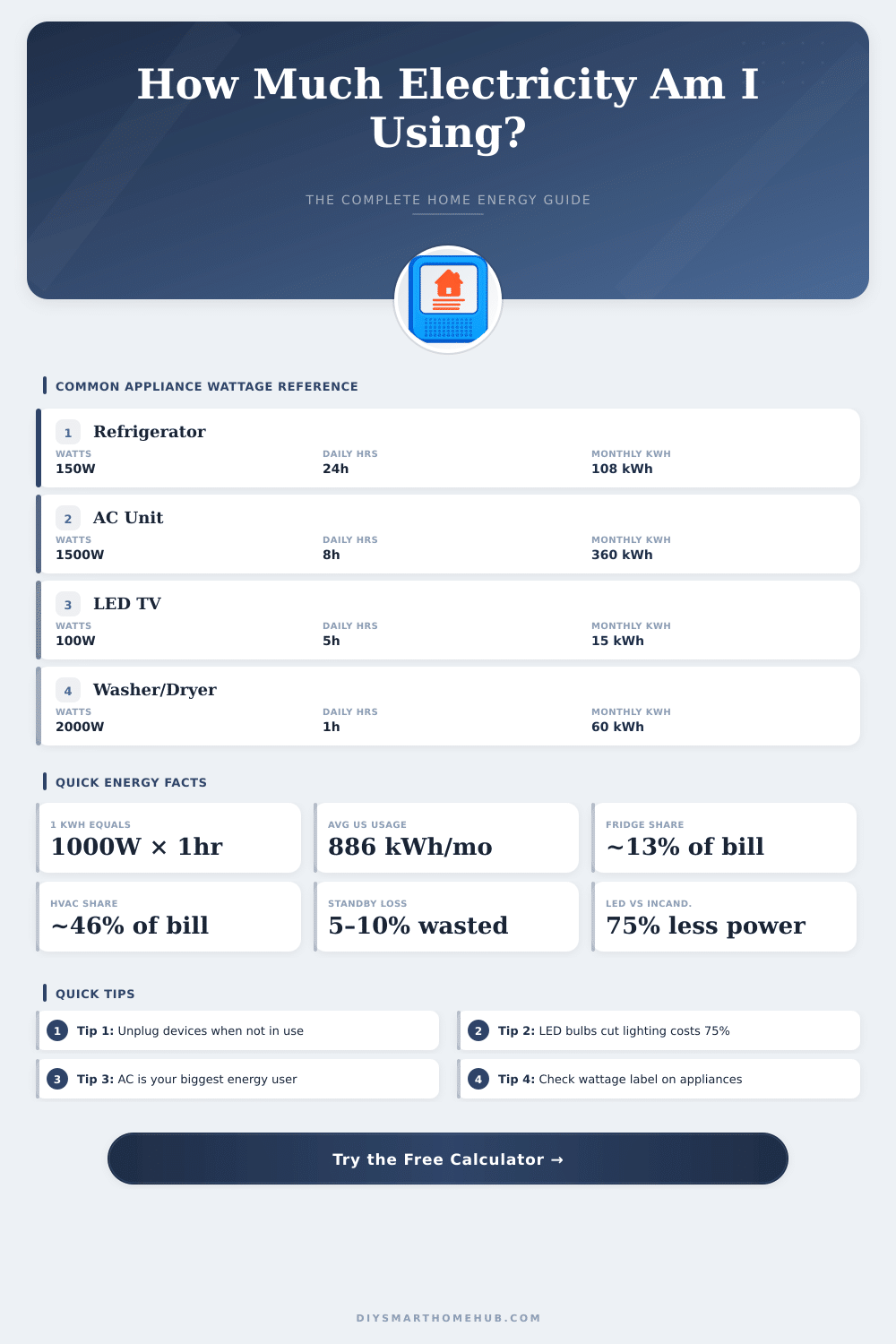
The unit of electricity that the utility companies sell is a kilowatt hour (kWh). One kilowatt hour are equivalent to the amount of energy that a thousand-watt appliance uses for one hour. The cost of one kilowatt hour is not consistent across the nation and for different customers.
The cost of electricity can vary depending off the location of the customer and the electricity plan that is used. Additionally, some electricity plans uses a tiered pricing structure where the lowest prices are placed for the initial few hundred kWh of electricity used by a customer. The cost increases for any additional kilowatt hours that is used by the customer.
This tiered pricing structure is often implemented as a way to encourage electricity consumers to reduce their use of electricity. The drawback of this structure, however, is that consumers that use a large amount of electricity (such as during the summer months) will pay higher bills under this system. Another structure for electricity companies is the implementation of a time-of-use structure for the electricity that is sold to consumers.
Under this system, electricity is sold at different prices depending upon the time-of-day that the electricity is used. Higher prices are placed for electricity during peak hours of use and lower prices are placed for off-peak hours. Many consumers purchase this type of electricity plan with the intention of lowering their electricity bills by shifting the use of electrical appliances to the off-peak hours.
If, however, customers do not change their electricity use patterns, a time-of-use plan may lead to more higher costs for electricity than they would of with a flat-rate electricity plan. In addition to the energy and delivery charges for each unit of electricity (kWh) that is sold to the customers, a utility bill will also include various other charges. These additional charges are referred to as “riders.” These fees can relate to various costs of providing electricity to customers, such as the cost of using renewable energy sources or modernizing the electrical grid.
These additional fees are typically small charges per kWh of electricity used. However, when multiplied by the number of kWh units that are sold to a customer each month, these fees can add to the total cost of electricity for that consumer. Another type of charge on a utility bill is the charge for the fixed plan that the company has with each of its customers.
Fixed charges will be present on each of a customer’s utility bills even if they use no electricity during the month. These charges are applied to cover the cost of maintaining the customer’s connection to the electrical grid. These costs are typically not dependent upon the amount of electricity that is used, but are a flat rate for each of the customer’s connections to the electrical grid.
Fixed charges are often a large portion of the total charge for customers that live in small, energy-efficient home. In addition to the other charges on the bill, utility bills also often include taxes and franchise fees. These taxes and fees are applied to the energy charges, the delivery charges, and the fixed charges on the bill.
In order to understand the true cost of electricity for a customer, you can divide the total electric bill by the total number of kWh of electricity that the customer used during that billing period. This resulting figure is referred to as the effective rate. The effective rate will be higher than the advertised rate for electricity by the utility company because it include all of the taxes, delivery charges, and other fees for the electricity.
Finally, utility bills often include reference tables that allow consumers to compare the amount of electricity that is used by that customer to the amount of electricity that is used by other homes of similar size. If the amount of electricity that is used by the customer is much higher than that of the average home of that size, then the consumers may have an inefficiency in appliances like their HVAC systems or water heater. Finally, most utility companies provides consumers with electrical “presets” that allow them to see what changes would occur in the cost of electricity for the customers if they changed their electricity plan or the amount with which they use electricity in their homes.
Thus, each of these components of the utility bill allows customers to understand their costs and to control those costs.