Sub Meter Electricity Bill Calculator
Calculate sub meter kWh, energy charge, allocated service charge, tax or fee adjustment, and daily use from starting and ending meter readings.
Sub Meter Bill Results
| Calculation step | Formula | Example | What to verify |
|---|---|---|---|
| Register difference | Current reading minus previous reading | 12,896.8 - 12,540.2 = 356.6 | Both readings must be from the same meter |
| Rollover difference | Register max minus previous plus current | 100,000 - 99,940 + 85 = 145 | Only use when the meter passed zero |
| Billable kWh | Register difference multiplied by meter multiplier | 356.6 x 1 = 356.6 kWh | Direct meters usually use multiplier 1 |
| Energy charge | Billable kWh multiplied by energy rate | 356.6 x $0.185 = $65.97 | Use the agreed rate from the main bill |
| Total bill | Energy charge plus fixed charge, then tax percent | ($65.97 + $8.00) x 1.05 = $77.67 | Keep fixed charges transparent |
| Scenario | Typical monthly kWh | Daily kWh range | Likely load driver | Billing check |
|---|---|---|---|---|
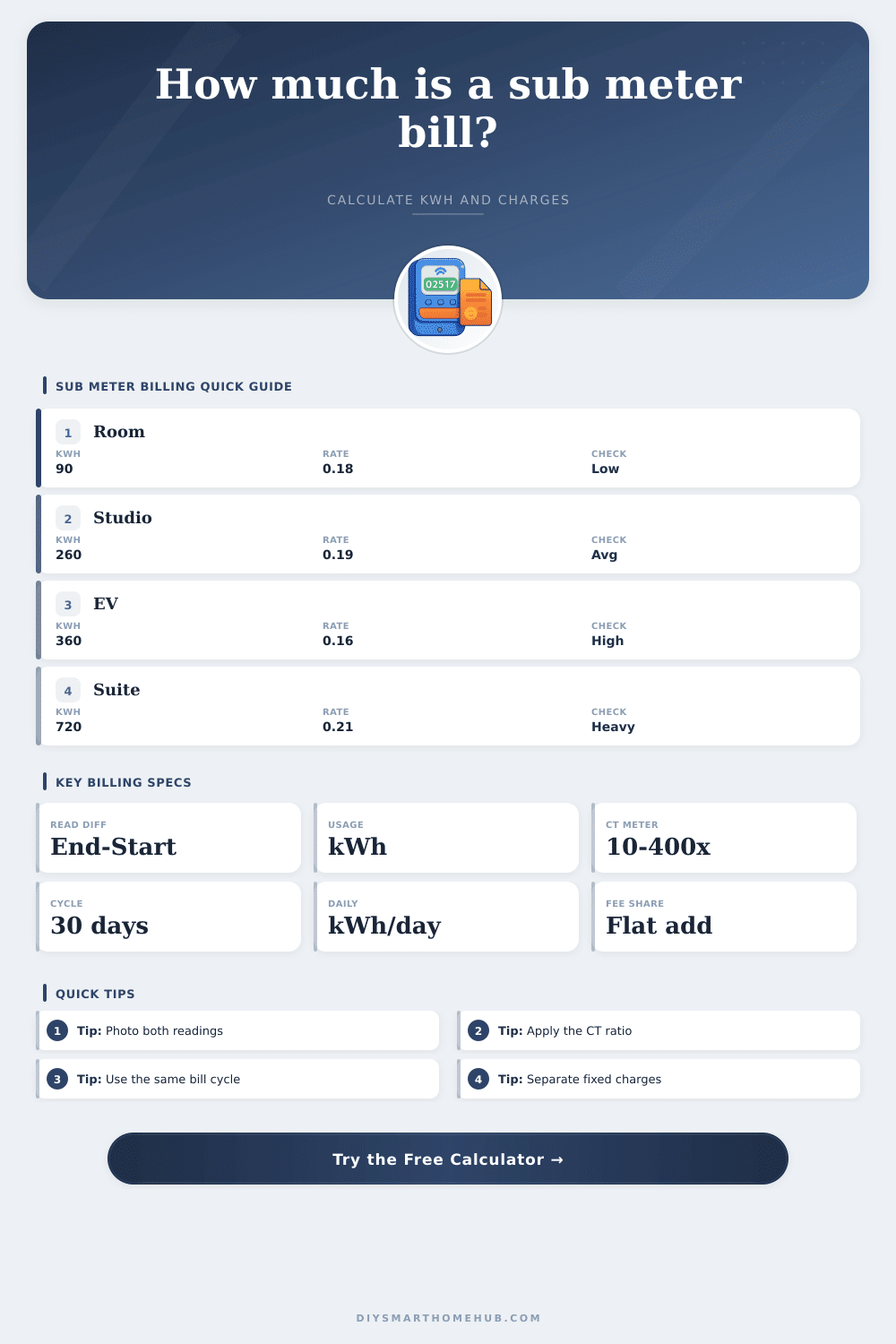
| Bedroom rental circuit | 60 to 130 kWh | 2 to 4.3 kWh/day | Lighting, computer, small electronics | Low fixed fee share keeps bill proportional |
| Garage studio unit | 180 to 360 kWh | 6 to 12 kWh/day | Mini fridge, cooking, portable HVAC | Confirm whether water heating is included |
| Basement suite | 350 to 750 kWh | 12 to 25 kWh/day | Kitchen, laundry, dehumidifier, HVAC fan | Use exact billing days for fair proration |
| Level 2 EV charger | 180 to 650 kWh | 6 to 22 kWh/day | Vehicle charging energy | Meter multiplier may differ from panel CT |
| Workshop subpanel | 120 to 500 kWh | 4 to 17 kWh/day | Tools, dust collector, compressor, lights | Check peak loads separately from kWh |
| Sub meter type | Common multiplier | Reading unit | Where multiplier comes from | Calculator input |
|---|---|---|---|---|
| Direct-read digital kWh meter | 1x | kWh register | Meter display already totals kWh | Enter multiplier 1 |
| DIN rail sub meter with CTs | 5x to 400x | kWh register | CT ratio and meter programming | Enter stated multiplier |
| Pulse-output meter | By pulse constant | Pulse count or kWh | Imp/kWh value on meter face | Convert pulses before entry |
| Smart panel branch meter | Usually 1x | kWh by circuit | Software channel calibration | Use exported kWh as reading delta |
| Legacy dial meter | 1x or listed | Dial register | Nameplate multiplier | Use rollover setting if needed |
| Bill component | Typical basis | Calculator field | Fair allocation method | Important note |
|---|---|---|---|---|
| Energy charge | kWh usage | Electricity rate per kWh | Sub meter kWh times agreed rate | Use same rate basis every cycle |
| Basic service charge | Fixed monthly amount | Allocated fixed charge | Flat share or written agreement | Do not hide it inside kWh rate |
| Delivery or network charge | kWh, demand, or fixed | Rate or fixed charge | Match the structure of the main bill | Demand charges need separate peak data |
| Tax or surcharge | Percent of subtotal | Tax percent | Apply after energy and fixed charge | Enter negative percent for credits |
| Renewable or fuel adjustment | kWh or percent | Rate or tax percent | Use the main bill line item method | Keep adjustment visible in breakdown |
| Example meter | Reading change | Multiplier | Billable kWh | Daily average over 30 days |
|---|---|---|---|---|
| Single room circuit | 92.4 | 1x | 92.4 kWh | 3.1 kWh/day |
| Studio apartment panel | 268.0 | 1x | 268.0 kWh | 8.9 kWh/day |
| EV charger CT meter | 36.2 | 10x | 362.0 kWh | 12.1 kWh/day |
| Basement suite panel | 684.5 | 1x | 684.5 kWh | 22.8 kWh/day |
| Workshop CT subpanel | 7.8 | 40x | 312.0 kWh | 10.4 kWh/day |
Sub-metering is the process of monitoring the electricity usages of a specific tenant or specific room in a dwelling. You can use a sub-meter in instances when you have a tenant in your basement suite, or when you have a friend who is renting you a room. The main utility meter will show one number for the entire house; it doesnt show how much electricity the owner use versus the tenant.
Using a random percentage to split the bill may lead to resentment from the tenant who feel that the percentage isnt accurate to the actual electricity use of there leased space. Thus, installing a sub-meter will allow the property owner to accurately determine the amount of electricity that the tenant is using. In order to understand how to read a sub-meter, you will notice a number on the sub-meter.
How to Read a Sub-Meter and Bill Your Tenant
Following one month, there will be another number on the sub-meter. The difference between the two numbers are the amount of electricity that the tenant has used. However, the raw difference may not be the difference that is reported.
Most sub-meters are direct-read meters that will provide the true number of kilowatt-hours that have been used. Some sub-meters, however, use a current transformer (CT) setup. These CT meters only show a sample of the electricity use by the tenant and require the use of a multiplier to reveal the actual electricity use by that tenant.
If the multiplier is not apply to the reading, the tenant will receive electricity bills that provide a discount to the tenant for the electricity that is used. Another consideration is the rollover of the digital sub-meter. Most digital meters has a limit to the number of kilowatt-hours that can be registered on the meter.
After that number is registered, the digital meter will begin to roll back to zero. Thus, it is possible that the sub-meter will register a negative number of kilowatt-hours for the tenant. In cases like these, the owner must account for the size of the register in order to produce a bill that accurately reflects the electricity use by the tenant.
Following the production of the actual number of kilowatt-hours that is used by the tenant, the owner must decide how to bill that tenant. The rate that can be used is the rate that is on the owners utility bill. However, that rate only reflect the cost of the electricity to the utility company.
The bill also contains charges for the delivery of that electricity to the property. Thus, if the owner only bills the tenant according to the raw number of kilowatt-hours that is used, the owner will be spending money on these additional fee. An alternative solution would be to use allocated shared charges, such as billing the tenant a flat fee for the use of the electrical panel, or even the pro-rated share of the main electrical connection fee to the power company.
In addition to billing according to the kilowatt-hours, it is also possible that additional charge must be made to the tenant. These additional charges may be sales taxes, or even an administrative surcharge for the owner to create the bill for the tenant. Furthermore, it is also common for the owner to provide a small credit to the tenant as an incentive for the tenant to use less electricity.
These adjustments should be made using a percentage adjustment so that both the owner and tenant agrees to the final bill. In addition to the actual calculations of the bill to the tenant, it is also helpful to calculate the daily average use of electricity by the tenant. If the tenant feel that the bill is too high, presenting the tenant with the number of kilowatt-hours that tenant uses each day will help to show the tenant there actual rate of electricity use.
Furthermore, if that number is high compared to the typical use in a studio apartment, it may help the tenant to recognize which device is causing the high use of electricity. Thus, the total electricity bill is the raw calculation of that use, but the daily average will show the tenant that use. There are also specialized load that can be monitored by the sub-meter.
For instance, if the tenant owns an electric vehicle, the EV will pull a massive amount of electricity from the electrical panel. Using the incorrect percentage (multiplier) for the EV will result in the owner lose revenue from the tenants electricity bill. In these instances, high ratio current transformers (CTs) are used because the amount of electricity from an electric vehicle is too strong to be registered by a standard sub-meter.
Furthermore, it is also useful to produce a tool that will show the correct jumps in the register for a vehicle owner to ensure that they are pay for every electron that is used to charge their electric vehicle battery. Finally, the goal of installing a sub-meter is to encourage the tenant to become more accountable for the electricity that is used in their leased space. By installing a sub-meter, the tenant will feel as if using the lights in the leased space or adjusting the thermostat will have an impact on the electric bill that is presented to the tenant.
Thus, it is important to keep a log of the register of the sub-meter. By logging each sub-meter reading and timestamping each picture of the sub-meter, an owner and renter will both have a paper trail of the electricity use and the accuracy of the electricity bills that is presented. By focusing on each of these elements: the raw difference of the register, the multiplier, and the shared fees, the owner can produce an electricity bill for the tenant that is both transparent and fair.