Battery State of Charge Calculator
Estimate battery state of charge from measured voltage, chemistry curve, bank voltage, load correction, temperature derating, and reserve level for smart home backup systems.
📌Real Battery Presets
🔋Battery Voltage And Load Inputs
Calculation Breakdown
⚙Battery SOC Spec Grid
📊12V Resting Voltage State Of Charge
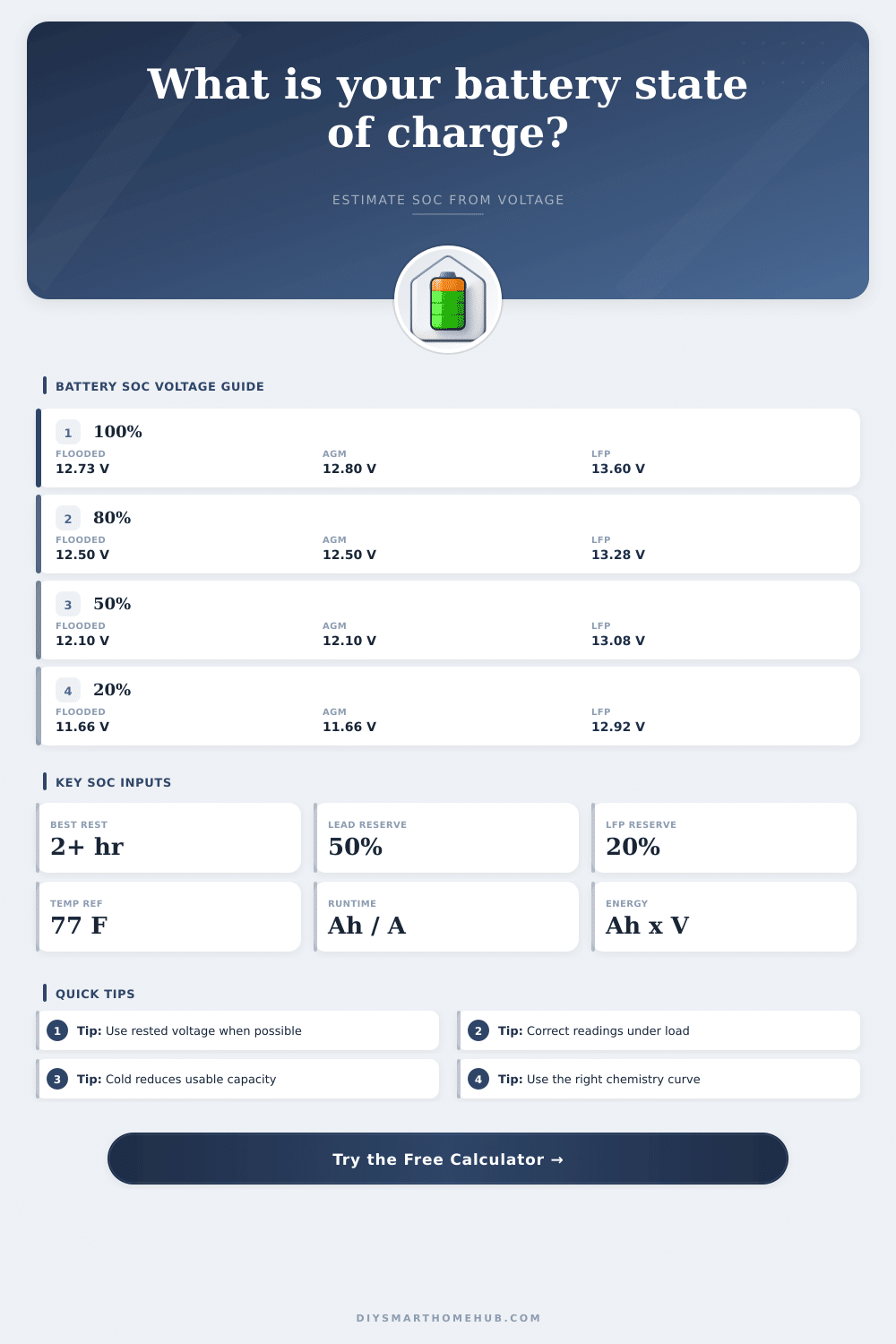
| SOC | Flooded Lead-Acid | AGM / SLA | Gel Lead-Acid |
|---|---|---|---|
| 100% | 12.73 V | 12.80 V | 12.85 V |
| 90% | 12.62 V | 12.65 V | 12.68 V |
| 80% | 12.50 V | 12.50 V | 12.52 V |
| 70% | 12.37 V | 12.37 V | 12.40 V |
| 60% | 12.24 V | 12.24 V | 12.27 V |
| 50% | 12.10 V | 12.10 V | 12.15 V |
| 40% | 11.96 V | 11.96 V | 12.00 V |
| 30% | 11.81 V | 11.81 V | 11.85 V |
| 20% | 11.66 V | 11.66 V | 11.70 V |
| 10% | 11.51 V | 11.51 V | 11.55 V |
| 0% | 10.50 V | 10.50 V | 10.50 V |
Lead-acid voltage SOC is most useful after the battery has rested. Manufacturer data should override generic reference curves.
📈Lithium Resting Voltage Reference
| SOC | 4S LiFePO4 12.8V | 16S LiFePO4 51.2V | 13S NMC 48V |
|---|---|---|---|
| 100% | 13.60 V | 54.40 V | 54.60 V |
| 90% | 13.40 V | 53.60 V | 53.30 V |
| 80% | 13.28 V | 53.12 V | 52.00 V |
| 70% | 13.20 V | 52.80 V | 50.96 V |
| 60% | 13.12 V | 52.48 V | 50.05 V |
| 50% | 13.08 V | 52.32 V | 49.14 V |
| 40% | 13.04 V | 52.16 V | 48.36 V |
| 30% | 13.00 V | 52.00 V | 47.58 V |
| 20% | 12.92 V | 51.68 V | 46.54 V |
| 10% | 12.80 V | 51.20 V | 44.85 V |
| 0% | 11.60 V | 46.40 V | 41.60 V |
🌡Temperature Capacity Reference
| Battery Temperature | Lead-Acid Capacity | Lithium Capacity | Planning Detail |
|---|---|---|---|
| 32°F / 0°C | About 80% | About 92% | Cold cabinets need extra reserve |
| 50°F / 10°C | About 90% | About 97% | Common garage derating point |
| 77°F / 25°C | 100% | 100% | Most ratings use this reference |
| 95°F / 35°C | About 97% | About 98% | Heat reduces long-term battery life |
| 113°F / 45°C | About 92% | About 95% | Hot equipment closets need caution |
📐Common Smart Home Battery Examples
| Use Case | Typical Battery | Planning Load | SOC Detail |
|---|---|---|---|
| Alarm panel standby | 12 V 7 Ah SLA | 0.3 to 1 A | Resting voltage is usually stable |
| Router and ONT backup | 12 V 35 Ah AGM | 1.5 to 4 A | Correct voltage while powering gear |
| PoE cameras and NVR | 12 V 100 Ah LFP | 8 to 18 A | Flat curve makes reserve important |
| 24 V solar battery shelf | 24 V 200 Ah flooded | 10 to 40 A | Use rested voltage after charging |
| 48 V network rack | 51.2 V 100 Ah LFP | 5 to 25 A | Check BMS SOC when available |
🧪Chemistry Comparison Table
| Battery Type | Voltage Curve | Reserve Habit | Best SOC Method |
|---|---|---|---|
| Flooded lead-acid | Moderate slope | Keep near 50% | Hydrometer plus rested voltage |
| AGM / SLA | Moderate slope | Keep near 50% | Rested voltage with load correction |
| Gel lead-acid | Moderate slope | Keep near 50% | Rested voltage and low charge rates |
| LiFePO4 / LFP | Very flat middle | 10% to 20% | Shunt/BMS plus voltage estimate |
| NMC / NCA lithium | Sloped curve | 10% to 20% | Voltage estimate is more responsive |
✅Battery SOC Calculation Tips
When monitoring an battery, a person might use a voltmeter to take voltage readings of the battery. However, voltage readings doesnt necessarily indicate the remaining time that the battery will last. Many batteries appear to provide a more linear view of their remaining life, but batteries dont always function in this linear view due to there complex chemical compositions.
To understand the nature of a battery, it is essential for the understanding of the relationship between the voltage, the temperature, and the electrical load of a battery. A voltmeter does not indicate the amount of energy left in a battery. Instead, it measures the electrical pressure of the battery at a specific time.
Voltage Alone Does Not Show How Long a Battery Will Last
If the battery is resting, the voltage will be more different then if the battery is providing power to an electrical device. When measuring the voltage of a battery that is under heavy electrical load, the voltage will drop. This drop in voltage indicate that the battery will fail to meet the demands of the device that it is powering.
This drop in voltage is referred to as voltage sag. One must account for the effect of voltage sag when determining the true voltage of a rested battery. Depending on the chemistry of the battery, the voltage of a battery can even drop in different manner.
For example, lead acid batteries will have a predictable discharge curve. This means that the voltage of the battery will drop in a steady manner as the capacity of the battery diminishes. In contrast, lithium batteries will have a flat discharge curve.
This means that the voltage of a lithium battery will remain the same over an extended period. Due to the same voltage of a lithium battery over time, it is possible for a battery that is seemingly full to be nearly empty. To account for this, a reserve limit must be used with lithium batteries as the voltage isnt a reliable indicator of the amount of charge that a lithium battery have left.
The temperature of a battery can alter the way that the battery function. This is due to the chemical reactions that the battery use to produce the power that it provides. When the chemicals in a battery move slow due to low battery temperatures, the chemical reactions that occur within the battery will also take place at a slow rate.
A slow rate of chemical reaction mean that the battery will not be able to provide as much power as it should. If a battery remains in a cold environment, the battery will have a lower capacity than it should have. For example, the battery might provide twenty percent less capacity with the same amount of cold storage than a battery that remains at room temperature.
Thus, the temperature of a battery can alter the amount of energy that it can provide. A battery should have a reserve capacity set aside to allow for the lifespan of the battery. If a lead-acid battery is discharged to zero percent, the plate in the battery will be damaged.
This damage to the battery plates can lead to a shortened lifespan of the battery. Due to this shortened lifespan, many people only use fifty percent of the capacity that a lead-acid battery can store. A lithium battery can have more of its capacity used than a lead-acid battery can.
However, a reserve should still be used for the same reasons as lead-acid batteries to allow for error in the electrical load of the device. In order to calculate how long a battery will last, it is necessary to understand the current draw of the equipment that will use the battery. If the current draw of the battery is in amps and the battery has a number of usable amp-hours, one can calculate the amount of time that the battery will last.
It is essential to use the usable capacity of the battery rather than the total amount of capacity that the battery can hold. The total capacity is the amount of energy that the battery can provide with no load on the battery. However, the usable capacity of the battery is the amount of energy that the equipment can use after providing for the reserve capacity of the battery and after accounting for the temperature of the battery.
Another way to determine the state of a battery is to compare the voltage of the battery to reference tables that display the expected voltage given the chemistry of the battery. If the voltage of a rested battery is less than the voltage indicate in the reference table, there is a chance that the battery has issues with cell failure or has issues with sulfation. By checking the voltage of a battery once a month, the person can ensure that the battery is in proper functioning condition.
By correcting for voltage sag and taking into account the temperature and chemistry of the battery, a person will be able to plan for the life of their battery rather than guess as to how long the battery will last.