Depth of Discharge Calculator
Estimate battery DoD, remaining usable energy, runtime to reserve, and cycle stress for home backup, solar, UPS, and smart home power packs.
🔋Real Battery Presets
⚙Battery and Load Inputs
📊Selected Battery Spec Grid
📘Depth of Discharge Reference Tables
| Battery chemistry | Common daily DoD | Occasional deep DoD | Typical cycle range | Planning note |
|---|---|---|---|---|
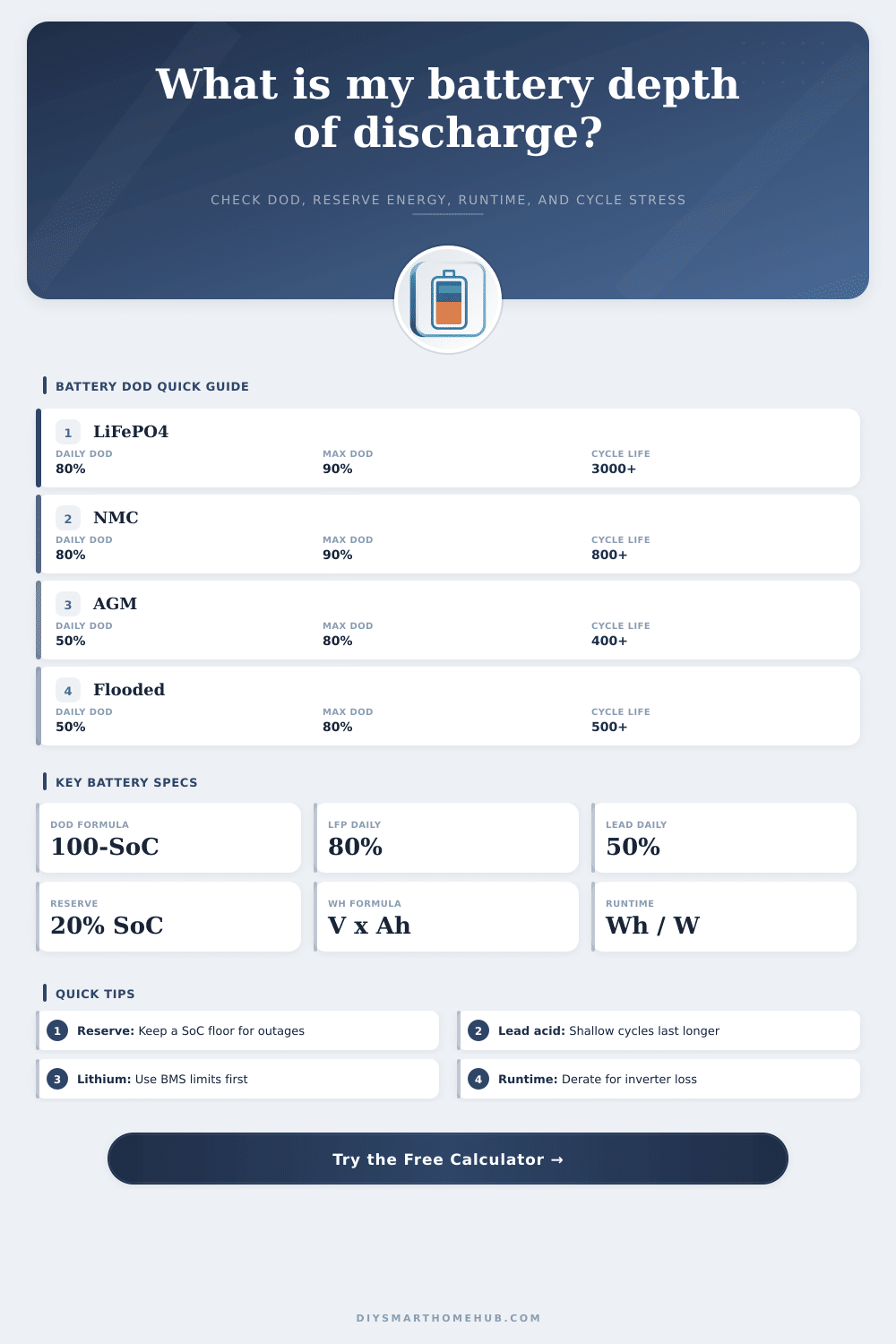
| LiFePO4 lithium iron phosphate | 70-80% | 90% | 3000-6000 cycles | High usable capacity with a BMS cutoff usually below the user reserve. |
| Lithium ion NMC or NCA | 60-80% | 90% | 800-1500 cycles | Cycle life improves when full charges and very deep discharges are limited. |
| Flooded lead acid deep cycle | 40-50% | 80% | 500-1200 cycles | Repeatedly going below 50% SoC shortens service life quickly. |
| AGM sealed lead acid | 40-50% | 80% | 300-900 cycles | Good standby behavior, but deep cycling still costs cycle life. |
| Gel sealed lead acid | 40-50% | 75% | 400-1000 cycles | Prefers controlled charge voltage and moderate discharge depth. |
| Small SLA standby battery | 30-50% | 80% | 200-600 cycles | Alarm and UPS packs are often sized for reserve, not frequent deep cycles. |
| 12V lead acid rest voltage | Approx SoC | Depth used from full | 24V bank equivalent | 48V bank equivalent |
|---|---|---|---|---|
| 12.73 V | 100% | 0% DoD | 25.46 V | 50.92 V |
| 12.50 V | 80% | 20% DoD | 25.00 V | 50.00 V |
| 12.24 V | 60% | 40% DoD | 24.48 V | 48.96 V |
| 12.10 V | 50% | 50% DoD | 24.20 V | 48.40 V |
| 11.96 V | 40% | 60% DoD | 23.92 V | 47.84 V |
| 11.66 V | 20% | 80% DoD | 23.32 V | 46.64 V |
| Common battery setup | Rated energy | Healthy daily use | Typical reserve floor | Good for |
|---|---|---|---|---|
| 12.8V 100Ah LiFePO4 | 1280 Wh | 900-1020 Wh | 10-20% SoC | Router, lights, small fridge controller, camera NVR |
| 51.2V 100Ah rack LFP | 5120 Wh | 3600-4100 Wh | 10-20% SoC | Whole home network, automation panel, sump control |
| 12V 18Ah AGM UPS | 216 Wh | 85-110 Wh | 50% SoC | Modem, router, hub, ONT, small PoE switch |
| 24V 225Ah flooded bank | 5400 Wh | 2160-2700 Wh | 50% SoC | Cabin DC system, inverter backup, solar shed |
| 52V 14Ah NMC pack | 728 Wh | 440-580 Wh | 15-25% SoC | Mobile gear, e-bike pack testing, portable DC loads |
| Load example | Average watts | Daily energy | 5120Wh LFP runtime | 1280Wh LFP runtime |
|---|---|---|---|---|
| Router, modem, smart hub | 25 W | 600 Wh/day | 5.5-6.8 days | 1.4-1.7 days |
| PoE switch plus 4 cameras | 65 W | 1560 Wh/day | 2.1-2.6 days | 12-16 hours |
| Network rack and NAS idle | 140 W | 3360 Wh/day | 23-29 hours | 6-7 hours |
| Backup lighting circuit | 180 W | 4320 Wh/day | 18-23 hours | 4-5 hours |
| Mixed outage essentials | 350 W | 8400 Wh/day | 9-12 hours | 2-3 hours |
💡Depth of Discharge Tips
When you utilize a battery system, you have to understand the differance between the capacity of the battery and the usable energy of the battery. Many peoples will assume that if the battery has a 100Ah capacity, then the battery can provide 100Ah of usable energy. However, batteries cannot be used as fuel tank for vehicles, for instance.
When you draw energy from a battery, the depth of discharge of the battery decrease. The depth of discharge is a measurement of the energy removed from the battery compared to the total capacity of the battery. Thus, if you have a battery with 100 percent of the energy within the battery, and you use 30 percent of the energy from that battery, then the depth of discharge will be 30 percent, but the state of charge will be 70 percent.
Battery Capacity and Usable Energy
Furthermore, as batteries experience a depth of discharge, the chemical reaction within the battery are stressed out. The more the depth of discharge of the battery decreases, the more chemical stress is place upon the battery. The chemistry of the battery will determine how deep you can discharge the battery.
For instance, lead-acid and AGM batteries should not experience a depth of discharge beyond 50 percent. If lead-acid batteries experience a depth of discharge beyond 50 percent, the lead acid batteries will experience a permanent loss of their capacity. Therefore, if you utilize lead acid batteries, you will have to purchase batteries that contain twice the capacity of what you think that you require.
In contrast, lithium batteries, specifically LiFePO4 batteries, can better handle deep discharges. Such lithium batteries can have 80 or 90 percent of their capacity utilize without damaging the battery. However, as with any other battery, there is a limit to the depth of discharge for the lithium batteries.
If the depth of discharge of the battery goes beyond that limit, then the battery will begin to fail. Beyond the chemistry of the batteries, there is also energy loss that must be considered. For instance, all inverter will lose some of the energy of the battery as heat.
Thus, you will lose energy to the inverter. Another factor that will reduce the amount of energy that the battery delivers is the temperature at which the batteries are being use. When you use batteries in cold environments, the chemical reactions within the batteries will occur at a slow rate.
Thus, the battery will deliver less energy if it is within a cold environment. For instance, a battery that can provide 100Ah at room temperature may only be able to provide 70Ah in a cold environment. In addition to these factors, you must create a floor for the battery’s state of charge so that the battery does not experience a depth of discharge to 100 percent (or a state of charge of 0 percent).
While there are Battery Management Systems in place to prevent this from occurring, you should not solely rely upon them. A manual floor should be created at 10 or 20 percent of the batteries capacity to account for any error in the systems measurement of the batteries state of charge. Finally, you must consider the age of the batteries when calculating the usable energy of the batteries.
Batteries are consumable item; over time, they will lose their ability to hold as much energy as they are rated for. For instance, a battery that is three years old may only hold 90 percent of the energy that it could hold when it was new. Thus, if you calculate the energy requirement of a system based off the original design capacity of the battery, the battery will provide less energy than is calculated.
Therefore, you should factor the age of the battery into energy calculations so that a realistic expectation of the energy that the battery will provide can be made. Through consideration of each of these factor, the battery can be made a reliable tool in fulfilling the energy need of a system.