Dehumidifier Energy Calculator
Estimate first-day pull-down energy and steady-state dehumidifier kWh from room geometry, indoor and outdoor humidity, air leakage, moisture sources, dampness level, and the real efficiency of the selected unit.
📌Preset Scenarios
Loaded preset: Coastal Garage Gym with marine air, moderate internal load, and a 50-pint Energy Star portable dehumidifier.
⚙Space, Humidity, and Unit Inputs
⚡Estimated Dehumidifier Energy
📊Dehumidifier Profile Snapshot
📑Reference Tables
| Climate | Outdoor | RH | Months |
|---|
| Dampness | Seepage | Leakage | Use case |
|---|
🏠Scenario Benchmarks
| Scenario | Load | Unit | kWh/day |
|---|
💡Calculation Notes
Use the right target RH
Finished basements and living spaces often feel comfortable between 45% and 55% RH. Paper archives, instruments, and enclosed storage may justify a lower target, but runtime will rise quickly.
Watch room temperature
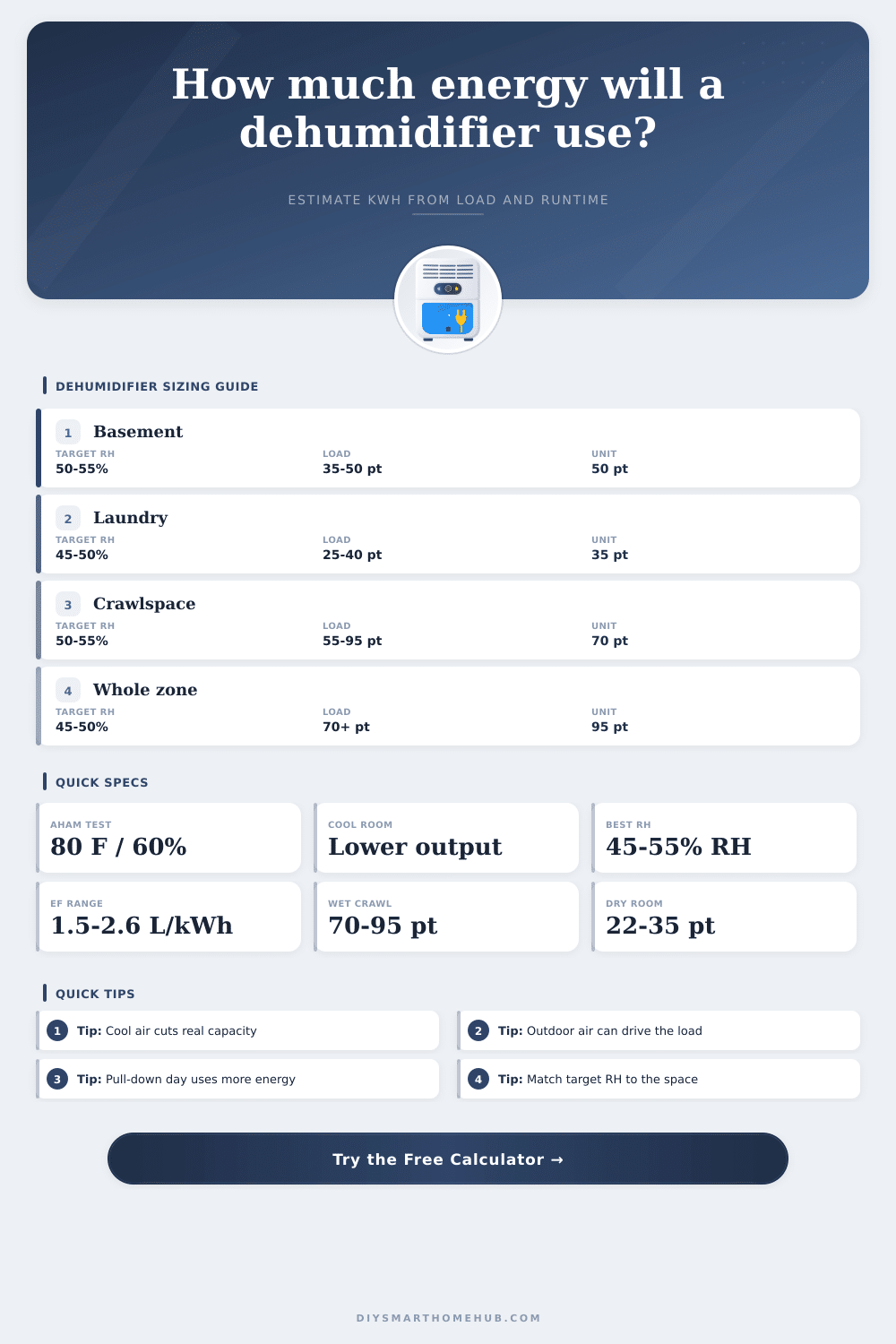
If the space runs closer to 60 F than 80 F, a portable dehumidifier can lose a meaningful share of its rated pint removal. That changes hours per day even when the moisture load stays the same.
A dehumidifier is a appliance that will remove the moisture from the air. A dehumidifier is used to control the humidity level in a given room. You may have noticed that your basement often feel sticky when it rains outside; this is due to the fact that the air within the basement contains high levels of water vapor.
Water vapor is the term used to describe moisture in the air; water vapor is also invisible to the human eyes. A dehumidifier works by cooling the internal coils of the appliance until the moisture in the air (the water vapor) condense into liquid form, after which the dehumidifier will blow the air with less moisture back into the room. The amount of energy that a dehumidifier will use is dependent upon several factor, including the volume of the room, the temperature of the room, and the amount of moisture that enter that room from outside the room.
How a Dehumidifier Works and How to Use It
The temperature of the room is often one of the most critical factor in the efficiency of the dehumidifier. Warm air is able to hold more water vapor than cool air are able to hold water vapor. Thus, if the air is warm, the dehumidifier will have to work harder to remove the moisture from the air than it would have to if the room were cooler.
Manufacturers of dehumidifiers test their models at a temperature of 80 degree Fahrenheit and a humidity level of 60 percent. However, basements tend to be cooler than 80 degrees F. Thus, a dehumidifier will pull less water out of the air in a basement at 65 degrees F. Than it would at 80 degrees F. Consequently, the dehumidifier will need to run longer to extract the amount of moisture require to reach the target humidity level. In selecting the settings for the dehumidifier, you must select a target humidity level.
If you set the target humidity level to 40 percent, the dehumidifier will work best for areas in which paper or musical instrument are stored. In most cases, however, 45 to 55 percent is the target humidity for living spaces. If the target humidity level is set too low, the dehumidifier will have to work harder to remove the moisture in the air; in other words, the dehumidifier will run more often.
Moisture enters a room from a variety of source. For instance, there can be moisture in the air from the cracks in the walls, doors that are left open, or from the moisture exhaled by individuals in the room who is breathing and doing laundry in the area. For instance, a laundry room will often have a high amount of moisture in the air; this moisture will enter the laundry room and impact the efficiency of the dehumidifier.
A dehumidifier has two different stages of operation. During the first day that the dehumidifier is operating, the dehumidifier will pull down moisture from the air to reach a lower initial humidity level; this initial period require more energy than the dehumidifier will use during its remaining operation. After the initial pull-down of moisture from the air, the dehumidifier will enter a steady-state mode that only removes moisture that enter the room.
Efficiency in dehumidifiers is usually discussed in terms of the amount of liter of water that are removed from the air for each kilowatt-hour of electricity that is used to power the dehumidifier. When you purchase a dehumidifier, you should not consider only the square footage of the area to be dehumidified. Instead, you should also consider the volume of that area and the amount of air that may leak into the area from outside the space to be dehumidified.
Areas with high ceiling have a higher volume of air than areas with low ceilings. Thus, areas with high ceilings will require a dehumidifier with a higher capacity for removing moisture from the air. Many leaks or many doors that is left open in a space will require the dehumidifier to run more often to control the amount of moisture in the air.
If you purchase a dehumidifier that is too small for the area to be controlled, the dehumidifier will work continuously to reduce humidity level in that area; it will be inefficient in its operation. If you purchase a dehumidifier that is too large for the area to be controlled, the dehumidifier may turn on and off very frequent; however, moddern Energy Star dehumidifiers are manufactured to minimize this issue. There are steps that can be taken to increase the efficiency of your dehumidifier.
For instance, you can seal the cracks in the walls or the rim joists of the basement to prevent moisture from entering the basement. Additionally, the location where you place the dehumidifier should allow for the movement of air in and out of the appliance; the water tank should be emptied regularly. If the room where the dehumidifier will be placed is very cool, care should be taken to ensure that the coils of the dehumidifier do not become iced over; if the coils become iced over, the dehumidifier will no longer be able to function effective.
By taking steps to control the source of moisture that enter the area and to ensure that the dehumidifier can effectively perform its task, you will find that the cost of the electricity that is used to operate the dehumidifier is manageable. You should of checked the manuals to make sure its working correctly.